Get consent record
Path Parameters
Consent record for data agreement (based on ISO 27560) retrieved successfully
Response Headers
Schema
- Array [
- ]
consentRecord object
A consent record expresses consent (as defined in this building block's specification) to a single DataAgreement. There must be a UNIQUE constraint on (data agreement revision, individual)
sectorPreferences object[]
bad input parameter
Response Headers
Unauthorized
Response Headers
Schema
Internal server error
Response Headers
Schema
Fetch all data agreements
Query Parameters
Data agreements (based on ISO 27560) listed successfully
Response Headers
Schema
- Array [
- ]
dataAgreements object[]
policy objectrequired
Policy under which this DataAgreement shall be governed. When creating a data agreement, the latest policy can be used to fill the default value, and organisation admin can decide to change it in the data agreement level.
signature object
Signature of authorising party of DataAgreement (Signatures may be chained in the case of multiple signatures)
pagination object
bad input parameter
Response Headers
Unauthorized
Response Headers
Schema
Internal server error
Response Headers
Schema
Fetch all consent records
Query Parameters
Consent records for data agreements (based on ISO 27560) listed successfully
Response Headers
Schema
pagination object
bad input parameter
Response Headers
Unauthorized
Response Headers
Schema
Internal server error
Response Headers
Schema
Get data agreement
Path Parameters
Data agreement (based on ISO 27560) retrieved successfully
Response Headers
Schema
dataAgreement object
An agreement contains the specification of a single purpose that can be consented to. A DataAgreement is universal and can be consented to by *many* individuals through a DataAgreementRecord.
policy objectrequired
Policy under which this DataAgreement shall be governed. When creating a data agreement, the latest policy can be used to fill the default value, and organisation admin can decide to change it in the data agreement level.
signature object
Signature of authorising party of DataAgreement (Signatures may be chained in the case of multiple signatures)
bad input parameter
Response Headers
Unauthorized
Response Headers
Schema
Internal server error
Response Headers
Schema
Create data agreement
Body
- Array [
- Array [
- ]
- ]
dataAgreement object
An agreement contains the specification of a single purpose that can be consented to. A DataAgreement is universal and can be consented to by *many* individuals through a DataAgreementRecord.
policy objectrequired
Policy under which this DataAgreement shall be governed. When creating a data agreement, the latest policy can be used to fill the default value, and organisation admin can decide to change it in the data agreement level.
dataAttributes object[]
Data attributes contain specifications of exactly what is collected.
restrictions object[]
signature object
Signature of authorising party of DataAgreement (Signatures may be chained in the case of multiple signatures)
dataExchange objectrequired
Data exchange details
Data agreement (based on ISO 27560) created successfully
Response Headers
Schema
- Array [
- Array [
- ]
- ]
- Array [
- ]
dataAgreement object
An agreement contains the specification of a single purpose that can be consented to. A DataAgreement is universal and can be consented to by *many* individuals through a DataAgreementRecord.
policy objectrequired
Policy under which this DataAgreement shall be governed. When creating a data agreement, the latest policy can be used to fill the default value, and organisation admin can decide to change it in the data agreement level.
dataAttributes object[]
Data attributes contain specifications of exactly what is collected.
restrictions object[]
signature object
Signature of authorising party of DataAgreement (Signatures may be chained in the case of multiple signatures)
dataExchange objectrequired
Data exchange details
presentationRequest object
requestedAttributes object
Map of requested attributes
restrictions object[]
List of restrictions for the requested attribute
revision object
A *generic* revision model captures the serialised contents of any schema's single row. This is then subject to 1) cryptographic signature and 2) auditing.
Aside from the "successor" column, a revision should be considered locked.
bad input parameter
Response Headers
Unauthorized
Response Headers
Schema
Internal server error
Response Headers
Schema
Create individual
Body
individual object
Shallowly models an Individual which may reference some instance in an external system (registration system, functional ID, foundational ID etc). An Individual instance of this model is not to be mistaken with a unique natural individual. It is up to the system owner to decide if this record permits mapping to a natural individual and/or if a single Individual row can map to several consent agreements.
Individual created successfully
Response Headers
Schema
individual object
Shallowly models an Individual which may reference some instance in an external system (registration system, functional ID, foundational ID etc). An Individual instance of this model is not to be mistaken with a unique natural individual. It is up to the system owner to decide if this record permits mapping to a natural individual and/or if a single Individual row can map to several consent agreements.
bad input parameter
Response Headers
Unauthorized
Response Headers
Schema
Internal server error
Response Headers
Schema
Create data policy
Body
policy objectrequired
An object of type Policy
A set consisting of the new Policy object created, together with the initial Revision object.
Response Headers
Schema
policy object
A policy governs data and DataAgreement in the realm of an organisation that is refered to as "data controller" (GDPR) and owner of referencing Agreements.
revision object
A *generic* revision model captures the serialised contents of any schema's single row. This is then subject to 1) cryptographic signature and 2) auditing.
Aside from the "successor" column, a revision should be considered locked.
bad input parameter
Response Headers
Unauthorized
Response Headers
Schema
Internal server error
Response Headers
Schema
Create webhook
Body
required
The webhook configuration.
webhook object
The webhook configuration to create or to update. The service ignores `id`, `orgId`, `sandboxOrgId` and `timestamp` if you send them. It takes the organisation from the `organizationId` header.
subscribedEvents objectrequired
The event types that the webhook receives, in 3 groups. A minimum of 1 of the 3 arrays must hold a minimum of 1 event type. The service refuses an event type that is not in the list of its group. The service does not remove duplicate values.
OK
Response Headers
Schema
webhook object
A webhook configuration of the organisation. The service always sends every field of this object, except `sandboxOrgId`.
subscribedEvents objectrequired
The event types that the webhook receives, in 3 groups. A minimum of 1 of the 3 arrays must hold a minimum of 1 event type. The service refuses an event type that is not in the list of its group. The service does not remove duplicate values.
Bad request. The server sends this error if a mandatory field is missing, if the payload URL does not start with `http://` or `https://`, if a webhook with the same payload URL exists, if you subscribe to no event type, or if an event type or a content type is not valid.
Response Headers
Schema
Unauthorized
Response Headers
Schema
Internal server error
Response Headers
Schema
Delete data agreement
Path Parameters
Data agreement (based on ISO 27560) deleted successfully
Response Headers
Schema
bad input parameter
Response Headers
Unauthorized
Response Headers
Schema
Resource not found
Response Headers
Schema
Internal server error
Response Headers
Schema
Delete data policy
Path Parameters
Data policy deleted successfully
Response Headers
Schema
bad input parameter
Response Headers
Unauthorized
Response Headers
Schema
Resource not found
Response Headers
Schema
Internal server error
Response Headers
Schema
Delete webhook
Path Parameters
OK
Response Headers
Schema
webhook object
A webhook configuration of the organisation. The service always sends every field of this object, except `sandboxOrgId`.
subscribedEvents objectrequired
The event types that the webhook receives, in 3 groups. A minimum of 1 of the 3 arrays must hold a minimum of 1 event type. The service refuses an event type that is not in the list of its group. The service does not remove duplicate values.
Unauthorized
Response Headers
Schema
Resource not found. The organisation has no webhook with the given ID, or the webhook is deleted.
Response Headers
Schema
Internal server error
Response Headers
Schema
List data agreement revisions
Path Parameters
Query Parameters
Data agreement (based on ISO 27560) revisions listed successfully
Response Headers
Schema
- Array [
- ]
dataAgreement object
An agreement contains the specification of a single purpose that can be consented to. A DataAgreement is universal and can be consented to by *many* individuals through a DataAgreementRecord.
policy objectrequired
Policy under which this DataAgreement shall be governed. When creating a data agreement, the latest policy can be used to fill the default value, and organisation admin can decide to change it in the data agreement level.
signature object
Signature of authorising party of DataAgreement (Signatures may be chained in the case of multiple signatures)
pagination object
revisions object[]
bad input parameter
Response Headers
Unauthorized
Response Headers
Schema
Internal server error
Response Headers
Schema
List all data agreements
Query Parameters
Data agreements (based on ISO 27560) listed successfully
Response Headers
Schema
pagination object
bad input parameter
Response Headers
Unauthorized
Response Headers
Schema
Internal server error
Response Headers
Schema
Read data attributes
Path Parameters
Query Parameters
Data attributes for data agreement listed successfully
Response Headers
Schema
pagination object
bad input parameter
Response Headers
Unauthorized
Response Headers
Schema
Internal server error
Response Headers
Schema
List all individuals
Query Parameters
Individuals listed successfully
Response Headers
Schema
pagination object
bad input parameter
Response Headers
Unauthorized
Response Headers
Schema
Internal server error
Response Headers
Schema
List data policy revisions
Path Parameters
Query Parameters
Data policy revisions listed successfully
Response Headers
Schema
- Array [
- ]
pagination object
policy object
A policy governs data and DataAgreement in the realm of an organisation that is refered to as "data controller" (GDPR) and owner of referencing Agreements.
revisions object[]
bad input parameter
Response Headers
Unauthorized
Response Headers
Schema
Resource not found
Response Headers
Schema
Internal server error
Response Headers
Schema
List all data policies
Query Parameters
A list of Policy objects readable for the current session's credentials.
Response Headers
Schema
- Array [
- ]
pagination object
policies object[]
bad input parameter
Response Headers
Unauthorized
Response Headers
Schema
Internal server error
Response Headers
Schema
List all webhooks
Query Parameters
OK
Response Headers
Schema
pagination object
Unauthorized
Response Headers
Schema
Internal server error
Response Headers
Schema
Read data agreement
Path Parameters
Data agreement (based on ISO 27560) retrieved successfully
Response Headers
Schema
- Array [
- Array [
- ]
- ]
- Array [
- ]
dataAgreement object
An agreement contains the specification of a single purpose that can be consented to. A DataAgreement is universal and can be consented to by *many* individuals through a DataAgreementRecord.
policy objectrequired
Policy under which this DataAgreement shall be governed. When creating a data agreement, the latest policy can be used to fill the default value, and organisation admin can decide to change it in the data agreement level.
dataAttributes object[]
Data attributes contain specifications of exactly what is collected.
restrictions object[]
signature object
Signature of authorising party of DataAgreement (Signatures may be chained in the case of multiple signatures)
dataExchange objectrequired
Data exchange details
presentationRequest object
requestedAttributes object
Map of requested attributes
restrictions object[]
List of restrictions for the requested attribute
revision object
A *generic* revision model captures the serialised contents of any schema's single row. This is then subject to 1) cryptographic signature and 2) auditing.
Aside from the "successor" column, a revision should be considered locked.
bad input parameter
Response Headers
Unauthorized
Response Headers
Schema
Resource not found
Response Headers
Schema
Internal server error
Response Headers
Schema
Read individual
Path Parameters
Individual retrieved successfully
Response Headers
Schema
individual object
Shallowly models an Individual which may reference some instance in an external system (registration system, functional ID, foundational ID etc). An Individual instance of this model is not to be mistaken with a unique natural individual. It is up to the system owner to decide if this record permits mapping to a natural individual and/or if a single Individual row can map to several consent agreements.
bad input parameter
Response Headers
Unauthorized
Response Headers
Schema
Resource not found
Response Headers
Schema
Internal server error
Response Headers
Schema
Read data policy
Path Parameters
Query Parameters
Data policy retrieved successfully
Response Headers
Schema
policy object
A policy governs data and DataAgreement in the realm of an organisation that is refered to as "data controller" (GDPR) and owner of referencing Agreements.
revision object
A *generic* revision model captures the serialised contents of any schema's single row. This is then subject to 1) cryptographic signature and 2) auditing.
Aside from the "successor" column, a revision should be considered locked.
bad input parameter
Response Headers
Unauthorized
Response Headers
Schema
Resource not found
Response Headers
Schema
Internal server error
Response Headers
Schema
Read webhook event types
OK
Response Headers
Schema
Unauthorized
Response Headers
Schema
Internal server error
Response Headers
Schema
Read webhook
Path Parameters
OK
Response Headers
Schema
webhook object
A webhook configuration of the organisation. The service always sends every field of this object, except `sandboxOrgId`.
subscribedEvents objectrequired
The event types that the webhook receives, in 3 groups. A minimum of 1 of the 3 arrays must hold a minimum of 1 event type. The service refuses an event type that is not in the list of its group. The service does not remove duplicate values.
Unauthorized
Response Headers
Schema
Resource not found. The organisation has no webhook with the given ID, or the webhook is deleted.
Response Headers
Schema
Internal server error
Response Headers
Schema
Update data agreement
Path Parameters
Body
- Array [
- Array [
- ]
- ]
dataAgreement object
An agreement contains the specification of a single purpose that can be consented to. A DataAgreement is universal and can be consented to by *many* individuals through a DataAgreementRecord.
policy objectrequired
Policy under which this DataAgreement shall be governed. When creating a data agreement, the latest policy can be used to fill the default value, and organisation admin can decide to change it in the data agreement level.
dataAttributes object[]
Data attributes contain specifications of exactly what is collected.
restrictions object[]
signature object
Signature of authorising party of DataAgreement (Signatures may be chained in the case of multiple signatures)
dataExchange objectrequired
Data exchange details
Data agreement (based on ISO 27560) updated successfully
Response Headers
Schema
- Array [
- Array [
- ]
- ]
- Array [
- ]
dataAgreement object
An agreement contains the specification of a single purpose that can be consented to. A DataAgreement is universal and can be consented to by *many* individuals through a DataAgreementRecord.
policy objectrequired
Policy under which this DataAgreement shall be governed. When creating a data agreement, the latest policy can be used to fill the default value, and organisation admin can decide to change it in the data agreement level.
dataAttributes object[]
Data attributes contain specifications of exactly what is collected.
restrictions object[]
signature object
Signature of authorising party of DataAgreement (Signatures may be chained in the case of multiple signatures)
dataExchange objectrequired
Data exchange details
presentationRequest object
requestedAttributes object
Map of requested attributes
restrictions object[]
List of restrictions for the requested attribute
revision object
A *generic* revision model captures the serialised contents of any schema's single row. This is then subject to 1) cryptographic signature and 2) auditing.
Aside from the "successor" column, a revision should be considered locked.
bad input parameter
Response Headers
Unauthorized
Response Headers
Schema
Resource not found
Response Headers
Schema
Internal server error
Response Headers
Schema
Update data attribute
Path Parameters
Body
dataAttribute objectrequired
Data attributes contain specifications of exactly what is collected.
Data attribute updated successfully
Response Headers
Schema
dataAttribute object
Data attributes contain specifications of exactly what is collected.
bad input parameter
Response Headers
Unauthorized
Response Headers
Schema
Internal server error
Response Headers
Schema
Update individual
Path Parameters
Body
individual object
Shallowly models an Individual which may reference some instance in an external system (registration system, functional ID, foundational ID etc). An Individual instance of this model is not to be mistaken with a unique natural individual. It is up to the system owner to decide if this record permits mapping to a natural individual and/or if a single Individual row can map to several consent agreements.
Individual updated successfully
Response Headers
Schema
individual object
Shallowly models an Individual which may reference some instance in an external system (registration system, functional ID, foundational ID etc). An Individual instance of this model is not to be mistaken with a unique natural individual. It is up to the system owner to decide if this record permits mapping to a natural individual and/or if a single Individual row can map to several consent agreements.
bad input parameter
Response Headers
Unauthorized
Response Headers
Schema
Resource not found
Response Headers
Schema
Internal server error
Response Headers
Schema
Update data policy
Path Parameters
Body
policy objectrequired
A policy governs data and DataAgreement in the realm of an organisation that is refered to as "data controller" (GDPR) and owner of referencing Agreements.
Data policy updated successfully
Response Headers
Schema
policy object
A policy governs data and DataAgreement in the realm of an organisation that is refered to as "data controller" (GDPR) and owner of referencing Agreements.
revision object
A *generic* revision model captures the serialised contents of any schema's single row. This is then subject to 1) cryptographic signature and 2) auditing.
Aside from the "successor" column, a revision should be considered locked.
bad input parameter
Response Headers
Unauthorized
Response Headers
Schema
Resource not found
Response Headers
Schema
Internal server error
Response Headers
Schema
Update webhook
Path Parameters
Body
required
The new webhook configuration.
webhook object
The webhook configuration to create or to update. The service ignores `id`, `orgId`, `sandboxOrgId` and `timestamp` if you send them. It takes the organisation from the `organizationId` header.
subscribedEvents objectrequired
The event types that the webhook receives, in 3 groups. A minimum of 1 of the 3 arrays must hold a minimum of 1 event type. The service refuses an event type that is not in the list of its group. The service does not remove duplicate values.
OK
Response Headers
Schema
webhook object
A webhook configuration of the organisation. The service always sends every field of this object, except `sandboxOrgId`.
subscribedEvents objectrequired
The event types that the webhook receives, in 3 groups. A minimum of 1 of the 3 arrays must hold a minimum of 1 event type. The service refuses an event type that is not in the list of its group. The service does not remove duplicate values.
Bad request. The server sends this error if a mandatory field is missing, if the payload URL does not start with `http://` or `https://`, if a different webhook uses the same payload URL, if you subscribe to no event type, or if an event type or a content type is not valid.
Response Headers
Schema
Unauthorized
Response Headers
Schema
Resource not found. The organisation has no webhook with the given ID, or the webhook is deleted.
Response Headers
Schema
Internal server error
Response Headers
Schema
List all webhook content types
OK
Response Headers
Schema
Unauthorized
Response Headers
Schema
Internal server error
Response Headers
Schema
iGrant.io API documentation
iGrant.io (™) is a Swedish data exchange and verification service provider. It uses self-sovereign identity, verifiable credentials, a digital wallet and solid pod technologies, enabling a new level of interoperability and automating compliance with data regulations in a fully auditable manner.Authentication
| Security Scheme Type: | apiKey |
|---|---|
| Header parameter name: | Authorization |
License
Apache 2.0Create individual
Body
individual object
Shallowly models an Individual which may reference some instance in an external system (registration system, functional ID, foundational ID etc). An Individual instance of this model is not to be mistaken with a unique natural individual. It is up to the system owner to decide if this record permits mapping to a natural individual and/or if a single Individual row can map to several consent agreements.
Individual created successfully
Response Headers
Schema
individual object
Shallowly models an Individual which may reference some instance in an external system (registration system, functional ID, foundational ID etc). An Individual instance of this model is not to be mistaken with a unique natural individual. It is up to the system owner to decide if this record permits mapping to a natural individual and/or if a single Individual row can map to several consent agreements.
bad input parameter
Response Headers
Unauthorized
Response Headers
Schema
Internal server error
Response Headers
Schema
Read individual
Path Parameters
Individual retrieved successfully
Response Headers
Schema
individual object
Shallowly models an Individual which may reference some instance in an external system (registration system, functional ID, foundational ID etc). An Individual instance of this model is not to be mistaken with a unique natural individual. It is up to the system owner to decide if this record permits mapping to a natural individual and/or if a single Individual row can map to several consent agreements.
bad input parameter
Response Headers
Unauthorized
Response Headers
Schema
Resource not found
Response Headers
Schema
Internal server error
Response Headers
Schema
Update individual
Path Parameters
Body
individual object
Shallowly models an Individual which may reference some instance in an external system (registration system, functional ID, foundational ID etc). An Individual instance of this model is not to be mistaken with a unique natural individual. It is up to the system owner to decide if this record permits mapping to a natural individual and/or if a single Individual row can map to several consent agreements.
Individual updated successfully
Response Headers
Schema
individual object
Shallowly models an Individual which may reference some instance in an external system (registration system, functional ID, foundational ID etc). An Individual instance of this model is not to be mistaken with a unique natural individual. It is up to the system owner to decide if this record permits mapping to a natural individual and/or if a single Individual row can map to several consent agreements.
bad input parameter
Response Headers
Unauthorized
Response Headers
Schema
Resource not found
Response Headers
Schema
Internal server error
Response Headers
Schema
iGrant.io API documentation
iGrant.io (™) is a Swedish data exchange and verification service provider. It uses self-sovereign identity, verifiable credentials, a digital wallet and solid pod technologies, enabling a new level of interoperability and automating compliance with data regulations in a fully auditable manner.Authentication
| Security Scheme Type: | apiKey |
|---|---|
| Header parameter name: | Authorization |
| Security Scheme Type: | http |
|---|---|
| HTTP Authorization Scheme: | bearer |
| Bearer format: | JWT |
License
Apache 2.0List data attributes
Path Parameters
Query Parameters
Data attributes for data agreement listed successfully
Response Headers
Schema
- Array [
- ]
dataAttributes object[]
pagination object
bad input parameter
Response Headers
Unauthorized
Response Headers
Schema
Internal server error
Response Headers
Schema
List all active data agreements
Query Parameters
Active data agreements (based on ISO 27560) listed successfully
Response Headers
Schema
- Array [
- ]
dataAgreements object[]
policy objectrequired
Policy under which this DataAgreement shall be governed. When creating a data agreement, the latest policy can be used to fill the default value, and organisation admin can decide to change it in the data agreement level.
signature object
Signature of authorising party of DataAgreement (Signatures may be chained in the case of multiple signatures)
pagination object
bad input parameter
Response Headers
Unauthorized
Response Headers
Schema
Internal server error
Response Headers
Schema
Read data agreement
Path Parameters
Data agreement (based on ISO 27560) retrieved successfully
Response Headers
Schema
- Array [
- ]
dataAgreement object
An agreement contains the specification of a single purpose that can be consented to. A DataAgreement is universal and can be consented to by *many* individuals through a DataAgreementRecord.
policy objectrequired
Policy under which this DataAgreement shall be governed. When creating a data agreement, the latest policy can be used to fill the default value, and organisation admin can decide to change it in the data agreement level.
signature object
Signature of authorising party of DataAgreement (Signatures may be chained in the case of multiple signatures)
revision object
A *generic* revision model captures the serialised contents of any schema's single row. This is then subject to 1) cryptographic signature and 2) auditing.
Aside from the "successor" column, a revision should be considered locked.
bad input parameter
Response Headers
Unauthorized
Response Headers
Schema
Resource not found
Response Headers
Schema
Internal server error
Response Headers
Schema
Create consent record and signature
Header Parameters
Body
- Array [
- ]
consentRecord objectrequired
A consent record expresses consent (as defined in this building block's specification) to a single DataAgreement. There must be a UNIQUE constraint on (data agreement revision, individual)
sectorPreferences object[]
signature objectrequired
A generic signature contains a cryptographic hash of some value, together with a signature created by some private key in another system. Required signing methods: Revision object or another Signature object.
Consent record and signature created successfully
Response Headers
Schema
- Array [
- ]
consentRecord object
A consent record expresses consent (as defined in this building block's specification) to a single DataAgreement. There must be a UNIQUE constraint on (data agreement revision, individual)
sectorPreferences object[]
revision object
A *generic* revision model captures the serialised contents of any schema's single row. This is then subject to 1) cryptographic signature and 2) auditing.
Aside from the "successor" column, a revision should be considered locked.
signature object
A generic signature contains a cryptographic hash of some value, together with a signature created by some private key in another system. Required signing methods: Revision object or another Signature object.
bad input parameter
Response Headers
Unauthorized
Response Headers
Schema
Internal server error
Response Headers
Schema
Create draft consent record
Query Parameters
Header Parameters
Draft consent record created successfully
Response Headers
Schema
- Array [
- ]
consentRecord object
A consent record expresses consent (as defined in this building block's specification) to a single DataAgreement. There must be a UNIQUE constraint on (data agreement revision, individual)
sectorPreferences object[]
signature object
A generic signature contains a cryptographic hash of some value, together with a signature created by some private key in another system. Required signing methods: Revision object or another Signature object.
bad input parameter
Response Headers
Unauthorized
Response Headers
Schema
Internal server error
Response Headers
Schema
Creates blank signature
Path Parameters
Header Parameters
Consent record signature created successfully
Response Headers
Schema
signature object
A generic signature contains a cryptographic hash of some value, together with a signature created by some private key in another system. Required signing methods: Revision object or another Signature object.
bad input parameter
Response Headers
Unauthorized
Response Headers
Schema
Resource not found
Response Headers
Schema
Internal server error
Response Headers
Schema
Create consent record
Path Parameters
Query Parameters
Header Parameters
Consent record created successfully
Response Headers
Schema
- Array [
- ]
consentRecord object
A consent record expresses consent (as defined in this building block's specification) to a single DataAgreement. There must be a UNIQUE constraint on (data agreement revision, individual)
sectorPreferences object[]
revision object
A *generic* revision model captures the serialised contents of any schema's single row. This is then subject to 1) cryptographic signature and 2) auditing.
Aside from the "successor" column, a revision should be considered locked.
bad input parameter
Response Headers
Unauthorized
Response Headers
Schema
Internal server error
Response Headers
Schema
Delete all consent records
Header Parameters
All consent records for individual deleted successfully
Response Headers
bad input parameter
Response Headers
Unauthorized
Response Headers
Schema
Internal server error
Response Headers
Schema
List consent record history
Query Parameters
Header Parameters
OK
Response Headers
Schema
consentRecordHistory object
pagination object
Unauthorized
Response Headers
Schema
Internal server error
Response Headers
Schema
List all consent records
Path Parameters
Query Parameters
Header Parameters
Consent records for data agreement (based on ISO 27560) listed successfully
Response Headers
Schema
- Array [
- Array [
- ]
- ]
consentRecords object[]
sectorPreferences object[]
pagination object
bad input parameter
Response Headers
Unauthorized
Response Headers
Schema
Internal server error
Response Headers
Schema
List all consent records for individual
Query Parameters
Header Parameters
Consent records listed successfully
Response Headers
Schema
- Array [
- Array [
- ]
- ]
consentRecords object[]
sectorPreferences object[]
pagination object
bad input parameter
Response Headers
Unauthorized
Response Headers
Schema
Internal server error
Response Headers
Schema
List all individuals
Query Parameters
Individuals listed successfully
Response Headers
Schema
pagination object
bad input parameter
Response Headers
Unauthorized
Response Headers
Schema
Internal server error
Response Headers
Schema
Read data policy
Path Parameters
Query Parameters
Data policy retrieved successfully
Response Headers
Schema
policy object
A policy governs data and DataAgreement in the realm of an organisation that is refered to as "data controller" (GDPR) and owner of referencing Agreements.
revision object
A *generic* revision model captures the serialised contents of any schema's single row. This is then subject to 1) cryptographic signature and 2) auditing.
Aside from the "successor" column, a revision should be considered locked.
bad input parameter
Response Headers
Unauthorized
Response Headers
Schema
Internal server error
Response Headers
Schema
Read data sharing UI
Query Parameters
Ok
Response Headers
bad input parameter
Response Headers
Unauthorized
Response Headers
Schema
Internal server error
Response Headers
Schema
Read IdP details
Path Parameters
IdP retrieved successfully
Response Headers
Schema
idp object
bad input parameter
Response Headers
Unauthorized
Response Headers
Schema
Internal server error
Response Headers
Schema
Read consent record
Path Parameters
Header Parameters
Consent record for individual retrieved successfully
Response Headers
Schema
- Array [
- ]
consentRecord object
A consent record expresses consent (as defined in this building block's specification) to a single DataAgreement. There must be a UNIQUE constraint on (data agreement revision, individual)
sectorPreferences object[]
bad input parameter
Response Headers
Unauthorized
Response Headers
Schema
Internal server error
Response Headers
Schema
Read organisation cover image
Response Headers
Unauthorized
Response Headers
Schema
Internal server error
Response Headers
Schema
Read organisation image
Response Headers
Unauthorized
Response Headers
Schema
Internal server error
Response Headers
Schema
Read organisation logo image
Response Headers
Unauthorized
Response Headers
Schema
Internal server error
Response Headers
Schema
Read organisation
Header Parameters
OK
Response Headers
Schema
Unauthorized
Response Headers
Schema
Internal server error
Response Headers
Schema
Update consent record signature
Path Parameters
Header Parameters
Body
signature objectrequired
A generic signature contains a cryptographic hash of some value, together with a signature created by some private key in another system. Required signing methods: Revision object or another Signature object.
Consent record signature updated successfully
Response Headers
Schema
signature object
A generic signature contains a cryptographic hash of some value, together with a signature created by some private key in another system. Required signing methods: Revision object or another Signature object.
bad input parameter
Response Headers
Unauthorized
Response Headers
Schema
Resource not found
Response Headers
Schema
Internal server error
Response Headers
Schema
Update consent record
Path Parameters
Query Parameters
Header Parameters
Body
oneOf
sectorPreference object
Consent record updated successfully
Response Headers
Schema
- Array [
- ]
consentRecord object
A consent record expresses consent (as defined in this building block's specification) to a single DataAgreement. There must be a UNIQUE constraint on (data agreement revision, individual)
sectorPreferences object[]
revision object
A *generic* revision model captures the serialised contents of any schema's single row. This is then subject to 1) cryptographic signature and 2) auditing.
Aside from the "successor" column, a revision should be considered locked.
bad input parameter
Response Headers
Unauthorized
Response Headers
Schema
Internal server error
Response Headers
Schema
Read latest consent record
Path Parameters
Consent record for data agreement (based on ISO 27560) retrieved successfully
Response Headers
Schema
- Array [
- ]
consentRecord object
A consent record expresses consent (as defined in this building block's specification) to a single DataAgreement. There must be a UNIQUE constraint on (data agreement revision, individual)
sectorPreferences object[]
revision object
A *generic* revision model captures the serialised contents of any schema's single row. This is then subject to 1) cryptographic signature and 2) auditing.
Aside from the "successor" column, a revision should be considered locked.
bad input parameter
Response Headers
Unauthorized
Response Headers
Schema
Internal server error
Response Headers
Schema
List all data agreements
Query Parameters
Data agreements (based on ISO 27560) listed successfully
Response Headers
Schema
- Array [
- ]
dataAgreements object[]
policy objectrequired
Policy under which this DataAgreement shall be governed. When creating a data agreement, the latest policy can be used to fill the default value, and organisation admin can decide to change it in the data agreement level.
signature object
Signature of authorising party of DataAgreement (Signatures may be chained in the case of multiple signatures)
pagination object
bad input parameter
Response Headers
Unauthorized
Response Headers
Schema
Internal server error
Response Headers
Schema
List all consent records
Query Parameters
Consent records listed successfully
Response Headers
Schema
- Array [
- Array [
- ]
- ]
consentRecords object[]
sectorPreferences object[]
pagination object
bad input parameter
Response Headers
Unauthorized
Response Headers
Schema
Internal server error
Response Headers
Schema
Create webhook
Body
required
The webhook configuration.
webhook object
The webhook configuration to create or to update. The service ignores `id`, `orgId`, `sandboxOrgId` and `timestamp` if you send them. It takes the organisation from the `organizationId` header.
subscribedEvents objectrequired
The event types that the webhook receives, in 3 groups. A minimum of 1 of the 3 arrays must hold a minimum of 1 event type. The service refuses an event type that is not in the list of its group. The service does not remove duplicate values.
OK
Response Headers
Schema
webhook object
A webhook configuration of the organisation. The service always sends every field of this object, except `sandboxOrgId`.
subscribedEvents objectrequired
The event types that the webhook receives, in 3 groups. A minimum of 1 of the 3 arrays must hold a minimum of 1 event type. The service refuses an event type that is not in the list of its group. The service does not remove duplicate values.
Bad request. The server sends this error if a mandatory field is missing, if the payload URL does not start with `http://` or `https://`, if a webhook with the same payload URL exists, if you subscribe to no event type, or if an event type or a content type is not valid.
Response Headers
Schema
Unauthorized
Response Headers
Schema
Internal server error
Response Headers
Schema
Delete webhook
Path Parameters
OK
Response Headers
Schema
webhook object
A webhook configuration of the organisation. The service always sends every field of this object, except `sandboxOrgId`.
subscribedEvents objectrequired
The event types that the webhook receives, in 3 groups. A minimum of 1 of the 3 arrays must hold a minimum of 1 event type. The service refuses an event type that is not in the list of its group. The service does not remove duplicate values.
Unauthorized
Response Headers
Schema
Resource not found. The organisation has no webhook with the given ID, or the webhook is deleted.
Response Headers
Schema
Internal server error
Response Headers
Schema
List all webhooks
Query Parameters
OK
Response Headers
Schema
pagination object
Unauthorized
Response Headers
Schema
Internal server error
Response Headers
Schema
Read webhook event types
OK
Response Headers
Schema
Unauthorized
Response Headers
Schema
Internal server error
Response Headers
Schema
Read webhook
Path Parameters
OK
Response Headers
Schema
webhook object
A webhook configuration of the organisation. The service always sends every field of this object, except `sandboxOrgId`.
subscribedEvents objectrequired
The event types that the webhook receives, in 3 groups. A minimum of 1 of the 3 arrays must hold a minimum of 1 event type. The service refuses an event type that is not in the list of its group. The service does not remove duplicate values.
Unauthorized
Response Headers
Schema
Resource not found. The organisation has no webhook with the given ID, or the webhook is deleted.
Response Headers
Schema
Internal server error
Response Headers
Schema
Update webhook
Path Parameters
Body
required
The new webhook configuration.
webhook object
The webhook configuration to create or to update. The service ignores `id`, `orgId`, `sandboxOrgId` and `timestamp` if you send them. It takes the organisation from the `organizationId` header.
subscribedEvents objectrequired
The event types that the webhook receives, in 3 groups. A minimum of 1 of the 3 arrays must hold a minimum of 1 event type. The service refuses an event type that is not in the list of its group. The service does not remove duplicate values.
OK
Response Headers
Schema
webhook object
A webhook configuration of the organisation. The service always sends every field of this object, except `sandboxOrgId`.
subscribedEvents objectrequired
The event types that the webhook receives, in 3 groups. A minimum of 1 of the 3 arrays must hold a minimum of 1 event type. The service refuses an event type that is not in the list of its group. The service does not remove duplicate values.
Bad request. The server sends this error if a mandatory field is missing, if the payload URL does not start with `http://` or `https://`, if a different webhook uses the same payload URL, if you subscribe to no event type, or if an event type or a content type is not valid.
Response Headers
Schema
Unauthorized
Response Headers
Schema
Resource not found. The organisation has no webhook with the given ID, or the webhook is deleted.
Response Headers
Schema
Internal server error
Response Headers
Schema
Create Base Configurations
Body
Data Marketplace Base Configurations created
Response Headers
Content-Type json
Content-Type header
Schema
baseConfigurations objectrequired
Unauthorized
Response Headers
Schema
Internal server error
Response Headers
Schema
Create Data Disclosure Agreement Template
Body
dataDisclosureAgreementTemplate objectrequired
Required fields to create a Data Disclosure Agreement Template
dataController objectrequired
An organisation constituted as a legally defined entity in any jurisdiction
dataSharingRestrictions objectrequired
Restrictions on how the data is shared. OBS! Object should be 'dataSharingRestrictions'
Data Disclosure Agreement Template created
Response Headers
Content-Type json
Content-Type header
Schema
- Array [
- ]
dataDisclosureAgreementTemplate objectrequired
A template outlines an agreement between a Data Source and Data Using Service that can be signed by both.
dataController objectrequired
An organisation constituted as a legally defined entity in any jurisdiction
dataSharingRestrictions objectrequired
Restrictions on how the data is shared. OBS! Object should be 'dataSharingRestrictions'
dataAttributes object[]required
revision objectrequired
A *generic* revision model captures the serialised contents of any schema's single row. This is then subject to 1) cryptographic signature and 2) auditing.
Aside from the "successor" column, a revision should be considered locked.
Unauthorized
Response Headers
Schema
Internal server error
Response Headers
Schema
Create OAuth2.0 Client
Body
Data Marketplace related OAuth2 Client created
Response Headers
Content-Type json
Content-Type header
Schema
oauth2Client object
Unauthorized
Response Headers
Schema
Internal server error
Response Headers
Schema
Delete Base Configurations
Data Marketplace Base Configurations delete
Response Headers
Content-Type json
Content-Type header
Schema
baseConfigurations objectrequired
Unauthorized
Response Headers
Schema
Internal server error
Response Headers
Schema
Delete Data Disclosure Agreement Template
Path Parameters
Data Disclosure Agreement Template Deleted
Response Headers
Content-Type json
Content-Type header
Schema
revision objectrequired
A *generic* revision model captures the serialised contents of any schema's single row. This is then subject to 1) cryptographic signature and 2) auditing.
Aside from the "successor" column, a revision should be considered locked.
Unauthorized
Response Headers
Schema
Resource not found
Response Headers
Schema
Internal server error
Response Headers
Schema
Delete OAuth2.0 Client
Path Parameters
Data Marketplace related OAuth2 Client deleted
Response Headers
Content-Type json
Content-Type header
Schema
oauth2Client object
Unauthorized
Response Headers
Schema
Resource not found
Response Headers
Schema
Internal server error
Response Headers
Schema
List all webhook content types
OK
Response Headers
Schema
Unauthorized
Response Headers
Schema
Internal server error
Response Headers
Schema
iGrant.io API documentation
iGrant.io (™) is a Swedish data exchange and verification service provider. It uses self-sovereign identity, verifiable credentials, a digital wallet and solid pod technologies, enabling a new level of interoperability and automating compliance with data regulations in a fully auditable manner.Authentication
| Security Scheme Type: | apiKey |
|---|---|
| Header parameter name: | Authorization |
License
Apache 2.0List all Data Disclosure Agreement Records
Query Parameters
Data Disclosure Agreement Record List
Response Headers
Content-Type json
Content-Type header
Schema
- Array [
- ]
dataDisclosureAgreementRecords object[]required
dataDisclosureAgreementTemplateRevision objectrequired
A *generic* revision model captures the serialised contents of any schema's single row. This is then subject to 1) cryptographic signature and 2) auditing.
Aside from the "successor" column, a revision should be considered locked.
dataSourceSignature objectrequired
The signature provided by the Data Source.
dataUsingServiceSignature objectrequired
The signature provided by the Data Using Service.
pagination objectrequired
Unauthorized
Response Headers
Schema
Internal server error
Response Headers
Schema
List all revisions for all Data Disclosure Agreement Records
Query Parameters
Data Disclosure Agreement Record Revision List
Response Headers
Content-Type json
Content-Type header
Schema
- Array [
- ]
revisions object[]required
pagination objectrequired
Unauthorized
Response Headers
Schema
Internal server error
Response Headers
Schema
List Data Disclosure Agreement Record Revisions
Path Parameters
Query Parameters
Data Disclosure Agreement Record Revision List
Response Headers
Content-Type json
Content-Type header
Schema
- Array [
- ]
dataDisclosureAgreementRecord objectrequired
A record represents an Agreement between a Data Source and Data Using Service that can be signed by both, based on the updated Go structure. The Opt-In value determines whether the record is active and data can be shared to the Data Using Service. The Opt-In value is only valid for records containing both signatures.
dataDisclosureAgreementTemplateRevision objectrequired
A *generic* revision model captures the serialised contents of any schema's single row. This is then subject to 1) cryptographic signature and 2) auditing.
Aside from the "successor" column, a revision should be considered locked.
dataSourceSignature objectrequired
The signature provided by the Data Source.
dataUsingServiceSignature objectrequired
The signature provided by the Data Using Service.
revisions object[]required
pagination objectrequired
Unauthorized
Response Headers
Schema
Resource not found
Response Headers
Schema
Internal server error
Response Headers
Schema
List Data Disclosure Agreement Template Revisions
Path Parameters
Query Parameters
Data Disclosure Agreement Template Revisions List
Response Headers
Content-Type json
Content-Type header
Schema
- Array [
- ]
- Array [
- ]
dataDisclosureAgreementTemplate objectrequired
A template outlines an agreement between a Data Source and Data Using Service that can be signed by both.
dataController objectrequired
An organisation constituted as a legally defined entity in any jurisdiction
dataSharingRestrictions objectrequired
Restrictions on how the data is shared. OBS! Object should be 'dataSharingRestrictions'
dataAttributes object[]required
revisions object[]required
pagination objectrequired
Unauthorized
Response Headers
Schema
Resource not found
Response Headers
Schema
Internal server error
Response Headers
Schema
List Data Disclosure Agreement Templates
Query Parameters
Data Disclosure Agreement Template List
Response Headers
Content-Type json
Content-Type header
Schema
- Array [
- Array [
- ]
- Array [
- ]
- ]
dataDisclosureAgreementTemplates object[]
dataController objectrequired
An organisation constituted as a legally defined entity in any jurisdiction
dataSharingRestrictions objectrequired
Restrictions on how the data is shared. OBS! Object should be 'dataSharingRestrictions'
dataAttributes object[]required
revisions object[]
List of revisions for this Data Disclosure Agreement Template
pagination object
Unauthorized
Response Headers
Schema
Internal server error
Response Headers
Schema
List OAuth2.0 Clients
Query Parameters
Data Marketplace related OAuth2 Clients listed
Response Headers
Content-Type json
Content-Type header
Schema
- Array [
- ]
oauth2Clients object[]
pagination object
Unauthorized
Response Headers
Schema
Internal server error
Response Headers
Schema
List Pull Data Records
Query Parameters
Pull Data Records listed
Response Headers
Content-Type json
Content-Type header
Schema
- Array [
- ]
pullDataRecords object[]
pagination object
Unauthorized
Response Headers
Schema
Internal server error
Response Headers
Schema
List Validate Access Records
Query Parameters
Validate Access Records listed
Response Headers
Content-Type json
Content-Type header
Schema
- Array [
- ]
validateAccessRecords object[]
connectedAgreementIds objectrequired
Holds the specific revision ID for the record connected to the access token, as well as the connected Data Disclosure Agreement Template Revision ID and the underlying Data Agreement Revision ID.
request objectrequired
The original validation request
response object required
The validation response (success or failure)
oneOf
decodedClaims objectrequired
The decoded JWT claims. The fields listed below will be present; additional claims are allowed.
pagination object
Unauthorized
Response Headers
Schema
Internal server error
Response Headers
Schema
Pull Data Endpoint
Body
Successful Access Token release
Schema
Unauthorized
Response Headers
Schema
Internal server error
Response Headers
Schema
Read Access Point Configuration
Data Marketplace Base Configurations read
Response Headers
Content-Type json
Content-Type header
Schema
Unauthorized
Response Headers
Schema
Internal server error
Response Headers
Schema
Read Base Configurations
Data Marketplace Base Configurations read
Response Headers
Content-Type json
Content-Type header
Schema
baseConfigurations objectrequired
Unauthorized
Response Headers
Schema
Internal server error
Response Headers
Schema
Read Data Disclosure Agreement Record Revision
Path Parameters
Data Disclosure Agreement Record Revision Read
Response Headers
Content-Type json
Content-Type header
Schema
dataDisclosureAgreementRecord objectrequired
A record represents an Agreement between a Data Source and Data Using Service that can be signed by both, based on the updated Go structure. The Opt-In value determines whether the record is active and data can be shared to the Data Using Service. The Opt-In value is only valid for records containing both signatures.
dataDisclosureAgreementTemplateRevision objectrequired
A *generic* revision model captures the serialised contents of any schema's single row. This is then subject to 1) cryptographic signature and 2) auditing.
Aside from the "successor" column, a revision should be considered locked.
dataSourceSignature objectrequired
The signature provided by the Data Source.
dataUsingServiceSignature objectrequired
The signature provided by the Data Using Service.
revision objectrequired
A *generic* revision model captures the serialised contents of any schema's single row. This is then subject to 1) cryptographic signature and 2) auditing.
Aside from the "successor" column, a revision should be considered locked.
Unauthorized
Response Headers
Schema
Resource not found
Response Headers
Schema
Internal server error
Response Headers
Schema
Read Data Disclosure Agreement Record
Path Parameters
Data Disclosure Agreement Record Read
Response Headers
Content-Type json
Content-Type header
Schema
dataDisclosureAgreementRecord objectrequired
A record represents an Agreement between a Data Source and Data Using Service that can be signed by both, based on the updated Go structure. The Opt-In value determines whether the record is active and data can be shared to the Data Using Service. The Opt-In value is only valid for records containing both signatures.
dataDisclosureAgreementTemplateRevision objectrequired
A *generic* revision model captures the serialised contents of any schema's single row. This is then subject to 1) cryptographic signature and 2) auditing.
Aside from the "successor" column, a revision should be considered locked.
dataSourceSignature objectrequired
The signature provided by the Data Source.
dataUsingServiceSignature objectrequired
The signature provided by the Data Using Service.
revision objectrequired
A *generic* revision model captures the serialised contents of any schema's single row. This is then subject to 1) cryptographic signature and 2) auditing.
Aside from the "successor" column, a revision should be considered locked.
Unauthorized
Response Headers
Schema
Resource not found
Response Headers
Schema
Internal server error
Response Headers
Schema
Read Data Disclosure Agreement Template Revision
Path Parameters
Data Disclosure Agreement Template Revision Read
Response Headers
Content-Type json
Content-Type header
Schema
- Array [
- ]
dataDisclosureAgreementTemplate objectrequired
A template outlines an agreement between a Data Source and Data Using Service that can be signed by both.
dataController objectrequired
An organisation constituted as a legally defined entity in any jurisdiction
dataSharingRestrictions objectrequired
Restrictions on how the data is shared. OBS! Object should be 'dataSharingRestrictions'
dataAttributes object[]required
revision objectrequired
A *generic* revision model captures the serialised contents of any schema's single row. This is then subject to 1) cryptographic signature and 2) auditing.
Aside from the "successor" column, a revision should be considered locked.
Unauthorized
Response Headers
Schema
Resource not found
Response Headers
Schema
Internal server error
Response Headers
Schema
Read Data Disclosure Agreement Template
Path Parameters
Data Disclosure Agreement Template Read
Response Headers
Content-Type json
Content-Type header
Schema
- Array [
- ]
dataDisclosureAgreementTemplate objectrequired
A template outlines an agreement between a Data Source and Data Using Service that can be signed by both.
dataController objectrequired
An organisation constituted as a legally defined entity in any jurisdiction
dataSharingRestrictions objectrequired
Restrictions on how the data is shared. OBS! Object should be 'dataSharingRestrictions'
dataAttributes object[]required
revision objectrequired
A *generic* revision model captures the serialised contents of any schema's single row. This is then subject to 1) cryptographic signature and 2) auditing.
Aside from the "successor" column, a revision should be considered locked.
Unauthorized
Response Headers
Schema
Resource not found
Response Headers
Schema
Internal server error
Response Headers
Schema
Read OAuth2.0 Client
Path Parameters
Data Marketplace related OAuth2 Client read
Response Headers
Content-Type json
Content-Type header
Schema
oauth2Client object
Unauthorized
Response Headers
Schema
Resource not found
Response Headers
Schema
Internal server error
Response Headers
Schema
Read Pull Data Record
Path Parameters
Pull Data Record read
Response Headers
Content-Type json
Content-Type header
Schema
pullDataRecord object
Record of a Pull Data request
Unauthorized
Response Headers
Schema
Resource not found
Response Headers
Schema
Internal server error
Response Headers
Schema
Read Validate Access Record
Path Parameters
Validate Access Record read
Response Headers
Content-Type json
Content-Type header
Schema
validateAccessRecord object
Record of an access token validation and authorisation attempt
connectedAgreementIds objectrequired
Holds the specific revision ID for the record connected to the access token, as well as the connected Data Disclosure Agreement Template Revision ID and the underlying Data Agreement Revision ID.
request objectrequired
The original validation request
response object required
The validation response (success or failure)
oneOf
decodedClaims objectrequired
The decoded JWT claims. The fields listed below will be present; additional claims are allowed.
Unauthorized
Response Headers
Schema
Resource not found
Response Headers
Schema
Internal server error
Response Headers
Schema
Update Base Configurations
Body
Data Marketplace Base Configurations updated
Response Headers
Content-Type json
Content-Type header
Schema
baseConfigurations objectrequired
Unauthorized
Response Headers
Schema
Internal server error
Response Headers
Schema
Update Data Disclosure Agreement Template
Path Parameters
Body
dataDisclosureAgreementTemplate objectrequired
Fields which can be updated in a Data Disclosure Agreement Template
dataController object
An organisation constituted as a legally defined entity in any jurisdiction
dataSharingRestrictions object
Restrictions on how the data is shared. OBS! Object should be 'dataSharingRestrictions'
Data Disclosure Agreement Template updated
Response Headers
Content-Type json
Content-Type header
Schema
- Array [
- ]
dataDisclosureAgreementTemplate objectrequired
A template outlines an agreement between a Data Source and Data Using Service that can be signed by both.
dataController objectrequired
An organisation constituted as a legally defined entity in any jurisdiction
dataSharingRestrictions objectrequired
Restrictions on how the data is shared. OBS! Object should be 'dataSharingRestrictions'
dataAttributes object[]required
revision objectrequired
A *generic* revision model captures the serialised contents of any schema's single row. This is then subject to 1) cryptographic signature and 2) auditing.
Aside from the "successor" column, a revision should be considered locked.
Unauthorized
Response Headers
Schema
Resource not found
Response Headers
Schema
Internal server error
Response Headers
Schema
Update OAuth2.0 Client
Path Parameters
Body
Data Marketplace related OAuth2 Client updated
Response Headers
Content-Type json
Content-Type header
Schema
oauth2Client object
Unauthorized
Response Headers
Schema
Resource not found
Response Headers
Schema
Internal server error
Response Headers
Schema
Access Point Configurations
Path Parameters
Get Access Point Configurations Metadata
Response Headers
Content-Type json
Content-Type header
Schema
Authorisation Server Metadata
Path Parameters
Get Authorisation Server Metadata
Response Headers
Content-Type json
Content-Type header
Schema
Get Individual is Opted-In
Path Parameters
Check if an Individual is Opted-In to Data Agreement
Schema
individual object
Shallowly models an Individual which may reference some instance in an external system (registration system, functional ID, foundational ID etc). An Individual instance of this model is not to be mistaken with a unique natural individual. It is up to the system owner to decide if this record permits mapping to a natural individual and/or if a single Individual row can map to several consent agreements.
Unauthorized
Response Headers
Schema
Resource not found
Response Headers
Schema
Internal server error
Response Headers
Schema
iGrant.io API documentation
iGrant.io (™) is a Swedish data exchange and verification service provider. It uses self-sovereign identity, verifiable credentials, a digital wallet and solid pod technologies, enabling a new level of interoperability and automating compliance with data regulations in a fully auditable manner.Authentication
| Security Scheme Type: | apiKey |
|---|---|
| Header parameter name: | Authorization |
License
Apache 2.0List all Data Disclosure Agreement Records
Query Parameters
Data Disclosure Agreement Record List
Response Headers
Content-Type json
Content-Type header
Schema
- Array [
- ]
dataDisclosureAgreementRecords object[]required
dataDisclosureAgreementTemplateRevision objectrequired
The full revision object of the Data Disclosure Agreement Template which the record is based on.
dataSourceSignature objectrequired
The signature provided by the Data Source.
dataUsingServiceSignature objectrequired
The signature provided by the Data Using Service.
pagination objectrequired
Unauthorized
Response Headers
Schema
Internal server error
Response Headers
Schema
List Opted-In Individuals
Path Parameters
List of Opted-In Individuals
Schema
Unauthorized
Response Headers
Schema
Resource not found
Response Headers
Schema
Internal server error
Response Headers
Schema
Pull Data Endpoint
Body
Successful Access Token release
Schema
Unauthorized
Response Headers
Schema
Internal server error
Response Headers
Schema
Token Verification and Authorisation
Body
Access token verification result
Schema
oneOf
decodedClaims objectrequired
The decoded JWT claims. The fields listed below will be present; additional claims are allowed.
Unauthorized
Response Headers
Schema
Internal server error
Response Headers
Schema
Admin login
Body
Returns access and refresh tokens along with user profile data.
Schema
user object
Incorrect credentials provided.
Malformed or incomplete request.
DRV Bund Controller API Documentation
iGrant.io (™) is a Swedish data exchange and verification service provider. It uses self-sovereign identity, verifiable credentials, a digital wallet and solid pod technologies, enabling a new level of interoperability and automating compliance with data regulations in a fully auditable manner.Authentication
| Security Scheme Type: | http |
|---|---|
| HTTP Authorization Scheme: | bearer |
| Bearer format: | JWT |
License
Apache 2.0Refresh access token
Body
Returns a new access token.
Schema
The refresh token is invalid or has expired.
Missing or malformed refresh token.
Upload EHIC
Body
- Array [
- ]
ehicData object[]
ehic object
credentialSubject object
hn object
EHIC attestation data uploaded successfully (no content)
Bad request
Internal server error
Upload PDA1
Body
- Array [
- Array [
- ]
- Array [
- ]
- ]
pda1Data object[]
pda1 object
credentialSubject object
section1 object
placeBirth object
stateOfResidenceAddress object
stateOfStayAddress object
section2 object
section3 object
section4 object
registeredAddress object
section5 object
workPlaceAddresses object[]
address object
workPlaceNames object[]
section6 object
address object
PDA1 attestation data uploaded successfully (no content)
Bad request
Unauthorized
Internal server error
| EU Business Owner ID (EBWOID/LPID) Issuance Bolagsverket (Swedish Companies Registration Office) use case demonstrating Legal Person Identification Data issuance to Business Wallets using the iGrant.io Organisation Wallet Suite. |
|
| Linking EUDI Wallets to Bank Accounts Enabling Strong Customer Authentication for payments by linking a user's bank account to the EUDI Wallet via a trusted business process. |
|
| EUDI Wallet in Action: Prove ID, Apply Discounts, Pay Real-world ferry payment flow where the user proves identity, applies discounts, pays and receives a boarding pass and e-receipt in seconds. |
|
| EUDI Wallet for Hotel Check-in Hotel registration scenario from the EWC LSP pilot, showing how guests can check in using verifiable credentials from their EUDI Wallet. |
|
| EUDI Wallet at Buda Castle Age-based discount scenario from EWC LSP Phase 02, demonstrating selective disclosure for ticketing at a real-world tourist attraction. |
|
| Biometric Traveler Enrolment with EUDI Wallet Easy flight check-in scenario from EWC Pilot Phase 02, combining biometric enrolment with EUDI Wallet credentials for streamlined travel. |
| European Health Data Space with EUDI & Business Wallets CRANE dHDSI demonstration of the European Health Data Space, showing how patients can manage and share health data across borders using EUDI Wallets and Business Wallets. |
| Cross-border ODI Data Exchange in EBSI VECTOR Demonstrating cross-border Organisation Digital Identity data exchange using OpenID4VCI and OpenID4VP within the EBSI VECTOR project. |
|
| iGrant.io & Walt.id Enterprise Wallet Interoperability Cross-wallet interoperability demonstration between iGrant.io and Walt.id enterprise wallets, anchored to the EBSI trust infrastructure. |
 iGrant.io offers organisations a consent management solution based on ISO 27560, seamlessly integrating with both Web 2.0 and Web 3.0 applications and optimised for use with digital wallets. Compliant with GDPR, CCPA, and other global data protection regulations, and adhering to MyData and FAIR data principles, iGrant.io equips organisations with the tools to ensure compliance and maintain a competitive edge.
In the digital era, effective data and consent management are crucial for ensuring regulatory compliance and safeguarding individual privacy. Many organisations face challenges in these areas due to regulatory and technical complexities. iGrant.io addresses these challenges with a robust Consent Management Microservice, designed to simplify the consent process through four distinct phases: Definition, Preparation, Capture, and Proof. This service not only captures end-user agreements and consent but also provides them with consent receipts for every data processing activity or transaction.
### Key Features
The key features of the iGrant.io consent management are summarised below:
- **Four-Phase Consent Process for easy onboarding and deployment**:
- **Definition**: Establish clear terms and conditions for user consent (Data Agreement with lawful basis consent).
- **Preparation**: Prepare the consent request in accordance with legal and ethical standards, aligned with ISO27560.
- **Capture**: Efficiently obtain user consent in a compliant manner.
- **Proof**: Provide irrefutable proof of consent (Consent Receipts or Data Agreement Receipts), ensuring both compliance and accountability.
- **Built on Three Pillars Inspired by Lessig’s Modalities of Regulation**:
- **Data Laws**: Complies with major data protection laws such as GDPR, CCPA, and DPDPA, incorporating principles from MyData, FAIR Data Principles, and Govstack based on ISO27560 agreements.
- **Ethics and Norms**: Adheres to ethical standards that respect user privacy and promote transparency.
- **Standards and Architectures**: Utilises advanced standards and architectures to support both Web 2.0 and Web 3.0 workflows and use cases.
- **Extentions to OAuth**:
- Data Agreements, enabling organisations to comply with advanced GDPR requirements (E.g. [GDPR Article 30](https://docs.igrant.io/regulations/reg-eu-gdpr/#article-30-records-of-processing-activities)).
This microservice is not just a tool; it is a forward-thinking solution that empowers organisations to innovate while complying with the latest regulations and upholding high standards of user privacy and digital rights management. Discover the future of consent management with the Consent Building Block microservice at iGrant.io. Empower your organisation, comply with regulations, and innovate responsibly. Because in the digital age, privacy matters more than ever.
For more information and to get started, visit the [Consent Github](https://github.com/decentralised-dataexchange/bb-consent-docs/wiki/).
### Deployment Option: On-Premise
| Feature | Default | Configurability |
|---|---|---|
| Identity Management | Pre-Built IDAM (KeyCloak) | OpenID Connect or SAML |
| Feature | Default | Configurability |
|---|---|---|
| Identity Management | Pre-Built IDAM (KeyCloak) | OpenID Connect or SAML |
name and email are optional fields. This allows for anonymous onboarding of individuals, with details being updated subsequently if collected.
| PATH PARAMETERS | |
| dataAgreementId | The data agreement ID (E.g. Process UCST payments) |
| REQUEST HEADERS | |
| X-ConsentBB-IndividualId | The individual ID whose consent record is being fetched |
You can download and explore our wallet app.
{ /* Add a space here */}
- Once you have your data wallet installed on your smartphone, we invite you to access our [demo catalogue](https://igrant.io/demo.html) to experience the data exchange features firsthand. This will give you a practical understanding of how the app manages and secures personal and sensitive data.
## Step 2: Try It Yourself
Some of the demos which you can try out to learn Data Wallet by iGrant.io are provided here.
### Issuer-Holder-Verifier Developer Workflow with APIs
For developers, you can try data wallet with your own end-to-end workflow with our organisational wallets APIs:
* [Issue Credentials API workflow](/docs/openID4vci-issue-credential-intime/) - View the ([Demo video](https://youtu.be/qtsyvw9alb4)).
* [Verify Credentials API workflow](/docs/openID4vc-send-verify-credentials/) - View the ([Demo video](https://youtu.be/xD4TLfdnSG0)).
### EBSI PDA1 Credential Exchange (ESSPASS Scenario)
[Click here](https://igrant.io/ebsi.html) and follow the steps in the example scenario for PDA1 credential issuance and verification with EBSI trust anchor in accordance with OpenID4VC. Watch the demo video below.
| Category | Supported Options |
|---|---|
| Formats Supported |
|
| Issuance Protocols | OpenID4VCI 1.0 with HAIP 1.0 EWC RFC001: Issue Verifiable Credential - v2.0 |
| Issuance Features |
|
| Key Managements | Cryptographic key formats supported are: X.509, JWK, Decentralised Identifier (DID) did:keyThe key storage can be:
|
| Presentation Protocols | OpenID4VP 1.0 with HAIP 1.0, OpenID4VP (Draft 18) ISO/IEC 18013-7 Annex C and the W3C Digital Credentials API (see DC API overview) EWC RFC002: Present Verifiable Credentials - v1.0 |
| Presentation Features |
|
| Signing Algorithms | ECDSA (secp256r1/P-256) with SHA-256 (ES256) |
| Revocation Management | IETF Token Status List:
|
| Trust Managements | X.509 certificate chains, EU Trusted Lists as per ETSI TS 119 612 (XML), Lists of Trusted Entities as per ETSI TS 119 602 (JSON and XML), and trust anchors configured per organisation. See Trust in the Wallet Ecosystem |
| Wallet Provider |
|
| Holder (Organisation Wallet) |
|
| Payments (TS12) | Strong Customer Authentication (SCA) attestations as per TS12: Electronic payments, SCA implementation with the wallet: payment card, payment account, payment service user (issued without user claims, as the rulebook defines), and Strong User Authentication (SUA) user and IBAN credentials. SCA transaction data is validated at presentation. See the payment extensions below. |
presentationDefinitionId can be reused to send multiple verification requests (Step 6).
credentialDefinitionId can be reused to issue multiple credentials (Step 3).
presentationDefinitionId can be reused to issue multiple credentials (Step 4).
credentialDefinitionId can be reused to issue multiple credentials (Step 4).
credentialDefinitionId can be reused to issue multiple credentials (Step 3).
Rights for a cloud KMS
Give the account of the wallet only the rights that it needs. The wallet lists keys, reads public keys and signs. It creates a key only when you ask it to, and it never deletes, disables or rotates a key. A missing right shows up as `The connection test failed: Key management service refused the request`. | Cloud KMS | Rights | |---|---| | Google Cloud KMS (service account with a JSON key) | On the key ring: `roles/cloudkms.viewer` and `roles/cloudkms.signerVerifier`. To create keys, also `cloudkms.cryptoKeys.create`. Of the predefined roles, only `roles/cloudkms.admin` has it, and that role can also destroy keys, so use a [custom role](https://cloud.google.com/iam/docs/creating-custom-roles). | | AWS KMS (IAM user with an access key) | `kms:ListKeys`, plus `kms:DescribeKey`, `kms:GetPublicKey` and `kms:Sign` on the keys. To create keys, also `kms:CreateKey`, and `kms:CreateAlias` on the aliases `alias/ows-*`. For a key that you reference, the key policy must allow `kms:DescribeKey`, `kms:GetPublicKey` and `kms:Sign`, or allow the IAM policies of the account. | | Azure Key Vault (app registration with a client secret or a client certificate) | With Azure RBAC: **Key Vault Crypto Officer** to create keys, or **Key Vault Crypto User** to use existing keys only. With access policies: the key permissions Get, List and Sign, plus Create to create keys. For a managed HSM: **Managed HSM Crypto User**. |Thales Luna Cloud HSM (DPoD)
1. In DPoD, create the Luna Cloud HSM service and download its service client package ([add and configure a client](https://thalesdocs.com/dpod/services/luna_cloud_hsm/client/configure/index.html)). 2. Initialise the partition and the Crypto Officer role with `lunacm` from the package, as described in the [DPoD documentation](https://thalesdocs.com/dpod/services/luna_cloud_hsm/index.html). 3. Copy `AuthTokenConfigURI`, `AuthTokenClientId` and `AuthTokenClientSecret` from `Chrystoki.conf` in the package. In the dashboard, **Fill In from Chrystoki.conf** reads them from the file in your browser, without sending the file. 4. Add the key store with the partition label, these three values and the Crypto Officer PIN. New keys are created in the partition as key pairs that cannot be extracted, with the label `ows:507. The response has no Retry-After, and a retry fails in the same way until there is room. For your own DPoD partition, remove unused key pairs or add capacity, then try again. If the local vault of your installation uses an HSM, contact the operator of your installation. Any request that creates a key can return this response, including test certificates, test CAs, the deployment of the organisation wallet, the creation of a sandbox organisation and the OpenID Conformance extension.
presentationDefinitionId can be reused to issue multiple credentials (Step 5).
credentialDefinitionId can be reused to issue multiple credentials (Step 5).
- Chrome 141 or later (or a current Chromium-based Edge), where the Digital Credentials API is on by default. Versions from Chrome 128 need the flag enabled at
chrome://flags#web-identity-digital-credentials. - A wallet installed on the Android device that registers with Credential Manager as a digital credential provider.
- Google Play services 24.0 or higher for the cross-device flow (a desktop QR code scanned with the phone), plus Bluetooth enabled on both devices for the proximity check.
- A Legal Person ID (LPID) credential in your Data Wallet before trialling; see European Business Wallet Owner ID.
presentationDefinitionId can be reused to verify multiple credentials (Step 3).
- Safari 26 or later, which is when the Digital Credentials API first shipped in a stable Apple browser (September 2025). There is no flag to enable it on an older version, so older devices need a fallback path rather than a setting change.
- A page served over HTTPS from the origin you list in
expectedOrigins. The wallet compares the calling origin against that list and will reject a mismatch. - For the cross-device flow (desktop browser, iPhone wallet), Bluetooth enabled on both devices, kept near each other for the proximity check.
- An age verification credential in your Data Wallet before trialling; see the Age Verification workflow.
presentationDefinitionId can be reused to verify multiple credentials (Step 3).
document-provider.mobile-document-types entitlement:
* **EU age verification** (`eu.europa.ec.av.1`)
* **EU personal ID (PID)** (`eu.europa.ec.eudi.pid.1`)
* **Photo ID** (`org.iso.23220.photoid.1`)
* **Japan MyNumber card** (`org.iso.23220.1.jp.mnc`)
* **Mobile driving licence, mDL** (`org.iso.18013.5.1.mDL`)
A document is only requestable if the holder has provisioned one of these types in a wallet on the device (for example a US state mDL under the mDL category, or the Japan MyNumber card). The set of categories is defined and gated by Apple, not open to arbitrary issuers. The two EU categories, age verification and PID, are the ones most relevant to European Digital Identity use cases.
Two further constraints apply. The verifier must obtain a signing certificate from Apple and use the Verify with Wallet mechanism, so the website is authenticated to the wallet through reader authentication (ISO 18013-5 and ISO 18013-7 Annex C) before any data is released. And because every requestable credential is an ISO 18013-5 mdoc, selective disclosure is supported, for example sharing only an "over 18" result, but the available set is fixed by Apple rather than open to any issuer.
### 4. Browser and OS support is recent and uneven
The API shipped in stable browsers only in late 2025: **Chrome 141** and **Safari 26** (September 2025). Same-device presentation on Android was available earlier, from Chrome 128, behind the flag at `chrome://flags#web-identity-digital-credentials`; cross-device presentation (a desktop QR scanned with an Android phone) arrived in Chrome 136. The DC API on Android also depends on Google Mobile Services: the cross-device flow requires Google Play services 24.0 or higher, and scanning its QR code was first available only on the Pixel camera, with other Android vendors now updating their camera apps to support it. Google Lens, reached through the Google or Chrome app, is one way to scan the code, but it is not itself the requirement. The dependency is Google Play services, not Google Lens, so devices without Google services are not supported for this flow. Firefox carries baseline code but Mozilla holds a negative standards position, so it should not be relied on. In short, coverage is improving quickly but is not yet universal, and older browser versions still need a flag.
### 5. The user experience has more friction than a redirect
Compared with a redirect-based OpenID4VP flow, the DC API adds steps and variability:
* The cross-device flow (verifier on one device, wallet on another) requires the user to scan a QR code shown by the verifier's browser, using the phone's camera or a supported QR scanner (Google Lens or a compatible camera app on Android, the Camera app on iOS), and then pass a Bluetooth proximity check between the two devices, so both must have Bluetooth on and be near each other. The camera or QR scan only appears in this cross-device case; it is the entry point for the hand-off, not a restriction on the API itself.
* The same-device flow, where the verifier and the wallet are on the same phone, shows an operating-system wallet chooser directly, with no QR code or camera step. Its appearance and behaviour still vary by platform and version.
* Until recently the API sat behind a browser flag, and the wallet invocation and consent screens are not identical across platforms.
For a first-time user this is less predictable than a single redirect, and it is worth testing the exact flow on each target platform rather than assuming a common experience.
### 6. Protocol and response-mode fragmentation
Even within the DC API there are several shapes to handle: OpenID4VP over the DC API, ISO 18013-7 Annex C (`org-iso-mdoc`), and encrypted response variants (`dc_api.jwt`). Signed and unsigned response modes behave differently, and signed requests require `expectedOrigins`. Getting a working end-to-end flow means matching the protocol, format, and response mode that the target platform and wallet actually support.
presentationDefinitionId can be reused to verify multiple credentials (Step 3).
presentationDefinitionId is autofilled in Step 3 automatically (and updated whenever Step 2 is re-run). You can also reuse the same presentationDefinitionId to issue multiple credentials.
presentationDefinitionId field below is autofilled automatically (and updated whenever Step 2 is re-run). If you are executing the APIs yourself, replace <presentationDefinitionId> with the ID obtained in Step 2. To create the verification request, execute the code block below using the **Run** button. Alternatively, you can manually copy the code block and use it in the body of the API request available [here](/docs/openid4vc-api/config-create-digital-wallet-open-id-verification-request-v-3).
After receiving the response, toggle the button provided to dynamically generate a QR code. The EUDI Wallet/Holder can then confirm the transaction using the Data Wallet (or any other EU Digital Identity Wallet) by either scanning the QR code or directly accessing the verification request on their mobile device, such as via a browser.
import Step3 from '@site/src/components/PaymentDataConfirmation/Step3';
upload pdf file
Body
required
File uploaded successfully
Response Headers
Schema
Unauthorized
Response Headers
Schema
Internal server error
Response Headers
Schema
Delete uploaded file
Path Parameters
Response Headers
Unauthorized
Response Headers
Schema
Resource not found
Response Headers
Schema
Internal server error
Response Headers
Schema
List uploaded files
List of uploaded files
Response Headers
Schema
- Array [
- ]
file object[]
pagination object
Unauthorized
Response Headers
Schema
Internal server error
Response Headers
Schema
Download uploaded file
Path Parameters
PDF file content
Schema
string
Unauthorized
Response Headers
Schema
File not found
Internal server error
Response Headers
Schema
Create OIDC Client
Body
identityMatchingAttributes object
A map of credential identifiers to claim paths used as linking values for identity matching. Each key identifies a credential: the `vct` of an SD-JWT credential, the `doctype` of an mdoc credential, or a `type` value of a W3C credential. The value is the dot-separated path to the claim within that credential. The value of that claim becomes the `sub`. Give one entry for each credential in the DCQL query of the presentation definition. The key and the path must exist in that DCQL query. Example: `{"urn:eudi:pid:1": "email"}` uses the `email` claim of the PID credential for identity matching. Do not send it together with `callbackURI`.
Client created
Response Headers
Cache-Control string
Indicates that the response should not be cached.
Schema
Bad request. The provider answers with `error` and `error_description` when the body is not valid JSON, when `presentationDefinitionId`, `name` or `callbackSecret` is missing, when both or none of `identityMatchingAttributes` and `callbackURI` are given, or when the presentation definition already belongs to a client. The answer has `errorCode` and `errorDescription` when the Passwordless Login extension is not enabled.
Response Headers
Schema
oneOf
Unauthorized
Response Headers
Schema
The validation of the presentation definition, of `identityMatchingAttributes` or of `transactionDataAction` refused the request, or an internal error occurred. A refusal holds the reason in `error_description`. The API answers with `errorCode` and `errorDescription` when it cannot reach the provider.
Response Headers
Schema
oneOf
Delete OIDC Client
Path Parameters
Client deleted
Response Headers
Bad request. The Passwordless Login extension is not enabled.
Response Headers
Schema
Unauthorized
Response Headers
Schema
The client is system-managed and cannot be deleted
Response Headers
Schema
Internal server error. The provider also answers with this status when no client has the given ID. The answer has `errorCode` and `errorDescription` when it cannot reach the provider.
Response Headers
Schema
oneOf
Discovery Endpoint
Path Parameters
OpenID Connect configuration
Response Headers
Schema
Bad request. The organisation is not found.
Response Headers
Schema
Not found. The Passwordless Login extension has never been enabled for the organisation.
Response Headers
Schema
Internal server error. The answer has `errorCode` and `errorDescription` when it cannot reach the provider.
Response Headers
Schema
oneOf
Authorisation Endpoint
Path Parameters
Query Parameters
Returns a web page. The page shows the QR code and the link that opens the EUDI Wallet. When `client_id` is unknown, or when `redirect_uri` does not match a redirect URI of the client, the page shows the error and no redirect takes place.
Response Headers
X-Frame-Options any
Blocks page from being rendered in HTML frame, iframe, embed, or object elements, regardless of the site attempting to do so.
Schema
string
The request is refused, or the verification cannot start. The provider redirects the browser to `redirect_uri` with the query parameters `error`, `error_description` and `state`.
Response Headers
Location string
The redirect URI with the error parameters.
Bad request. The provider answers with an empty body when the request holds `response_mode`. The answer has `errorCode` and `errorDescription` when the organisation is not found.
Response Headers
Schema
Not found. The Passwordless Login extension has never been enabled for the sandbox organisation.
Response Headers
Schema
Internal server error. The answer has `errorCode` and `errorDescription` when it cannot reach the provider.
Response Headers
Schema
oneOf
Authorisation Endpoint
Path Parameters
Query Parameters
Returns a web page. The page shows the QR code and the link that opens the EUDI Wallet. When `client_id` is unknown, or when `redirect_uri` does not match a redirect URI of the client, the page shows the error and no redirect takes place.
Response Headers
X-Frame-Options any
Blocks page from being rendered in HTML frame, iframe, embed, or object elements, regardless of the site attempting to do so.
Schema
string
The request is refused, or the verification cannot start. The provider redirects the browser to `redirect_uri` with the query parameters `error`, `error_description` and `state`.
Response Headers
Location string
The redirect URI with the error parameters.
Bad request. The provider answers with an empty body when the request holds `response_mode`. The answer has `errorCode` and `errorDescription` when the organisation is not found.
Response Headers
Schema
Not found. The Passwordless Login extension has never been enabled for the organisation.
Response Headers
Schema
Internal server error. The answer has `errorCode` and `errorDescription` when it cannot reach the provider.
Response Headers
Schema
oneOf
Discovery Endpoint
Path Parameters
OpenID Connect configuration
Response Headers
Schema
Bad request. The organisation is not found.
Response Headers
Schema
Not found. The Passwordless Login extension has never been enabled for the sandbox organisation.
Response Headers
Schema
Internal server error. The answer has `errorCode` and `errorDescription` when it cannot reach the provider.
Response Headers
Schema
oneOf
JWKS Endpoint
Path Parameters
JSON Web Key Set (JWKS)
Response Headers
Schema
- Array [
- ]
keys object[]
Bad request. The organisation is not found.
Response Headers
Schema
Not found. The Passwordless Login extension has never been enabled for the organisation.
Response Headers
Schema
Internal server error. The answer has `errorCode` and `errorDescription` when it cannot reach the provider.
Response Headers
Schema
oneOf
UserInfo Endpoint
Path Parameters
User information
Response Headers
Schema
presentation object
The presented credentials. This is an object, not an array. Each key is the index of a presentation as a string, starting at `"0"`. Each value holds the claims of that presentation, and its content depends on the credential format.
property name* object
Bad request. The provider answers with an empty body and the `WWW-Authenticate` header when a request parameter occurs more than once. The answer has `errorCode` and `errorDescription` when the organisation is not found.
Response Headers
WWW-Authenticate string
The Bearer challenge. It holds `error` and `error_description` when the provider gives a reason.
Schema
Unauthorized. The access token is missing, not valid or expired. The body is empty.
Response Headers
WWW-Authenticate string
The Bearer challenge. It holds `error` and `error_description` when the provider gives a reason.
Forbidden. The access token does not have the scope `openid`. The body is empty.
Response Headers
WWW-Authenticate string
The Bearer challenge. It holds `error` and `error_description` when the provider gives a reason.
Not found. The Passwordless Login extension has never been enabled for the sandbox organisation.
Response Headers
Schema
Internal server error. The answer has `errorCode` and `errorDescription` when it cannot reach the provider.
Response Headers
Schema
oneOf
UserInfo Endpoint
Path Parameters
User information
Response Headers
Schema
presentation object
The presented credentials. This is an object, not an array. Each key is the index of a presentation as a string, starting at `"0"`. Each value holds the claims of that presentation, and its content depends on the credential format.
property name* object
Bad request. The provider answers with an empty body and the `WWW-Authenticate` header when a request parameter occurs more than once. The answer has `errorCode` and `errorDescription` when the organisation is not found.
Response Headers
WWW-Authenticate string
The Bearer challenge. It holds `error` and `error_description` when the provider gives a reason.
Schema
Unauthorized. The access token is missing, not valid or expired. The body is empty.
Response Headers
WWW-Authenticate string
The Bearer challenge. It holds `error` and `error_description` when the provider gives a reason.
Forbidden. The access token does not have the scope `openid`. The body is empty.
Response Headers
WWW-Authenticate string
The Bearer challenge. It holds `error` and `error_description` when the provider gives a reason.
Not found. The Passwordless Login extension has never been enabled for the organisation.
Response Headers
Schema
Internal server error. The answer has `errorCode` and `errorDescription` when it cannot reach the provider.
Response Headers
Schema
oneOf
iGrant.io API documentation
iGrant.io (™) is a Swedish data exchange and verification service provider. It uses self-sovereign identity, verifiable credentials, a digital wallet and solid pod technologies, enabling a new level of interoperability and automating compliance with data regulations in a fully auditable manner.Authentication
| Security Scheme Type: | apiKey |
|---|---|
| Header parameter name: | Authorization |
| Security Scheme Type: | http |
|---|---|
| HTTP Authorization Scheme: | bearer |
| Bearer format: | JWT |
License
Apache 2.0List extension
Extensions listed successfully
Response Headers
Schema
extensions objectrequired
A map of **extension IDs** whose values indicate whether
the extension is enabled
property name* object
Unauthorized
Response Headers
Schema
Internal server error
Response Headers
Schema
List OIDC Client
Query Parameters
List of clients
Response Headers
Cache-Control string
Indicates that the response should not be cached.
Schema
- Array [
- ]
clients object[]required
identityMatchingAttributes object
A map of credential identifiers to claim paths used as linking values for identity matching. Each key identifies a credential: the `vct` of an SD-JWT credential, the `doctype` of an mdoc credential, or a `type` value of a W3C credential. The value is the dot-separated path to the claim within that credential. The value of that claim becomes the `sub`. Empty when the client uses `callbackURI`.
pagination objectrequired
Bad request. The provider answers with `error` and `error_description` when `offset` or `limit` is not a number. The answer has `errorCode` and `errorDescription` when the Passwordless Login extension is not enabled.
Response Headers
Schema
oneOf
Unauthorized
Response Headers
Schema
Internal server error. The answer has `errorCode` and `errorDescription` when it cannot reach the provider.
Response Headers
Schema
oneOf
Authorisation Endpoint
Path Parameters
Body
required
Returns a web page. The page shows the QR code and the link that opens the EUDI Wallet. When `client_id` is unknown, or when `redirect_uri` does not match a redirect URI of the client, the page shows the error and no redirect takes place.
Response Headers
X-Frame-Options any
Blocks page from being rendered in HTML frame, iframe, embed, or object elements, regardless of the site attempting to do so.
Schema
string
The request is refused, or the verification cannot start. The provider redirects the browser to `redirect_uri` with the query parameters `error`, `error_description` and `state`.
Response Headers
Location string
The redirect URI with the error parameters.
Bad request. The provider answers with an empty body when the request holds `response_mode`. The answer has `errorCode` and `errorDescription` when the organisation is not found.
Response Headers
Schema
Not found. The Passwordless Login extension has never been enabled for the sandbox organisation.
Response Headers
Schema
Internal server error. The answer has `errorCode` and `errorDescription` when it cannot reach the provider.
Response Headers
Schema
oneOf
Authorisation Endpoint
Path Parameters
Body
required
Returns a web page. The page shows the QR code and the link that opens the EUDI Wallet. When `client_id` is unknown, or when `redirect_uri` does not match a redirect URI of the client, the page shows the error and no redirect takes place.
Response Headers
X-Frame-Options any
Blocks page from being rendered in HTML frame, iframe, embed, or object elements, regardless of the site attempting to do so.
Schema
string
The request is refused, or the verification cannot start. The provider redirects the browser to `redirect_uri` with the query parameters `error`, `error_description` and `state`.
Response Headers
Location string
The redirect URI with the error parameters.
Bad request. The provider answers with an empty body when the request holds `response_mode`. The answer has `errorCode` and `errorDescription` when the organisation is not found.
Response Headers
Schema
Not found. The Passwordless Login extension has never been enabled for the organisation.
Response Headers
Schema
Internal server error. The answer has `errorCode` and `errorDescription` when it cannot reach the provider.
Response Headers
Schema
oneOf
Token Endpoint
Path Parameters
Body
required
Access (and ID) token response
Response Headers
Cache-Control string
Indicates that the response should not be cached.
Schema
Bad request. The provider answers with `error` and `error_description`. The error codes are `invalid_request`, `unsupported_grant_type`, `invalid_client` and `invalid_grant`. The answer has `errorCode` and `errorDescription` when the organisation is not found.
Response Headers
Schema
oneOf
Unauthorized. The `Authorization` header does not use the Basic scheme.
Response Headers
WWW-Authenticate string
The authentication scheme that the endpoint accepts.
Schema
Not found. The Passwordless Login extension has never been enabled for the sandbox organisation.
Response Headers
Schema
The `sub` value cannot be resolved. With `callbackURI` the error codes are `callback_failed`, `callback_error`, `invalid_response` and `missing_sub`. With `identityMatchingAttributes` the error code is `invalid_request`. Other failures give `server_error`. The answer has `errorCode` and `errorDescription` when it cannot reach the provider.
Response Headers
Schema
oneOf
Token Endpoint
Path Parameters
Body
required
Access (and ID) token response
Response Headers
Cache-Control string
Indicates that the response should not be cached.
Schema
Bad request. The provider answers with `error` and `error_description`. The error codes are `invalid_request`, `unsupported_grant_type`, `invalid_client` and `invalid_grant`. The answer has `errorCode` and `errorDescription` when the organisation is not found.
Response Headers
Schema
oneOf
Unauthorized. The `Authorization` header does not use the Basic scheme.
Response Headers
WWW-Authenticate string
The authentication scheme that the endpoint accepts.
Schema
Not found. The Passwordless Login extension has never been enabled for the organisation.
Response Headers
Schema
The `sub` value cannot be resolved. With `callbackURI` the error codes are `callback_failed`, `callback_error`, `invalid_response` and `missing_sub`. With `identityMatchingAttributes` the error code is `invalid_request`. Other failures give `server_error`. The answer has `errorCode` and `errorDescription` when it cannot reach the provider.
Response Headers
Schema
oneOf
Read Account Information Access extension (TS12)
Read Account Information Access extension (TS12)
Schema
credential objectrequired
Account Information Access information (TS12)
Read age verification with eudi wallet extension
EUDI Wallet extension configuration
Schema
- Array [
- ]
identityCredentials object[]required
List of supported identity credentials
Read document signing with eudi wallet extension
Read document signing with eudi wallet extension
Schema
Read kyc with eudi wallet extension
Updated EUDI Wallet extension KYC configuration
Schema
- Array [
- ]
identityCredentials object[]required
List of supported identity credentials
Read OIDC Client
Path Parameters
Client details
Response Headers
Cache-Control string
Indicates that the response should not be cached.
Schema
client object
identityMatchingAttributes object
A map of credential identifiers to claim paths used as linking values for identity matching. Each key identifies a credential: the `vct` of an SD-JWT credential, the `doctype` of an mdoc credential, or a `type` value of a W3C credential. The value is the dot-separated path to the claim within that credential. The value of that claim becomes the `sub`. Empty when the client uses `callbackURI`.
Bad request. The Passwordless Login extension is not enabled.
Response Headers
Schema
Unauthorized
Response Headers
Schema
Client not found
Response Headers
Schema
Internal server error. The answer has `errorCode` and `errorDescription` when it cannot reach the provider.
Response Headers
Schema
oneOf
Read Payment Authorisation - (for Banks) TS12 extension
Read Payment Authorisation - (for Banks) TS12 extension
Schema
paymentCredentials objectrequired
The Payment Authorisation Presentation Definitions
paymentCardCredential object
paymentAccountCredential object
Read Payment Authorisation (for Merchants) TS12 extension
Read Payment Authorisation (for Merchants) TS12 extension
Schema
paymentCredentials objectrequired
The Payment Authorisation Presentation Definitions
paymentCardCredential object
paymentAccountCredential object
Read Payment Credential Issuance (TS12) extension
Read Payment Credential Issuance (TS12) extension
Schema
paymentCredentials objectrequired
paymentUserCredential object
paymentCardCredential object
paymentAccountsCredential object
Read Photo ID Credential Issuance extension
Read Photo ID Credential Issuance extension
Schema
credential objectrequired
Photo ID Credential Issuance information
Read PID Credential Issuance extension
Read PID Credential Issuance extension
Schema
credential objectrequired
PID Credential Issuance information
Read Recurring Payment Mandate (TS12) extension
Read Recurring Payment Mandate (TS12) extension
Schema
paymentCredentials objectrequired
The Reccuring Payment Mandate Presentation Definitions
paymentCardCredential object
paymentAccountCredential object
Read Risk-based Authentication extension (TS12)
Read Risk-based Authentication extension (TS12)
Schema
credential objectrequired
Risk-based Authentication information (TS12)
Toggle extension
Path Parameters
Body
Successfully updated the extension state
Response Headers
Schema
Unauthorized
Response Headers
Schema
Resource not found
Response Headers
Schema
Internal server error
Response Headers
Schema
Insufficient Storage: the HSM partition of the key store has no room for a new key. This is the partition of the installation HSM (the local key store in a hardware security module), or the DPoD partition of a key store of your organisation. The text is `The HSM partition has no room for a new key. Remove unused key pairs (kms signer orphans list) or give the partition more room.` A new try fails the same way: the answer has no `Retry-After`, so do not send the request again before room is free. For the installation HSM, the operator of the installation removes the unused key pairs or gives the partition more room. For a DPoD partition of your organisation, delete unused key pairs in the partition or give it more room. Some operations put the text after their own text: the test CA (`Failed to make the test CA: The HSM partition has no room ...`), the deploy of the organisation wallet (`Failed to deploy the OpenID digital wallet for organisation ID : ...`) and the create of a sandbox organisation (`Failed to deploy sandbox organisation: ...`). A route that signs can also give this answer for an organisation that has no default key yet, because the wallet makes the default key the first time that it needs it.
Response Headers
Schema
Update age verification identity credentials with EUDI Wallet extension
Body
required
identityCredentials objectrequired
Map of identity credential identifiers to enabled flags
Updated EUDI Wallet extension age verification configuration
Schema
- Array [
- ]
identityCredentials object[]required
List of configured identity credentials
Update KYC identity credentials with EUDI Wallet extension
Body
required
identityCredentials objectrequired
Map of identity credential identifiers to enabled flags
Updated EUDI Wallet extension KYC configuration
Schema
- Array [
- ]
identityCredentials object[]required
List of configured identity credentials
Update OIDC Client
Path Parameters
Body
required
At least one of the following fields must be provided for updating the client: `name`, `presentationDefinitionId`, `transactionDataAction`, `redirectURIs`, `allowedOrigins`, `identityMatchingAttributes`, `callbackURI`, or `callbackSecret`.
identityMatchingAttributes object
A map of credential identifiers to claim paths used as linking values for identity matching. Each key identifies a credential: the `vct` of an SD-JWT credential, the `doctype` of an mdoc credential, or a `type` value of a W3C credential. The value is the dot-separated path to the claim within that credential. The value of that claim becomes the `sub`. Give one entry for each credential in the DCQL query of the presentation definition. The key and the path must exist in that DCQL query. Example: `{"urn:eudi:pid:1": "email"}` uses the `email` claim of the PID credential for identity matching. Setting it removes `callbackURI` and `callbackSecret` from the client.
Client updated
Response Headers
Cache-Control string
Indicates that the response should not be cached.
Schema
client object
identityMatchingAttributes object
A map of credential identifiers to claim paths used as linking values for identity matching. Each key identifies a credential: the `vct` of an SD-JWT credential, the `doctype` of an mdoc credential, or a `type` value of a W3C credential. The value is the dot-separated path to the claim within that credential. The value of that claim becomes the `sub`. Empty when the client uses `callbackURI`.
Bad request. The provider answers with `error` and `error_description` when the body is not valid JSON or holds no field, when the client is system-managed, when `presentationDefinitionId` is empty or already belongs to another client, when `callbackSecret` is empty, or when the client would have both or none of `identityMatchingAttributes` and `callbackURI`. The answer has `errorCode` and `errorDescription` when the Passwordless Login extension is not enabled.
Response Headers
Schema
oneOf
Unauthorized
Response Headers
Schema
Client not found
Response Headers
Schema
The validation of the presentation definition, of `identityMatchingAttributes` or of `transactionDataAction` refused the request, or an internal error occurred. A refusal holds the reason in `error_description`. The API answers with `errorCode` and `errorDescription` when it cannot reach the provider.
Response Headers
Schema
oneOf
Update Payment Authorisation - (for Banks) TS12 extension
Body
paymentCardCredential object
paymentAccountCredential object
Update Payment Authorisation - (for Banks) TS12 extension
Schema
paymentCredentials objectrequired
The Payment Authorisation Presentation Definitions
paymentCardCredential object
paymentAccountCredential object
Update Payment Authorisation (for Merchants) TS12 extension
Body
paymentCardCredential object
paymentAccountCredential object
Update Payment Authorisation (for Merchants) TS12 extension
Schema
paymentCredentials objectrequired
The Payment Authorisation Presentation Definitions
paymentCardCredential object
paymentAccountCredential object
Update Payment Credential Issuance (TS12) extension
Body
paymentUserCredential object
paymentCardCredential object
paymentAccountCredential object
Update Payment Credential Issuance (TS12) extension
Schema
paymentCredentials objectrequired
The Payment Authorisation Credential Definitions
paymentUserCredential object
paymentCardCredential object
paymentAccountCredential object
Update Recurring Payment Mandate (TS12) extension
Body
paymentCardCredential object
paymentAccountCredential object
Update Recurring Payment Mandate (TS12) extension
Schema
paymentCredentials objectrequired
The Reccuring Payment Mandate Presentation Definitions
paymentCardCredential object
paymentAccountCredential object
Accept credential
Path Parameters
The holder accepted the credential.
Response Headers
Schema
- Array [
- ]
credential objectrequired
Credential record that the holder wallet stores. The wallet always returns every field. A field that has no value is returned with its empty value: `""` for a string, `0` for a number, `false` for a boolean and `null` for an object or an array.
credential objectrequired
Decoded payload of the Verifiable Credential token. Contains the parsed claims from the W3C VC (JWT), IETF SD-JWT VC, or ISO 18013-5 mDoc/mDL credential. The field is `null` while the wallet waits for the credential.
issuer objectrequired
Display information about the credential issuer, resolved from the Credential Issuer Metadata of the issuer. The wallet always returns the five fields, with empty strings when it cannot resolve the metadata.
credentialConfigurations objectrequired
Credential configuration from the Credential Issuer Metadata of the issuer that applies to this credential. The keys follow the OID4VCI metadata format, for example `vct`, `doctype`, `credential_definition` and `display`.
txCode objectrequired
Transaction code (`tx_code`) parameters taken from the OID4VCI Credential Offer. The keys use snake case because they mirror the OID4VCI wire format. The wallet returns `{"length": 0, "input_mode": "", "description": ""}` when the offer has no transaction code.
authorizationDetails object[]required
Authorization details that the issuer returned in the OID4VCI Token Response. The field is `null` for the Pre-Authorized Code Flow.
trustServiceProvider objectrequired
Details of the trust service provider entry that matched the issuer during trust list verification. The field is `null` when the wallet found no match.
dpopJwk object
JSON Web Key (JWK) representing the holder's public key for DPoP binding.
The organisation is not valid, the credential ID is unknown, or the issuer refused the notification. Holder operations are also not available for a sandbox organisation.
Response Headers
Schema
Unauthorized
Response Headers
Schema
Internal server error
Response Headers
Schema
Configure auto presentation for the credential
Path Parameters
Body
required
New automatic presentation setting for the credential.
The wallet saved the new automatic presentation setting.
Response Headers
Schema
- Array [
- ]
credential objectrequired
Credential record that the holder wallet stores. The wallet always returns every field. A field that has no value is returned with its empty value: `""` for a string, `0` for a number, `false` for a boolean and `null` for an object or an array.
credential objectrequired
Decoded payload of the Verifiable Credential token. Contains the parsed claims from the W3C VC (JWT), IETF SD-JWT VC, or ISO 18013-5 mDoc/mDL credential. The field is `null` while the wallet waits for the credential.
issuer objectrequired
Display information about the credential issuer, resolved from the Credential Issuer Metadata of the issuer. The wallet always returns the five fields, with empty strings when it cannot resolve the metadata.
credentialConfigurations objectrequired
Credential configuration from the Credential Issuer Metadata of the issuer that applies to this credential. The keys follow the OID4VCI metadata format, for example `vct`, `doctype`, `credential_definition` and `display`.
txCode objectrequired
Transaction code (`tx_code`) parameters taken from the OID4VCI Credential Offer. The keys use snake case because they mirror the OID4VCI wire format. The wallet returns `{"length": 0, "input_mode": "", "description": ""}` when the offer has no transaction code.
authorizationDetails object[]required
Authorization details that the issuer returned in the OID4VCI Token Response. The field is `null` for the Pre-Authorized Code Flow.
trustServiceProvider objectrequired
Details of the trust service provider entry that matched the issuer during trust list verification. The field is `null` when the wallet found no match.
dpopJwk object
JSON Web Key (JWK) representing the holder's public key for DPoP binding.
The organisation is not valid, the credential ID is unknown, or the mandatory field `autoPresent` is missing. Holder operations are also not available for a sandbox organisation.
Response Headers
Schema
Unauthorized
Response Headers
Schema
Internal server error
Response Headers
Schema
Create credential definition
Body
required
Credential definition to create. Supply `label` with at least 3 characters, and one `credentialDefinitions` entry for each credential configuration.
- Array [
- Array [
- ]
- Array [
- ]
- ]
credentialDefinitions object[]required
**Possible values:** `>= 1`
Credential configurations of this credential definition. Supply one entry for each credential configuration that the issuer must publish. Do not repeat `version`, `trustAnchor`, `kid` or `enforceWUA` in an entry, and do not supply a configuration field such as `credentialFormat` or `claims` at the top level, because the issuer rejects the request.
display object
Display properties for the credential card in wallet UIs. The issuer adds the organisation logo and cover image when you do not supply `logo.uri` and `backgroundImage.uri`.
logo object
Logo image of the credential card.
backgroundImage object
Background image of the credential card.
keyAttestationsRequired object
Object specifying key attestation requirements per proof type supported by the Credential Issuer.
attestation object
Key attestation requirements for the 'attestation' proof type.
jwt object
Key attestation requirements for the 'jwt' proof type.
claims object
Claims of the credential, as claim path pointers. Supply this field when `credentialFormat` is `dc+sd-jwt` or `mso_mdoc` and you do not supply `credentialDefinitionUri`. Do not supply this field when `credentialFormat` is `jwt_vc_json`; use `credentialDefinition` instead.
claims object[]required
One claim path pointer for each claim that the issuer publishes.
credentialDefinition object
Claims of the credential, as claim path pointers. Supply this field when `credentialFormat` is `jwt_vc_json` and you do not supply `credentialDefinitionUri`. Each path starts with `credentialSubject`, because the issuer validates the claims below `$.vc`.
claims object[]required
One claim path pointer for each claim that the issuer publishes.
display object
Default display properties for every credential configuration of this credential definition. The issuer copies the organisation logo into `logo.uri` and the organisation cover image into `backgroundImage.uri` when you leave them empty. To upload your own artwork, use the update logo image and update cover image operations after you create the credential definition.
logo object
Logo image of the credential card.
backgroundImage object
Background image of the credential card.
The issuer created the credential definition and published it in the OID4VCI Credential Issuer Metadata. This operation returns 200, not 201.
Response Headers
Schema
- Array [
- Array [
- ]
- Array [
- ]
- ]
- Array [
- ]
- Array [
- ]
credentialDefinition object
The credential definition that the issuer created.
credentialDefinitions object[]
Credential configurations of this credential definition. The issuer publishes each entry as a separate credential configuration in the OID4VCI Credential Issuer Metadata. The value is `null` for a record that holds no configuration.
display object
Display properties for the credential card in wallet UIs.
logo object
Logo image of the credential card.
backgroundImage object
Background image of the credential card.
signingKeyCheck object
The check of the signing key of a credential configuration, made at the time of the answer. It covers two rules: the certificate of the key fits the credential category of the configuration, and the key of an mDL (doctype `org.iso.18013.5.1.mDL`) has the ISO/IEC 18013-5 Document Signer profile. The save of a credential definition uses the same check, so the result is the result that a save gives now. The result `does-not-fit` does not stop issuance.
keyAttestationsRequired object
Object specifying key attestation requirements per proof type supported by the Credential Issuer.
attestation object
Key attestation requirements for the 'attestation' proof type.
jwt object
Key attestation requirements for the 'jwt' proof type.
claims object
Claims of the credential, as claim path pointers. The issuer sets this field when `credentialFormat` is `dc+sd-jwt` or `mso_mdoc`.
claims object[]
One claim path pointer for each claim that the issuer publishes.
credentialDefinition object
Claims of the credential, as claim path pointers. The issuer sets this field when `credentialFormat` is `jwt_vc_json`. Each path starts with `credentialSubject`.
claims object[]
One claim path pointer for each claim that the issuer publishes.
display objectrequired
Display properties of the credential, as published in the OID4VCI Credential Issuer Metadata. Wallets use these values to draw the credential card.
logo objectrequired
Logo image shown on the credential card. The issuer sets the organisation logo when you do not supply a URI. The issuer always returns the object, and `uri` is empty when the credential definition holds no logo.
backgroundImage objectrequired
Background image of the credential card. The issuer sets the organisation cover image when you do not supply a URI. The issuer always returns the object, and `uri` is empty when the credential definition holds no background image.
claims object
Claims of the credential, as claim path pointers. The issuer sets this field when `credentialFormat` is `dc+sd-jwt` or `mso_mdoc`.
claims object[]
One claim path pointer for each claim that the issuer publishes.
credentialDefinition object
Claims of the credential, as claim path pointers. The issuer sets this field when `credentialFormat` is `jwt_vc_json`. Each path starts with `credentialSubject`.
claims object[]
One claim path pointer for each claim that the issuer publishes.
The request is invalid. The issuer returns this status when `label` is missing or shorter than 3 characters, when `label` uses a reserved platform value, when `credentialBindingMethods` holds `cose_key` for a credential format other than `mso_mdoc`, when a `credentialDefinitions` entry repeats `version`, `trustAnchor`, `kid` or `enforceWUA`, when a configuration field is present both at the top level and in an entry, when the entries do not agree on `authorizationRequestType` or `scope`, when a required field of the credential format is missing, when `credentialCategory` is not a category id, when an entry with the category `eaa`, `qeaa` or `pub-eaa` has a claim at the place of the EAA category of ETSI TS 119 472-1 (`errorType` `eaa_category_claim_reserved`, `errorField` `credentialDefinitions[].claims`, or `credentialDefinitions[].type` for W3C VC), or when the claims fail validation. When the certificate of the signing key of an entry does not fit its `credentialCategory`, or the key of an mDL entry has no ISO/IEC 18013-5 Document Signer profile, the answer has `errorType` `signing_key_does_not_fit` and `errorField` `credentialDefinitions[].cryptographicKeyIdentifier`, `errorMessages` has the texts of the rules that the key does not fit (with the fix), and `errorDescription` has the field and the first text. The first entry that does not fit gives the error. A key with an exemption (`trustedListExemption`) is not refused.
Response Headers
Schema
Unauthorized
Response Headers
Schema
Internal server error
Response Headers
Schema
Create trust authority
Body
required
The trust list to add to the organisation.
The service created the trust authority.
Response Headers
Schema
trustAuthority objectrequired
The trust authority that the service created.
The organisation ID is not valid, the wallet is not resolved, the `type` is not `ETSI_TL`, or the `value` is not a URL.
Response Headers
Schema
Unauthorized
Response Headers
Schema
Internal server error
Response Headers
Schema
Send verification request
Body
required
Delivery options for the Authorization Request. Set `presentationDefinitionId` to name the stored presentation definition that holds the credential requirements.
transactionData object
Transaction data to add to the Authorization Request. The holder must approve this data before the wallet sends the presentation.
Give this property when, and only when, the presentation definition that `presentationDefinitionId` names sets a transaction data template type. The server answers with HTTP 400 when the definition sets a template type and the body has no `transactionData`, and also when the definition sets no template type and the body has `transactionData`.
The structure must agree with the JSON Schema of the template type of the presentation definition.
dataAgreement object
Data agreement that gives the terms for this verification exchange. V3 endpoint only.
The server made the Authorization Request and saved the verification exchange record.
Response Headers
Schema
- Array [
- ]
- Array [
- ]
- Array [
- ]
- Array [
- ]
verificationHistory objectrequired
Verification exchange record. The record tracks one OpenID for Verifiable Presentation (OpenID4VP) verification, from the Authorization Request to the verification result.
The server returns every property of this schema on every operation, except `dcApiRequest` and `dcApiProtocol`. A property that has no value yet holds the empty value for its type: `""` for a string, `0` for a number, `false` for a boolean and `null` for an object or an array.
presentationSubmission object
Wrapper that holds the Presentation Submission object of the wallet.
DCQL is the only supported query form, and a DCQL Authorization Response carries no Presentation Submission, so the server returns `null` here for every verification that a current presentation definition starts. A value is present only on an old record that a DIF Presentation Exchange definition made. Read `presentation` to get the credentials of the holder.
presentation_submission object
DIF Presentation Exchange Submission object that maps the credentials of the holder to the requirements of the verifier. Kept for old records only.
descriptor_map object[]required
Array of Descriptor Map entries mapping each requested credential to its location in the Verifiable Presentation.
path_nested object
Nested path descriptor for credentials wrapped in envelope formats (e.g. JWT inside a VP JWT).
holder objectrequired
Contains the metadata describing a holder. For e.g. Name, location, logo e.t.c
transactionData object
Transaction data confirmed by the holder during the presentation flow.
idTokenDecoded object
Decoded payload of the ID Token of the holder.
dataAgreement object
Data agreement that gives the terms for this verification exchange.
dcApiRequest object
Request object for the W3C Digital Credentials API, structured for browser invocation via `navigator.credentials.get()`.
Contains browser-specific request formats for Chrome and Safari.
Only present when `responseMode` is `dc_api` or `dc_api.jwt`.
chrome object
Digital Credentials API request format for Chromium-based browsers. Uses the `providers` structure per the W3C Digital Credentials API specification.
digital object
Digital credential request options for Chromium-based browsers.
providers object[]
Array of credential request providers, each specifying a protocol and request data.
request object
The OpenID4VP Authorization Request payload. Structure varies by protocol:
- For `openid4vp-v1-signed`: Contains `{ "request": "" }`, a JWT signed by the verifier's key.
- For `openid4vp-v1-unsigned`: Contains the full Authorization Request object with `client_metadata`, `dcql_query`, `nonce`, `response_mode`, `response_type`.
safari object
Digital Credentials API request format for Safari-based browsers. Uses the `requests` structure.
digital object
Digital credential request options for Safari-based browsers.
requests object[]
Array of credential requests for Safari, each containing data and protocol.
files object[]
List of files generated during the verification, including signed and unsigned PDF documents.
presentationDefinitionSnapshot object
Copy of the presentation definition at the time of the request.
The organisation is unknown, the digital wallet deployment is not resolved, the body has no `presentationDefinitionId`, no presentation definition has that identifier, the body disagrees with the transaction data template of the presentation definition, or the digital wallet refused the request.
Response Headers
Schema
Unauthorized
Response Headers
Schema
Internal server error. The server also answers with this status when the body sets `individualId` and `mapperId` together, when the individual is unknown, or when the individual has no push notification token.
Response Headers
Schema
Create wallet unit
Body
required
Details of the wallet unit to register.
clientPublicKey objectrequired
Public key JWK of the wallet instance for cryptographic verification. The service refuses the request when this object is empty.
The wallet provider registered the wallet unit.
Response Headers
Schema
walletUnit objectrequired
The wallet unit record that the wallet provider created.
clientPublicKey objectnullablerequired
Public key JWK of the wallet instance, used to verify Wallet Unit Attestation Proof of Possession.
walletUnitMetadata objectnullablerequired
Additional metadata that the wallet unit supplied during registration.
The request body is not valid, `clientPublicKey` is empty, or the organisation is not a wallet provider.
Response Headers
Schema
Unauthorized
Response Headers
Schema
Internal server error
Response Headers
Schema
Create sandbox organisation
Body
required
The sandbox organisation to create.
sandboxOrg objectrequired
The sandbox organisation to create.
The service created the sandbox organisation.
Response Headers
Schema
sandboxOrg objectrequired
The sandbox organisation that the service created. The service sets the `id`, the `openIdDeploymentId`, the `status` and the timestamps.
The main wallet of the organisation is not deployed, the `name` is missing, a sandbox organisation with the same name exists, or the wallet refused the request. A refusal of the wallet keeps the status and the text of the wallet, after `Failed to deploy sandbox organisation: `, also for another status than `400`. The service then removes the sandbox organisation.
Response Headers
Schema
Unauthorized
Response Headers
Schema
Internal server error
Response Headers
Schema
The wallet cannot be reached: `Failed to deploy sandbox organisation: The wallet cannot be reached`. The service removes the sandbox organisation.
Response Headers
Schema
The wallet did not answer in time: `Failed to deploy sandbox organisation: The wallet did not answer in time`. The service removes the sandbox organisation.
Response Headers
Schema
Insufficient Storage: the HSM partition of the key store has no room for a new key. This is the partition of the installation HSM (the local key store in a hardware security module), or the DPoD partition of a key store of your organisation. The text is `The HSM partition has no room for a new key. Remove unused key pairs (kms signer orphans list) or give the partition more room.` A new try fails the same way: the answer has no `Retry-After`, so do not send the request again before room is free. For the installation HSM, the operator of the installation removes the unused key pairs or gives the partition more room. For a DPoD partition of your organisation, delete unused key pairs in the partition or give it more room. Some operations put the text after their own text: the test CA (`Failed to make the test CA: The HSM partition has no room ...`), the deploy of the organisation wallet (`Failed to deploy the OpenID digital wallet for organisation ID : ...`) and the create of a sandbox organisation (`Failed to deploy sandbox organisation: ...`). A route that signs can also give this answer for an organisation that has no default key yet, because the wallet makes the default key the first time that it needs it.
Response Headers
Schema
Create SSE ticket
Body
required
Created. The ticket is valid for one request to the SSE operation of `path`.
Response Headers
Schema
The body is not JSON, or `path` is not one of the SSE operations above.
Response Headers
Schema
The `Authorization` header is missing or not valid.
Response Headers
Schema
The caller is not allowed to open the SSE operation of `path`.
Response Headers
Schema
Create webhook
Body
required
The webhook configuration.
webhook object
The webhook configuration to create or to update. The service ignores `id`, `orgId`, `sandboxOrgId` and `timestamp` if you send them. It takes the organisation from the `organizationId` header.
subscribedEvents objectrequired
The event types that the webhook receives, in 3 groups. A minimum of 1 of the 3 arrays must hold a minimum of 1 event type. The service refuses an event type that is not in the list of its group. The service does not remove duplicate values.
OK
Response Headers
Schema
webhook object
A webhook configuration of the organisation. The service always sends every field of this object, except `sandboxOrgId`.
subscribedEvents objectrequired
The event types that the webhook receives, in 3 groups. A minimum of 1 of the 3 arrays must hold a minimum of 1 event type. The service refuses an event type that is not in the list of its group. The service does not remove duplicate values.
Bad request. The server sends this error if a mandatory field is missing, if the payload URL does not start with `http://` or `https://`, if a webhook with the same payload URL exists, if you subscribe to no event type, or if an event type or a content type is not valid.
Response Headers
Schema
Unauthorized
Response Headers
Schema
Internal server error
Response Headers
Schema
Delete all notifications
The wallet deleted all notifications.
Response Headers
The organisation is unknown, or the wallet cannot delete the notifications.
Response Headers
Schema
Unauthorized
Response Headers
Schema
Internal server error
Response Headers
Schema
Delete credential definition
Path Parameters
The issuer deleted the credential definition. The response body is empty.
Response Headers
The organisation is unknown, no credential definition matches `credentialDefinitionId`, or the issuer cannot delete the credential definition.
Response Headers
Schema
Unauthorized
Response Headers
Schema
Internal server error
Response Headers
Schema
Delete issuance history
Path Parameters
The issuer deleted the credential exchange record. The response body is empty.
Response Headers
The organisation is unknown, no record matches `credentialExchangeId`, or the issuer cannot delete the record.
Response Headers
Schema
Unauthorized
Response Headers
Schema
Internal server error
Response Headers
Schema
Delete credential
Path Parameters
The wallet deleted the credential. The response has no body.
Response Headers
The organisation is not valid or the credential ID is unknown. Holder operations are also not available for a sandbox organisation.
Response Headers
Schema
Unauthorized
Response Headers
Schema
Internal server error
Response Headers
Schema
Delete notification
Path Parameters
The wallet deleted the notification.
Response Headers
The notification ID is unknown.
Response Headers
Schema
Unauthorized
Response Headers
Schema
Internal server error
Response Headers
Schema
Delete presentation definition
Path Parameters
The server deleted the presentation definition. The response has no body.
Response Headers
The organisation is unknown, the digital wallet deployment is not resolved, no presentation definition has the supplied `presentationDefinitionId`, an extension uses the presentation definition, the presentation definition is system managed, or the digital wallet refused the delete.
Response Headers
Schema
Unauthorized
Response Headers
Schema
Internal server error
Response Headers
Schema
Delete trust authority
Path Parameters
The service deleted the trust authority. The response has no body.
Response Headers
The organisation ID is not valid, the wallet is not resolved, or the organisation has no trust authority with this ID.
Response Headers
Schema
Unauthorized
Response Headers
Schema
Internal server error
Response Headers
Schema
Delete verification history
Path Parameters
The server deleted the verification exchange record. The response has no body.
Response Headers
The organisation is unknown, the digital wallet deployment is not resolved, no verification exchange record has the supplied `presentationExchangeId`, or the digital wallet refused the delete.
Response Headers
Schema
Unauthorized
Response Headers
Schema
Internal server error
Response Headers
Schema
Delete verification
Path Parameters
The wallet deleted the presentation record.
Response Headers
The presentation ID is unknown, or the organisation runs in sandbox mode. Holder operations are not available to sandbox organisations.
Response Headers
Schema
Unauthorized
Response Headers
Schema
Internal server error
Response Headers
Schema
Delete wallet unit
Path Parameters
The wallet provider deleted the wallet unit. The response body is empty.
Response Headers
The wallet unit does not exist, or the organisation is not a wallet provider.
Response Headers
Schema
Unauthorized
Response Headers
Schema
Internal server error
Response Headers
Schema
Delete sandbox organisation
Path Parameters
The service deleted the sandbox organisation. The response has no body.
Response Headers
The given ID is the main wallet, and the service cannot delete it.
Response Headers
Schema
Unauthorized
Response Headers
Schema
The organisation has no sandbox organisation with this ID.
Response Headers
Schema
Internal server error
Response Headers
Schema
Delete webhook
Path Parameters
OK
Response Headers
Schema
webhook object
A webhook configuration of the organisation. The service always sends every field of this object, except `sandboxOrgId`.
subscribedEvents objectrequired
The event types that the webhook receives, in 3 groups. A minimum of 1 of the 3 arrays must hold a minimum of 1 event type. The service refuses an event type that is not in the list of its group. The service does not remove duplicate values.
Unauthorized
Response Headers
Schema
Resource not found. The organisation has no webhook with the given ID, or the webhook is deleted.
Response Headers
Schema
Internal server error
Response Headers
Schema
Deploy digital wallet
Body
Optional seed for the key material of the wallet. Send an empty body to let the service make the deployment without a seed.
The service deployed the OpenID digital wallet and returned the deployment details.
Response Headers
Schema
The organisation is unknown, the organisation already has a deployment, a deployment request is already open, or the wallet refused the request. A refusal of the wallet keeps the status and the text of the wallet, after `Failed to deploy the OpenID digital wallet for organisation ID : `, also for another status than `400`.
Response Headers
Schema
Unauthorized
Response Headers
Schema
Internal server error
Response Headers
Schema
The wallet cannot be reached: `Failed to deploy the OpenID digital wallet for organisation ID : The wallet cannot be reached`.
Response Headers
Schema
The wallet did not answer in time: `Failed to deploy the OpenID digital wallet for organisation ID : The wallet did not answer in time`.
Response Headers
Schema
Insufficient Storage: the HSM partition of the key store has no room for a new key. This is the partition of the installation HSM (the local key store in a hardware security module), or the DPoD partition of a key store of your organisation. The text is `The HSM partition has no room for a new key. Remove unused key pairs (kms signer orphans list) or give the partition more room.` A new try fails the same way: the answer has no `Retry-After`, so do not send the request again before room is free. For the installation HSM, the operator of the installation removes the unused key pairs or gives the partition more room. For a DPoD partition of your organisation, delete unused key pairs in the partition or give it more room. Some operations put the text after their own text: the test CA (`Failed to make the test CA: The HSM partition has no room ...`), the deploy of the organisation wallet (`Failed to deploy the OpenID digital wallet for organisation ID : ...`) and the create of a sandbox organisation (`Failed to deploy sandbox organisation: ...`). A route that signs can also give this answer for an organisation that has no default key yet, because the wallet makes the default key the first time that it needs it.
Response Headers
Schema
Create key store
Body
required
The type, the name, the settings and the credentials of the key store.
settings object required
Settings of the type. The wallet refuses an unknown member and checks the format of each value (for example the AWS region, the Azure tenant ID and vault URL, the Google Cloud project ID). An invalid value gives `400` with `: `.
oneOf.vault.azure.net`) or of the managed HSM (`https://.managedhsm.azure.net`), without a path and without a trailing `/`.","example":"https://my-vault.vault.azure.net"}}>
authentication objectrequired
How the wallet logs in to the vault.
authentication object
How the wallet logs in to AWS KMS.
authentication objectrequired
How the application logs in to Microsoft Entra ID.
credentials object
Write-only credentials of the type. Give the credentials that the settings use (for `vault` and `azure-key-vault`, the credentials of the authentication method).
oneOf"}}> "}}> "}}> "}}> "}}> "}}> "}}> "}}> "}}> "}}> "}}> "}}> "}}> "}}> "}}> "}}>
The service tested and saved the key store, and returned it.
Response Headers
Schema
settings object required
Settings of the key store type. Never a secret.
oneOf.vault.azure.net`) or of the managed HSM (`https://.managedhsm.azure.net`), without a path and without a trailing `/`.","example":"https://my-vault.vault.azure.net"}}>
authentication objectrequired
How the wallet logs in to the vault.
authentication object
How the wallet logs in to AWS KMS.
authentication objectrequired
How the application logs in to Microsoft Entra ID.
credentialsConfigured objectrequired
For each credential field of the key store type, `true` when the wallet has a value. The answer never has the value. Empty for the type `local`. The fields: `vault` `password`, `secretId`, `token`, `clientPrivateKey`; `gcp-kms` `serviceAccountKey`; `aws-kms` `accessKeyId`, `secretAccessKey`; `azure-key-vault` `clientSecret`, `clientCertificate`, `clientPrivateKey`; `dpod` `authTokenConfigUri`, `authTokenClientId`, `authTokenClientSecret`, `pin`; `csc` `clientSecret`, `userPin`.
lastCheckResult objectnullable
Result of a connection test of a key store.
The body, the settings or the credentials are not valid (`: `), a credential that the settings need is missing (`credentials.: required`), the type is `local`, the provider is missing, unknown, hidden by the installation or of another type, the organisation is a sandbox organisation, or the connection test failed (`The connection test failed: `). `errorDescription` tells why, as a safe text.
Response Headers
Schema
Unauthorized
Response Headers
Schema
The installation does not let an organisation add a key store of this type (`The key store type is not allowed in this installation.`), or, for `dpod`, the installation has no HSM signer (`This installation has no HSM signer for DPoD partitions.`).
Response Headers
Schema
The organisation already has a key store with this name, or a key store of this provider (`The organisation already has a key store of this provider: `).
Response Headers
Schema
Internal server error
Response Headers
Schema
The provider of the key store is not available, or, for `dpod`, the HSM signers of the installation have no free capacity for a partition.
Response Headers
Schema
Create key
Body
The key store and the name of the new key, or the key store and the reference of a provider key.
The service added the key and returned it.
Response Headers
Schema
jwk objectrequired
Public key of the new key in JSON Web Key (JWK) format.
key objectrequired
One signing key of the organisation, with the key store that holds it and the DIDs that come from it. The answer has public key material only. It never has the private part of the key, the reference of the key in the provider or a secret.
keyStore objectrequired
The key store that holds the key.
jwk objectrequired
Public key in JSON Web Key (JWK) format. The service sends only public members. It never sends the private key member `d`.
certificateAssessment object
What the leaf certificate of the key allows: its key usage type, the credential categories that it fits, the mDL Document Signer profile, its QcPSB statement, and the texts of the save check for each category. The wallet reads the certificate chain of the key. A key without a certificate chain, or with a leaf that the wallet cannot read, gives `keyUsageType` `null`, empty lists, `mdlDocumentSigner` `false`, `qcPsb` `null` and texts such as `An EAA needs a seal certificate of a legal person. This key has no certificate. Request a certificate with the preset EAA provider (eaa-provider).` The texts do not count the trusted-list exemption of the key: an exempt key is never refused.
qcPsb objectnullablerequired
The QcPSB statement (`0.4.0.194126.1.3`) of a PuB-EAA provider, with all three values. `null` when the certificate has no QcPSB statement. A key with this statement signs only the attestations under its law (`legislationIdentification`, `countryOfLegislation`) and from its authentic source (`authSourceIdentification`), ETSI TS 119 412-6 clause 8.3.
categoryMessages objectrequired
For each credential category, the texts of the save check for a configuration that is not an mDL. `none` is always an empty list.
mdlConfigurationMessages objectrequired
For each credential category, the texts of the save check for an mDL configuration (`mso_mdoc` with doctype `org.iso.18013.5.1.mDL`) of that category. First the category rule (with key usage Type C also allowed for `eaa`, `qeaa` and `pub-eaa`), then the ISO/IEC 18013-5 Document Signer rule. `none` has only the Document Signer rule.
trustedListExemption objectnullable
The trusted-list exemption of a key: the certificate of the key is in a trusted list, or chains to a listed CA. While the exemption applies, a rule of the signing key check that the key does not fit gives the check result `exempt` and no refusal. The exemption is bound to the leaf certificate that the key had when the exemption was set (`leafSha256`): with another leaf, `applies` is `false` and `reason` says why and what to do (`null` while it applies). `listUri` is the source of the exemption: the URL of the trusted list, or a text, for example a recorded decision. Only the platform operator sets or removes it; the API cannot change it. The other members: `listUri` (the trusted list), `service` (the service of the list), `certificateSha256` (the SHA-256 fingerprint of the certificate of the list), `match` (how the certificate of the key matched the list), `setAt` (the time, in UTC) and `setBy` (who set it). Each of them can be `null`.
trust objectnullable
The qualified status of a key of a key store of a qualified trust service provider: its leaf certificate against the EU trusted lists. The wallet checks it when the key is referenced and when the connection of the key store is tested.
usage object
The number of credential definitions and presentation definitions that sign with the key. Only the list keys operation returns this member. A credential definition counts once, also when several of its configurations or its status lists use the key. The read key usage operation gives the details.
The body is not valid (for example an unknown field), `providerKeyRef` is given without `keyStoreId` or has the wrong form for the type, `providerSecret` is given for a type other than `csc`, the provider has no such key (`Provider key not found`), the key is not an enabled P-256 signing key, the test signature does not verify, the key store cannot create or reference keys, the provider refused the request, or the organisation is a sandbox organisation.
Response Headers
Schema
Unauthorized
Response Headers
Schema
The organisation has no key store with this ID.
Response Headers
Schema
The organisation has the maximum number of keys, or a key of the organisation already references this provider key.
Response Headers
Schema
Internal server error
Response Headers
Schema
The provider of the key store is not available.
Response Headers
Schema
Insufficient Storage: the HSM partition of the key store has no room for a new key. This is the partition of the installation HSM (the local key store in a hardware security module), or the DPoD partition of a key store of your organisation. The text is `The HSM partition has no room for a new key. Remove unused key pairs (kms signer orphans list) or give the partition more room.` A new try fails the same way: the answer has no `Retry-After`, so do not send the request again before room is free. For the installation HSM, the operator of the installation removes the unused key pairs or gives the partition more room. For a DPoD partition of your organisation, delete unused key pairs in the partition or give it more room. Some operations put the text after their own text: the test CA (`Failed to make the test CA: The HSM partition has no room ...`), the deploy of the organisation wallet (`Failed to deploy the OpenID digital wallet for organisation ID : ...`) and the create of a sandbox organisation (`Failed to deploy sandbox organisation: ...`). A route that signs can also give this answer for an organisation that has no default key yet, because the wallet makes the default key the first time that it needs it.
Response Headers
Schema
Create test CA
Body
required
The trust domain and the country of the root.
The wallet made the test CA, and the service returned it.
Response Headers
Schema
- Array [
- ]
testCa objectrequired
A test root CA of the organisation, for development and testing only. The organisation has one test root for each trust domain (`domain`). Every root has key usage `keyCertSign` and `cRLSign` (critical), basic constraints CA with path length 0 (critical), a subject key identifier, a validity of 9 years and a P-256 key. The `mdoc-iaca` root has the profile of an ISO/IEC 18013-5 IACA (Table B.1): C, O, CN ` Test CA (NOT FOR PRODUCTION)` and an issuer alternative name (the contact). The `provider` and `access` roots have C, O, the organisation identifier when it is known, and CN ` Test Provider CA (NOT FOR PRODUCTION)` or ` Test Access CA (NOT FOR PRODUCTION)`. The key of a root is in the local key store of the installation. It cannot be exported, it is not a signing key of the organisation (it is not in the list keys operation), and the organisation cannot use it for other purposes.
warnings object[]required
The `test-certificate` warning.
`domain` is not a trust domain (`domain: one of mdoc-iaca, provider, access`), the domain is `mdoc-iaca` and the body has no `country` (`country: required for the domain mdoc-iaca (the issuing_country of the mdoc document signers)`), `country` is not a string (`country: invalid type`) or not an ISO 3166-1 alpha-2 code (`country: not an ISO 3166-1 alpha-2 country code (two upper-case letters, for example SE)`), or the organisation is a sandbox organisation (`Subwallets are not allowed to create a test CA.`). The body checks come before the test CA check, so an invalid body gives `400` also when the root of the domain exists.
Response Headers
Schema
Unauthorized
Response Headers
Schema
The installation switched the test CA off (`The built-in test CA is switched off in this installation.`).
Response Headers
Schema
The organisation already has the root of this domain (`The organisation already has a test CA for the domain .`).
Response Headers
Schema
Internal server error
Response Headers
Schema
The local key store of the installation does not answer (`Failed to make the test CA: Key management service is not available`).
Response Headers
Schema
Insufficient Storage: the HSM partition of the key store has no room for a new key. This is the partition of the installation HSM (the local key store in a hardware security module), or the DPoD partition of a key store of your organisation. The text is `The HSM partition has no room for a new key. Remove unused key pairs (kms signer orphans list) or give the partition more room.` A new try fails the same way: the answer has no `Retry-After`, so do not send the request again before room is free. For the installation HSM, the operator of the installation removes the unused key pairs or gives the partition more room. For a DPoD partition of your organisation, delete unused key pairs in the partition or give it more room. Some operations put the text after their own text: the test CA (`Failed to make the test CA: The HSM partition has no room ...`), the deploy of the organisation wallet (`Failed to deploy the OpenID digital wallet for organisation ID : ...`) and the create of a sandbox organisation (`Failed to deploy sandbox organisation: ...`). A route that signs can also give this answer for an organisation that has no default key yet, because the wallet makes the default key the first time that it needs it.
Response Headers
Schema
Create test certificate
Path Parameters
Body
required
The preset and the values of the certificate (CsrRequest), and the optional validity.
subject object
The subject of the certificate. Each attribute has one value. An attribute that the request does not give takes the prefill of the preset. `null` is no value. The wallet encodes the subject in X.500 order, from the country to the common name. The subject has no `emailAddress`: put the email address in `subjectAltName.email`.
subjectAltName object
The subject alternative names of the certificate, at most 50 values of each type. A type that the request does not give takes the prefill of the preset. The wallet checks the format of each value and refuses a repeated value.
keyUsage objectnullable
The key usage extension. `null` is no key usage extension.
extendedKeyUsage objectnullable
The extended key usage extension. `null` is no extended key usage extension.
qcStatements objectnullable
The QC statements of ETSI EN 319 412-5 and the QcPSB statement of ETSI TS 119 412-6. `null` is no QC statement.
qcPsb objectnullable
The QcPSB statement (`0.4.0.194126.1.3`) of a PuB-EAA provider, with all three values. `null` is no QcPSB statement; with the preset `pub-eaa-provider`, `null` gives the warning `preset-override`.
The test CA issued the certificate, and the wallet stored the chain on the key.
Response Headers
Schema
- Array [
- ]
- Array [
- ]
key objectrequired
One signing key of the organisation, with the key store that holds it and the DIDs that come from it. The answer has public key material only. It never has the private part of the key, the reference of the key in the provider or a secret.
keyStore objectrequired
The key store that holds the key.
jwk objectrequired
Public key in JSON Web Key (JWK) format. The service sends only public members. It never sends the private key member `d`.
certificateAssessment object
What the leaf certificate of the key allows: its key usage type, the credential categories that it fits, the mDL Document Signer profile, its QcPSB statement, and the texts of the save check for each category. The wallet reads the certificate chain of the key. A key without a certificate chain, or with a leaf that the wallet cannot read, gives `keyUsageType` `null`, empty lists, `mdlDocumentSigner` `false`, `qcPsb` `null` and texts such as `An EAA needs a seal certificate of a legal person. This key has no certificate. Request a certificate with the preset EAA provider (eaa-provider).` The texts do not count the trusted-list exemption of the key: an exempt key is never refused.
qcPsb objectnullablerequired
The QcPSB statement (`0.4.0.194126.1.3`) of a PuB-EAA provider, with all three values. `null` when the certificate has no QcPSB statement. A key with this statement signs only the attestations under its law (`legislationIdentification`, `countryOfLegislation`) and from its authentic source (`authSourceIdentification`), ETSI TS 119 412-6 clause 8.3.
categoryMessages objectrequired
For each credential category, the texts of the save check for a configuration that is not an mDL. `none` is always an empty list.
mdlConfigurationMessages objectrequired
For each credential category, the texts of the save check for an mDL configuration (`mso_mdoc` with doctype `org.iso.18013.5.1.mDL`) of that category. First the category rule (with key usage Type C also allowed for `eaa`, `qeaa` and `pub-eaa`), then the ISO/IEC 18013-5 Document Signer rule. `none` has only the Document Signer rule.
trustedListExemption objectnullable
The trusted-list exemption of a key: the certificate of the key is in a trusted list, or chains to a listed CA. While the exemption applies, a rule of the signing key check that the key does not fit gives the check result `exempt` and no refusal. The exemption is bound to the leaf certificate that the key had when the exemption was set (`leafSha256`): with another leaf, `applies` is `false` and `reason` says why and what to do (`null` while it applies). `listUri` is the source of the exemption: the URL of the trusted list, or a text, for example a recorded decision. Only the platform operator sets or removes it; the API cannot change it. The other members: `listUri` (the trusted list), `service` (the service of the list), `certificateSha256` (the SHA-256 fingerprint of the certificate of the list), `match` (how the certificate of the key matched the list), `setAt` (the time, in UTC) and `setBy` (who set it). Each of them can be `null`.
trust objectnullable
The qualified status of a key of a key store of a qualified trust service provider: its leaf certificate against the EU trusted lists. The wallet checks it when the key is referenced and when the connection of the key store is tested.
usage object
The number of credential definitions and presentation definitions that sign with the key. Only the list keys operation returns this member. A credential definition counts once, also when several of its configurations or its status lists use the key. The read key usage operation gives the details.
warnings object[]required
The warnings. The first one is always `test-certificate`. Others can follow (`preset-override`, `purpose-reuse`, `profile-mismatch`).
affectedCredentialConfigurations object[]required
The credential configurations that sign with the key, whose signing key check fitted with the old chain and gives `does-not-fit` with the test certificate. An empty list when there is none.
A check of the request failed (`: `, as for the generate CSR operation), the preset is unknown, `validityDays` is more than the preset allows (`validityDays: at most days for the preset ()`), the test root of the domain expired (`The test CA of the organisation for the domain expired on
Response Headers
Schema
Unauthorized
Response Headers
Schema
The installation switched the test CA off (`The built-in test CA is switched off in this installation.`).
Response Headers
Schema
The organisation has no key with this key ID (`Key not found: `).
Response Headers
Schema
The key has a certificate chain from another CA (`The key has a certificate chain from another CA. Delete the chain first.`). The delete certificate chain operation removes it.
Response Headers
Schema
Internal server error
Response Headers
Schema
The key store of the key or the local key store of the test CA does not answer, for example `Failed to issue the test certificate: Key management service is not available`.
Response Headers
Schema
Insufficient Storage: the HSM partition of the key store has no room for a new key. This is the partition of the installation HSM (the local key store in a hardware security module), or the DPoD partition of a key store of your organisation. The text is `The HSM partition has no room for a new key. Remove unused key pairs (kms signer orphans list) or give the partition more room.` A new try fails the same way: the answer has no `Retry-After`, so do not send the request again before room is free. For the installation HSM, the operator of the installation removes the unused key pairs or gives the partition more room. For a DPoD partition of your organisation, delete unused key pairs in the partition or give it more room. Some operations put the text after their own text: the test CA (`Failed to make the test CA: The HSM partition has no room ...`), the deploy of the organisation wallet (`Failed to deploy the OpenID digital wallet for organisation ID : ...`) and the create of a sandbox organisation (`Failed to deploy sandbox organisation: ...`). A route that signs can also give this answer for an organisation that has no default key yet, because the wallet makes the default key the first time that it needs it.
Response Headers
Schema
Delete certificate chain
Path Parameters
Body
required
Confirmation of the delete operation.
The wallet removed the certificate chain.
Response Headers
Schema
- Array [
- ]
affectedCredentialConfigurations object[]required
The credential configurations whose signing key check fitted with the chain and gives `does-not-fit` without the chain. They then show `does-not-fit` in their `signingKeyCheck`. An empty list when there is none.
The confirmation string is missing or is not `DELETE`, the key has no certificate chain, the key store of the key does not take a certificate chain (`A certificate chain delete is not available for a key of a QTSP key store: the chain comes from the QTSP.`), or the organisation is a sandbox organisation.
Response Headers
Schema
Unauthorized
Response Headers
Schema
The organisation has no key with this key ID.
Response Headers
Schema
The key signs with the `x509` format (`Certificate chain is in use with cryptographicKeyFormat x509: . Select another key for these uses first.`). `` is for example `1 credential definition(s), 1 presentation definition(s), 1 status list(s), 1 signed issuer metadata, 1 wallet provider global configuration(s)`.
Response Headers
Schema
Internal server error
Response Headers
Schema
Delete key store
Path Parameters
Body
required
Confirmation of the delete operation.
Key store deleted successfully. The response body is empty.
Response Headers
The confirmation string is missing or is not `DELETE`, the key store is a `local` key store, or the organisation is a sandbox organisation.
Response Headers
Schema
Unauthorized
Response Headers
Schema
The organisation has no key store with this ID.
Response Headers
Schema
The key store has keys of the organisation.
Response Headers
Schema
Internal server error
Response Headers
Schema
Delete key
Path Parameters
Body
required
Confirmation of the delete operation.
Key deleted successfully. The response body is empty.
Response Headers
The request body is missing, the confirmation string is not `DELETE`, the key is the default key or is in use, or the organisation is a sandbox organisation.
Response Headers
Schema
Unauthorized
Response Headers
Schema
The organisation has no key with this key ID.
Response Headers
Schema
Internal server error
Response Headers
Schema
The key has a test certificate, and the key of the test CA cannot sign the new CRL. The key stays.
Response Headers
Schema
Exchange code and receive credential
Body
required
Authorization code and state that the authorization server returned in the redirect.
The wallet exchanged the code and received the credential.
Response Headers
Schema
- Array [
- ]
- Array [
- Array [
- ]
- ]
credential object
Credential that the wallet received. The wallet returns a single object if the token exchange gives one credential. The wallet returns an array if the exchange gives more than one credential.
oneOf
credential objectrequired
Decoded payload of the Verifiable Credential token. Contains the parsed claims from the W3C VC (JWT), IETF SD-JWT VC, or ISO 18013-5 mDoc/mDL credential. The field is `null` while the wallet waits for the credential.
issuer objectrequired
Display information about the credential issuer, resolved from the Credential Issuer Metadata of the issuer. The wallet always returns the five fields, with empty strings when it cannot resolve the metadata.
credentialConfigurations objectrequired
Credential configuration from the Credential Issuer Metadata of the issuer that applies to this credential. The keys follow the OID4VCI metadata format, for example `vct`, `doctype`, `credential_definition` and `display`.
txCode objectrequired
Transaction code (`tx_code`) parameters taken from the OID4VCI Credential Offer. The keys use snake case because they mirror the OID4VCI wire format. The wallet returns `{"length": 0, "input_mode": "", "description": ""}` when the offer has no transaction code.
authorizationDetails object[]required
Authorization details that the issuer returned in the OID4VCI Token Response. The field is `null` for the Pre-Authorized Code Flow.
trustServiceProvider objectrequired
Details of the trust service provider entry that matched the issuer during trust list verification. The field is `null` when the wallet found no match.
dpopJwk object
JSON Web Key (JWK) representing the holder's public key for DPoP binding.
The organisation is not valid, the code is missing or expired, or the token endpoint of the issuer refused the request. Holder operations are also not available for a sandbox organisation.
Response Headers
Schema
Unauthorized
Response Headers
Schema
Internal server error
Response Headers
Schema
Generate CSR
Path Parameters
Body
required
The preset and the values of the CSR (CsrRequest), or the flat form (CsrFlatRequest). Give the subject values that your Certificate Authority registered for your organisation.
oneOf`).","enum":["wrpac-legal","wrpac-natural","pid-provider","wallet-provider","wallet-status-list-signer","eaa-provider","qeaa-provider","pub-eaa-provider","mdoc-document-signer","mdoc-reader","mdoc-status-list-signer","status-list-signer","credential-issuer","request-signer-san-dns","custom",null],"example":"mdoc-document-signer"}}> = 1`"} schema={{"type":"array","minItems":1,"description":"The key usages, each one time.","example":["digitalSignature"],"items":{"type":"string","description":"One key usage by its X.509 name.","enum":["digitalSignature","nonRepudiation","keyAgreement"]}}}> = 1`"} schema={{"type":"array","minItems":1,"description":"The key purposes as OIDs in dotted form, at most 20, each one time. For example `1.0.18013.5.1.2` (ISO/IEC 18013-5 mdoc Document Signer), `1.0.18013.5.1.6` (ISO/IEC 18013-5 reader authentication) or `1.3.6.1.5.5.7.3.45` (Token Status List signer).","example":["1.0.18013.5.1.2"],"items":{"type":"string","description":"One OID in dotted form."}}}>
subject object
The subject of the certificate. Each attribute has one value. An attribute that the request does not give takes the prefill of the preset. `null` is no value. The wallet encodes the subject in X.500 order, from the country to the common name. The subject has no `emailAddress`: put the email address in `subjectAltName.email`.
subjectAltName object
The subject alternative names of the certificate, at most 50 values of each type. A type that the request does not give takes the prefill of the preset. The wallet checks the format of each value and refuses a repeated value.
keyUsage objectnullable
The key usage extension. The keys are EC keys, so `keyEncipherment` and `dataEncipherment` are not allowed (RFC 5480 section 3). A leaf certificate has no CA key usage (`keyCertSign`, `cRLSign`).
extendedKeyUsage objectnullable
The extended key usage extension.
qcStatements objectnullable
The QC statements of ETSI EN 319 412-5 and the QcPSB statement of ETSI TS 119 412-6. A member that the request does not give takes the value of the preset. `null` or `false` is no statement.
qcPsb objectnullable
The QcPSB statement (`0.4.0.194126.1.3`) of a PuB-EAA provider, with all three values. `null` is no QcPSB statement; with the preset `pub-eaa-provider`, `null` gives the warning `preset-override`.
The wallet generated and stored the CSR.
Response Headers
Schema
- Array [
- ]
warnings object[]required
The warnings of the request (`preset-override`, `purpose-reuse`). An empty list when there is none.
A check of the request failed (`: `), the preset is unknown, the body has members of the two forms, the key store of the key cannot make a CSR (`The key store cannot make a CSR; the QTSP of the key store issues its certificates.`), or the organisation is a sandbox organisation (`Subwallets are not allowed to generate CSRs.`).
Response Headers
Schema
Unauthorized
Response Headers
Schema
The organisation has no key with this key ID (`Key not found: `).
Response Headers
Schema
Internal server error
Response Headers
Schema
The key store does not answer (`Failed to sign the CSR: Key management service is not available`).
Response Headers
Schema
Create credential offer
Body
required
Credential issuer and the credentials that the offer must contain.
The wallet created the credential offer.
Response Headers
Schema
The organisation is not valid, the version is not supported, or a field that the version needs is missing. Holder operations are also not available for a sandbox organisation.
Response Headers
Schema
Unauthorized
Response Headers
Schema
Internal server error
Response Headers
Schema
Import key
Body
required
The file with the private key and the optional certificate chain, its password, and optional key store and name.
The service imported the key and returned it. `origin` is `imported`. `hasCertificateChain` is `false` when the file has no certificate.
Response Headers
Schema
keyStore objectrequired
The key store that holds the key.
jwk objectrequired
Public key in JSON Web Key (JWK) format. The service sends only public members. It never sends the private key member `d`.
certificateAssessment object
What the leaf certificate of the key allows: its key usage type, the credential categories that it fits, the mDL Document Signer profile, its QcPSB statement, and the texts of the save check for each category. The wallet reads the certificate chain of the key. A key without a certificate chain, or with a leaf that the wallet cannot read, gives `keyUsageType` `null`, empty lists, `mdlDocumentSigner` `false`, `qcPsb` `null` and texts such as `An EAA needs a seal certificate of a legal person. This key has no certificate. Request a certificate with the preset EAA provider (eaa-provider).` The texts do not count the trusted-list exemption of the key: an exempt key is never refused.
qcPsb objectnullablerequired
The QcPSB statement (`0.4.0.194126.1.3`) of a PuB-EAA provider, with all three values. `null` when the certificate has no QcPSB statement. A key with this statement signs only the attestations under its law (`legislationIdentification`, `countryOfLegislation`) and from its authentic source (`authSourceIdentification`), ETSI TS 119 412-6 clause 8.3.
categoryMessages objectrequired
For each credential category, the texts of the save check for a configuration that is not an mDL. `none` is always an empty list.
mdlConfigurationMessages objectrequired
For each credential category, the texts of the save check for an mDL configuration (`mso_mdoc` with doctype `org.iso.18013.5.1.mDL`) of that category. First the category rule (with key usage Type C also allowed for `eaa`, `qeaa` and `pub-eaa`), then the ISO/IEC 18013-5 Document Signer rule. `none` has only the Document Signer rule.
trustedListExemption objectnullable
The trusted-list exemption of a key: the certificate of the key is in a trusted list, or chains to a listed CA. While the exemption applies, a rule of the signing key check that the key does not fit gives the check result `exempt` and no refusal. The exemption is bound to the leaf certificate that the key had when the exemption was set (`leafSha256`): with another leaf, `applies` is `false` and `reason` says why and what to do (`null` while it applies). `listUri` is the source of the exemption: the URL of the trusted list, or a text, for example a recorded decision. Only the platform operator sets or removes it; the API cannot change it. The other members: `listUri` (the trusted list), `service` (the service of the list), `certificateSha256` (the SHA-256 fingerprint of the certificate of the list), `match` (how the certificate of the key matched the list), `setAt` (the time, in UTC) and `setBy` (who set it). Each of them can be `null`.
trust objectnullable
The qualified status of a key of a key store of a qualified trust service provider: its leaf certificate against the EU trusted lists. The wallet checks it when the key is referenced and when the connection of the key store is tested.
usage object
The number of credential definitions and presentation definitions that sign with the key. Only the list keys operation returns this member. A credential definition counts once, also when several of its configurations or its status lists use the key. The read key usage operation gives the details.
The file or the password is missing, the request has the removed field `fullchain_file`, the private key is not protected with a password, the password is not correct or the file is not a PKCS#12 file or an encrypted PKCS#8 PEM, the file does not have exactly one private key, the private key is not a P-256 key, no certificate in the file is for the private key, a certificate does not use the P-256 curve, a certificate is expired or not yet valid, a chain signature is not correct, the key store cannot import keys, or the organisation is a sandbox organisation.
Response Headers
Schema
Unauthorized
Response Headers
Schema
The organisation has no key store with this ID.
Response Headers
Schema
The organisation already has the key, or it has the maximum number of keys. For a file with a certificate, the service compares the leaf certificate (`x5t`), then the public key (the same private key with a new certificate is refused too). For a file without a certificate, it compares the public key.
Response Headers
Schema
Internal server error
Response Headers
Schema
The provider of the key store is not available.
Response Headers
Schema
Issue credential
Body
required
Issuance instruction. `issuanceMode` is the only mandatory field. Select the credential template with `credentialDefinitionId`, and send the claims in `credential` or `credentials`. You do not set the grant type directly: the issuer uses the Pre-Authorized Code Flow when you send `userPin`, and the Authorization Code Flow when you do not.
- Array [
- ]
- Array [
- ]
- Array [
- ]
anyOf= 4`, `<= 4`"} schema={{"type":"array","description":"Position of the signature stamp on the document page. Give exactly four pixel coordinates. The issuer refuses any other number of values.","items":{"type":"integer"},"minItems":4,"maxItems":4,"example":[0,0,0,0]}}>
credential object
Credential object containing the claims to be issued via the OpenID for Verifiable Credentials Issuance (OID4VCI) protocol. Structure varies by format: use `type` and `credentialSubject` for W3C VC (JWT), `vct` and `claims` for IETF SD-JWT VC, or `doctype` and `claims` for ISO 18013-5 mDoc/mDL. The issuer does not restrict the members of this object: any member that this schema does not list passes through, is stored in the credential, and is returned in the credential payload.
credentialSubject object
Key-value pairs representing the credential claims for W3C VC (JWT) format (`jwt_vc_json`).
credentialMetadata object
Free-form metadata that you want to keep with the credential. The issuer does not read or process this object: it stores the object inside the credential and returns it unchanged in the credential payload.
claims object
Key-value pairs representing the credential claims for IETF SD-JWT VC (`dc+sd-jwt`) or ISO 18013-5 mDoc/mDL (`mso_mdoc`) formats.
transactionData object
Transaction data to bind to the issuance, as defined in the OpenID4VP transaction data extension. The issuer applies this field only together with `credentialDefinitionId`.
credentials object[]required
Array of credentials to issue. Each entry contains the `id` from the `credentialDefinitions` array and the claims as flat key-value pairs for IETF SD-JWT VC format. The issuer matches the entries to the credential definition entries by `id`, so `id` is mandatory.
claims object
Flat key-value pairs representing the credential claims for IETF SD-JWT VC format. Keys are claim names (e.g. `given_name`, `birthdate`), values are the claim data. Nested objects (e.g. `address`) are supported.
credentials object[]required
Array of credentials to issue. Each entry contains the `id` from the `credentialDefinitions` array and the claims namespaced under the mDoc doctype. The issuer matches the entries to the credential definition entries by `id`, so `id` is mandatory.
claims object
Claims namespaced under the ISO 18013-5 mDoc/mDL doctype (e.g. `eu.europa.ec.eudi.pid.1`). The top-level key is the doctype namespace containing the data elements as key-value pairs.
credentials object[]required
Array of credentials to issue. Each entry contains the `id` from the `credentialDefinitions` array and the claims under `credentialSubject` for W3C VC (JWT) format. The issuer matches the entries to the credential definition entries by `id`, so `id` is mandatory.
credentialSubject object
W3C Verifiable Credential subject containing the claims as key-value pairs following the W3C Verifiable Credentials Data Model.
transactionData object
Transaction data to bind to the issuance, as defined in the OpenID4VP transaction data extension. The issuer includes this data in the presentation request that it sends to the holder.
The issuer created the credential exchange record and the credential offer. The response holds a single object when the issuer creates one exchange record, and an array when the credential definition creates more than one record. The issuer answers `200`, not `201`.
Response Headers
Schema
- Array [
- ]
- Array [
- ]
- Array [
- Array [
- ]
- Array [
- ]
- ]
credentialHistory object
Credential exchange record, or array of credential exchange records, created for this issuance.
oneOf= 4`, `<= 4`"} schema={{"type":"array","description":"Position of the signature stamp on the document page, given as four pixel coordinates.","items":{"type":"integer"},"minItems":4,"maxItems":4}}> = 4`, `<= 4`"} schema={{"type":"array","description":"Position of the signature stamp on the document page, given as four pixel coordinates.","items":{"type":"integer"},"minItems":4,"maxItems":4}}>
dataAttributeValues object[]required
Attribute values supplied for a data agreement based issuance. The field is `null` when the issuance uses a credential definition.
credential objectrequired
The credential payload being issued. Contains `type` and `credentialSubject` for W3C VC (JWT) format, or `vct`/`doctype` and `claims` for IETF SD-JWT VC / ISO 18013-5 mDoc/mDL formats.
disclosureMapping objectrequired
Selective disclosure mapping for IETF SD-JWT VC credentials. Each entry maps a claim path to its disclosure setting.
holder objectrequired
Metadata about the credential holder obtained during the OID4VCI exchange. The issuer returns only the `name` field. The default value before the holder starts the flow is `Unknown`.
walletUnitValidity object[]required
Array of wallet unit validity records containing attestation and proof of possession verification status.
attestation object
Wallet unit attestation verification status.
proofOfPossession object
Proof of possession verification status.
cnf objectrequired
Confirmation claim (`cnf`) containing the holder's public key JWK for key binding.
decodedWalletUnitAttestation objectrequired
Decoded payload of the holder's Wallet Unit Attestation credential.
idTokenDecoded objectrequired
Decoded payload of the holder's OpenID Connect ID Token.
transactionData object
Transaction data bound to this issuance, as defined in the OpenID4VP transaction data extension. This is the only field that the issuer leaves out when it has no value.
credentialResponseEncryption objectrequired
Encryption parameters that the wallet requests for the OID4VCI Credential Response. The field is `null` when the wallet asks for a plain response.
jwk object
Public JSON Web Key that the issuer uses to encrypt the Credential Response.
issuerTrustServiceProvider objectrequired
Trust service provider record of the issuer, resolved from the trust list.
holderTrustServiceProvider objectrequired
Trust service provider record of the holder, resolved from the trust list.
credentialDefinitionSnapshot object
Copy of the credential definition at the time of the issuance.
The request is invalid. The issuer returns this status when `issuanceMode` is missing or is not `InTime` or `Deferred`, when `userPin` is shorter than 4 or longer than 12 characters, when `userPin` is combined with `presentationDefinitionId`, when `credentialDefinitionId` is missing or is not a valid UUID, when `transactionData` is sent without `presentationDefinitionId` or does not match its schema, or when the issuance fails. This operation can also return the raw error body of the issuance backend instead of the `errorCode` and `errorDescription` envelope.
Response Headers
Schema
Unauthorized
Response Headers
Schema
Internal server error. The issuer returns this status when it cannot resolve the individual for `individualId` or `mapperId`, when the individual has no push notification token, or when both fields are set.
Response Headers
Schema
Look up a key in the trust lists
Body
required
The key and the key format to look up.
The service returned the result of each trust source.
Response Headers
Schema
- Array [
- Array [
- ]
- ]
query objectrequired
What the wallet looks up. `x5c` for the `x509` format (the certificate chain of the key), `did` for a DID format, `kid` for the `kid` format.
selected objectnullable
One entry of a trust source that matches the key: the trust service and its provider, as the source gives them.
trustList object
The trust list of the entry.
provider object
The trust service provider of the entry, as the trust list gives it.
service object
The trust service of the entry, as the trust list gives it, for example `serviceName`, `serviceTypeIdentifier` and `serviceStatus`.
sources object[]required
The answer of each trust source, in this order: the trust list lookup service of the platform, the trust lists of the organisation, and the X.509 CAs of its trust authorities. Each source has `name`, `kind` (`lookup`, `ETSI_TL`, `ETSI_TL_JSON` or `X509_CA`), `url` (`null` for an X.509 CA), `matched`, the matching `entries`, and `error`. A source that cannot answer gives its reason in `error`; the request still succeeds.
entries object[]required
trustList object
The trust list of the entry.
provider object
The trust service provider of the entry, as the trust list gives it.
service object
The trust service of the entry, as the trust list gives it, for example `serviceName`, `serviceTypeIdentifier` and `serviceStatus`.
The request is not valid: no body, a missing `kid` or `format`, an unknown member, an unknown key (`Key not found`), a key format that the wallet does not support, `x509` for a key without a certificate chain (`The key has no certificate chain. Upload a certificate chain for the key, or select another key format.`), or a DID format without `did` or with a `did` of another format.
Response Headers
Schema
Unauthorized
Response Headers
Schema
Internal server error
Response Headers
Schema
List certificate presets
The service returned the presets.
Response Headers
Schema
- Array [
- Array [
- ]
- ]
presets object[]required
The presets, with `custom` last.
fixed objectrequired
The values that the profile fixes, in the form of a CsrRequest. A value of a request that is not the fixed value gives the warning `preset-override`.
keyUsage objectnullable
The key usage extension. The keys are EC keys, so `keyEncipherment` and `dataEncipherment` are not allowed (RFC 5480 section 3). A leaf certificate has no CA key usage (`keyCertSign`, `cRLSign`).
extendedKeyUsage objectnullable
The extended key usage extension.
qcStatements objectrequired
The QC statements. `null` for a statement that the preset does not fix.
prefill object
The values of a certificate signing request (CSR). With a `preset`, a member that the request does not give takes the prefill and the fixed values of the preset (the list certificate presets operation). A value that is not the fixed value of the preset gives the warning `preset-override`, not an error, and the request value applies. Without a preset, the request is `custom`. The extensions of the CSR are a request: the Certificate Authority (CA) decides what goes into the certificate.
subject object
The subject of the certificate. Each attribute has one value. An attribute that the request does not give takes the prefill of the preset. `null` is no value. The wallet encodes the subject in X.500 order, from the country to the common name. The subject has no `emailAddress`: put the email address in `subjectAltName.email`.
subjectAltName object
The subject alternative names of the certificate, at most 50 values of each type. A type that the request does not give takes the prefill of the preset. The wallet checks the format of each value and refuses a repeated value.
keyUsage objectnullable
The key usage extension. `null` is no key usage extension.
extendedKeyUsage objectnullable
The extended key usage extension. `null` is no extended key usage extension.
qcStatements objectnullable
The QC statements of ETSI EN 319 412-5 and the QcPSB statement of ETSI TS 119 412-6. `null` is no QC statement.
qcPsb objectnullable
The QcPSB statement (`0.4.0.194126.1.3`) of a PuB-EAA provider, with all three values. `null` is no QcPSB statement; with the preset `pub-eaa-provider`, `null` gives the warning `preset-override`.
sources object[]required
The documents and the clauses of the fixed values.
Unauthorized
Response Headers
Schema
Internal server error
Response Headers
Schema
List credential categories
The service returned the credential categories.
Response Headers
Schema
- Array [
- ]
credentialCategories object[]required
The credential categories, in the order of the description.
mdlRule objectrequired
The mDL rule: a credential configuration with `credentialFormat` `mso_mdoc` and one of the `doctypes` needs a signing key with the Document Signer profile of ISO/IEC 18013-5 Table B.3, whatever its credential category (also `none`). For an mDL with the category `eaa`, `qeaa` or `pub-eaa`, the key usage rule of the category also accepts Type C, as ETSI TS 119 412-6 PID-4.4.1-01 does for a PID (a known deviation from ETSI EN 319 412-3 LEG-4.3.1-3). For an mDL with the category `none`, request the certificate with the preset `presetId`; for another category, use the preset of the category and add the values of `fixed`.
fixed objectrequired
The key usage and the extended key usage of the rule, in the form of a CsrRequest. For an mDL with the category `pid`, `eaa`, `qeaa` or `pub-eaa`, add them to the CSR of the preset of the category.
keyUsage objectrequired
The key usage extension. The keys are EC keys, so `keyEncipherment` and `dataEncipherment` are not allowed (RFC 5480 section 3). A leaf certificate has no CA key usage (`keyCertSign`, `cRLSign`).
extendedKeyUsage objectrequired
The extended key usage extension.
Unauthorized
Response Headers
Schema
Internal server error
Response Headers
Schema
List key store types
The service returned the key store types.
Response Headers
Schema
- Array [
- ]
- Array [
- Array [
- ]
- ]
keyStoreTypes object[]required
The key store types, `local` first.
providers object[]required
The key store providers, in display order (the category, then `order`).
defaults objectrequired
Settings to fill in for a new key store of the provider. They are not secret. Built in, `openbao` and `hashicorp-vault` give `transitMount`, `google-cloud-kms` gives `protectionLevel` `HSM`, `azure-key-vault` gives `keyType` `EC-HSM`, `intesi` gives `cscUrl` and `apiVersion`, and `other-csc` gives `apiVersion`. An entry of the installation can also give `location` (`gcp-kms`) or `region` (`aws-kms`).
apiVersions object[]nullablerequired
For the type `csc`, the exact CSC API versions of the wallet. `null` for the other types.
Unauthorized
Response Headers
Schema
Internal server error
Response Headers
Schema
List key stores
The service returned the key stores.
Response Headers
Schema
- Array [
- ]
keyStores object[]required
The key stores of the organisation.
settings object required
Settings of the key store type. Never a secret.
oneOf.vault.azure.net`) or of the managed HSM (`https://.managedhsm.azure.net`), without a path and without a trailing `/`.","example":"https://my-vault.vault.azure.net"}}>
authentication objectrequired
How the wallet logs in to the vault.
authentication object
How the wallet logs in to AWS KMS.
authentication objectrequired
How the application logs in to Microsoft Entra ID.
credentialsConfigured objectrequired
For each credential field of the key store type, `true` when the wallet has a value. The answer never has the value. Empty for the type `local`. The fields: `vault` `password`, `secretId`, `token`, `clientPrivateKey`; `gcp-kms` `serviceAccountKey`; `aws-kms` `accessKeyId`, `secretAccessKey`; `azure-key-vault` `clientSecret`, `clientCertificate`, `clientPrivateKey`; `dpod` `authTokenConfigUri`, `authTokenClientId`, `authTokenClientSecret`, `pin`; `csc` `clientSecret`, `userPin`.
lastCheckResult objectnullable
Result of a connection test of a key store.
Unauthorized
Response Headers
Schema
Internal server error
Response Headers
Schema
List keys
Query Parameters
The service returned one page of the keys of the organisation.
Response Headers
Schema
- Array [
- ]
keys object[]required
The keys on this page. The list is empty when no key agrees with the filters.
keyStore objectrequired
The key store that holds the key.
jwk objectrequired
Public key in JSON Web Key (JWK) format. The service sends only public members. It never sends the private key member `d`.
certificateAssessment object
What the leaf certificate of the key allows: its key usage type, the credential categories that it fits, the mDL Document Signer profile, its QcPSB statement, and the texts of the save check for each category. The wallet reads the certificate chain of the key. A key without a certificate chain, or with a leaf that the wallet cannot read, gives `keyUsageType` `null`, empty lists, `mdlDocumentSigner` `false`, `qcPsb` `null` and texts such as `An EAA needs a seal certificate of a legal person. This key has no certificate. Request a certificate with the preset EAA provider (eaa-provider).` The texts do not count the trusted-list exemption of the key: an exempt key is never refused.
qcPsb objectnullablerequired
The QcPSB statement (`0.4.0.194126.1.3`) of a PuB-EAA provider, with all three values. `null` when the certificate has no QcPSB statement. A key with this statement signs only the attestations under its law (`legislationIdentification`, `countryOfLegislation`) and from its authentic source (`authSourceIdentification`), ETSI TS 119 412-6 clause 8.3.
categoryMessages objectrequired
For each credential category, the texts of the save check for a configuration that is not an mDL. `none` is always an empty list.
mdlConfigurationMessages objectrequired
For each credential category, the texts of the save check for an mDL configuration (`mso_mdoc` with doctype `org.iso.18013.5.1.mDL`) of that category. First the category rule (with key usage Type C also allowed for `eaa`, `qeaa` and `pub-eaa`), then the ISO/IEC 18013-5 Document Signer rule. `none` has only the Document Signer rule.
trustedListExemption objectnullable
The trusted-list exemption of a key: the certificate of the key is in a trusted list, or chains to a listed CA. While the exemption applies, a rule of the signing key check that the key does not fit gives the check result `exempt` and no refusal. The exemption is bound to the leaf certificate that the key had when the exemption was set (`leafSha256`): with another leaf, `applies` is `false` and `reason` says why and what to do (`null` while it applies). `listUri` is the source of the exemption: the URL of the trusted list, or a text, for example a recorded decision. Only the platform operator sets or removes it; the API cannot change it. The other members: `listUri` (the trusted list), `service` (the service of the list), `certificateSha256` (the SHA-256 fingerprint of the certificate of the list), `match` (how the certificate of the key matched the list), `setAt` (the time, in UTC) and `setBy` (who set it). Each of them can be `null`.
trust objectnullable
The qualified status of a key of a key store of a qualified trust service provider: its leaf certificate against the EU trusted lists. The wallet checks it when the key is referenced and when the connection of the key store is tested.
usage object
The number of credential definitions and presentation definitions that sign with the key. Only the list keys operation returns this member. A credential definition counts once, also when several of its configurations or its status lists use the key. The read key usage operation gives the details.
pagination objectrequired
Page details of the key list.
A query parameter has a value that is not allowed, for example an unknown `sortBy` or `sortOrder`, a `search` text longer than 128 characters, or a `withCertificateChain` value that is not a boolean.
Response Headers
Schema
Unauthorized
Response Headers
Schema
The organisation has no key store with the ID in `keyStoreId`.
Response Headers
Schema
Internal server error
Response Headers
Schema
List provider keys
Path Parameters
The service returned the keys of the provider.
Response Headers
Schema
- Array [
- ]
providerKeys object[]required
The keys of the provider.
jwk objectnullablerequired
The public key of the provider key in JSON Web Key (JWK) format: `kty`, `crv`, `x`, `y`, and `alg` when the provider gives it. It has no `kid`: the wallet gives the key its own `keyId` when you reference it. For `csc`, the public key of the leaf certificate. `null` when the provider gives no P-256 public key.
certificate objectnullablerequired
For `csc`, the certificate of the CSC credential. `null` for the other types, and when the QTSP gives no certificate.
The key store type does not list provider keys (`local`), or the provider refused the request.
Response Headers
Schema
Unauthorized
Response Headers
Schema
The organisation has no key store with this ID.
Response Headers
Schema
Internal server error
Response Headers
Schema
The provider of the key store is not available.
Response Headers
Schema
Create presentation definition
Body
required
Label, credential requirements and transport settings of the new presentation definition.
- Array [
- Array [
- ]
- Array [
- ]
- ]
- Array [
- ]
anyOf= 3 characters` and `<= 100 characters`"} schema={{"type":"string","minLength":3,"maxLength":100,"description":"Human-readable label that gives the purpose of this presentation definition, for example 'Verify Portable Document A1'. The dashboard shows this label. The label must be 3 to 100 characters long. Labels that extensions reserve are refused, for example 'Age Verification', 'Document Signing' and 'Know-Your-Customer (KYC)'."}}> = 1`"} schema={{"type":"array","minItems":1,"description":"Accepted combinations. Each entry is an array of credential query identifiers. This property is mandatory, and it must hold at least one combination.","items":{"type":"array","items":{"type":"string"}}}}> = 3 characters` and `<= 100 characters`"} schema={{"type":"string","minLength":3,"maxLength":100,"description":"Human-readable label that gives the purpose of this presentation definition. The dashboard shows this label. The label must be 3 to 100 characters long. Labels that extensions reserve are refused, for example 'Age Verification', 'Document Signing' and 'Know-Your-Customer (KYC)'."}}> = 3 characters` and `<= 100 characters`"} schema={{"type":"string","minLength":3,"maxLength":100,"description":"Human-readable label that gives the purpose of this presentation definition. The dashboard shows this label. The label must be 3 to 100 characters long. Labels that extensions reserve are refused, for example 'Age Verification', 'Document Signing' and 'Know-Your-Customer (KYC)'."}}> = 3 characters` and `<= 100 characters`"} schema={{"type":"string","minLength":3,"maxLength":100,"description":"Human-readable label that gives the purpose of this presentation definition. The dashboard shows this label. The label must be 3 to 100 characters long. Labels that extensions reserve are refused, for example 'Age Verification', 'Document Signing' and 'Know-Your-Customer (KYC)'."}}>
dcqlQuery object
Digital Credentials Query Language (DCQL) query that gives the credentials and the claims that the verifier asks from the holder. This is the only way to give the credential requirements.
The query holds a `credentials` array. Each entry needs an `id` and a `format`. The `format` controls which `meta` keys the server accepts. Each entry can also hold `claims`, `claim_sets`, `require_cryptographic_holder_binding`, `multiple` and `trusted_authorities`. A top-level `credential_sets` array can group the credential queries.
`dcqlQuery` is mandatory when `responseType` is `vp_token` or `device_response`. Do not send it when `responseType` is `id_token`.
credentials object[]required
**Possible values:** `>= 1`
Credential queries. The wallet of the holder must satisfy every entry, unless `credential_sets` says otherwise.
meta object
Format-specific match rules. The server refuses any key that the `format` does not allow:
- `mso_mdoc` - `doctype_value` only.
- `dc+sd-jwt` - `vct_values` or `type_values`.
- `jwt_vc_json` - `type_values` only. `vct_values` is refused.
- `vc+sd-jwt`, `vp+sd-jwt`, `jwt_vc` - no key is allowed. Leave `meta` out.
claims object[]
Claims that the verifier asks for. Leave this property out to ask for the whole credential.
trusted_authorities object[]
Issuers that the verifier trusts for this query.
credential_sets object[]
Groups of credential queries. Each entry gives the combinations of credential query identifiers that satisfy the request.
dcqlQuery object
Digital Credentials Query Language (DCQL) query for the IETF SD-JWT VC format. It holds a `credentials` array, and every entry needs an `id` and a `format`.
Set `format` to `dc+sd-jwt` and give the accepted credential types in `meta.vct_values`. Claim paths are flat, for example `['identifier']`.
Ask only for subject claims, for example `given_name` or `birthdate`. The envelope claims `iss`, `iat`, `exp`, `cnf`, `vct` and `status` are always in the presentation. You cannot ask for them.
dcqlQuery object
Digital Credentials Query Language (DCQL) query for the ISO 18013-5 mDoc/mDL format. It holds a `credentials` array, and every entry needs an `id` and a `format`.
Set `format` to `mso_mdoc` and give the document type in `meta.doctype_value`. Every claim path holds two elements: the namespace and the data element, for example `['org.iso.18013.5.1', 'family_name']`.
Ask only for subject data elements, for example `given_name` or `birth_date`. The MSO fields `validityInfo`, `digestAlgorithm` and `deviceKey` are always in the presentation. You cannot ask for them.
dcqlQuery object
Digital Credentials Query Language (DCQL) query for the W3C VC (JWT) format. It holds a `credentials` array, and every entry needs an `id` and a `format`.
Set `format` to `jwt_vc_json` and give the accepted type sets in `meta.type_values`, which is an array of arrays. Every claim path starts with `credentialSubject`, for example `['credentialSubject', 'identifier']`.
Ask only for claims under `credentialSubject`. The envelope fields `issuer`, `issuanceDate`, `expirationDate` and `credentialStatus` are always in the presentation. You cannot ask for them.
The server created the presentation definition.
Response Headers
Schema
presentationDefinition objectrequired
dcqlQuery object
Digital Credentials Query Language (DCQL) query that gives the credentials and the claims that the verifier asks from the holder.
The query holds a `credentials` array. Each entry has an `id`, a `format` and a format-specific `meta` object: `doctype_value` for `mso_mdoc`, `vct_values` or `type_values` for `dc+sd-jwt`, and `type_values` for `jwt_vc_json`. An entry can also hold `claims`, `claim_sets`, `require_cryptographic_holder_binding`, `multiple` and `trusted_authorities`. A top-level `credential_sets` array can group the credential queries.
The server leaves this property out when the presentation definition has no DCQL query.
presentationDefinition object
Legacy credential requirements of a presentation definition that an older OpenID4VP version created. The value is `null` for every presentation definition that uses `dcqlQuery`. You cannot set this property.
The body is not valid JSON, `label` is missing or shorter than 3 characters, `label` is a label that an extension reserves, `dcApiRequestType` does not agree with `responseMode`, `expectedOrigins` is missing for a signed DC API request, `directPostRedirectUri` is set for `direct_post.jwt`, `encryptedResponseEncValuesSupported` is missing for `direct_post.jwt` or the verifier global configuration does not permit response encryption, the DCQL query is not valid, `transactionDataDefinitionType` is missing for a transaction data credential, the organisation is unknown, the digital wallet deployment is not resolved, or the digital wallet refused the presentation definition.
Response Headers
Schema
Unauthorized
Response Headers
Schema
Internal server error
Response Headers
Schema
Read credential issuer metadata
Query Parameters
The wallet read the issuer metadata.
Response Headers
Schema
credentialIssuerMetadata object
Credential Issuer Metadata of the issuer, as defined in OID4VCI. The object holds the endpoints of the issuer and the credential configurations that the issuer supports.
The organisation is not valid, the parameter `credentialIssuer` is missing, the version is not supported, or the wallet cannot read the metadata of the issuer. Holder operations are also not available for a sandbox organisation.
Response Headers
Schema
Unauthorized
Response Headers
Schema
Internal server error
Response Headers
Schema
Read key store
Path Parameters
The service returned the key store.
Response Headers
Schema
settings object required
Settings of the key store type. Never a secret.
oneOf.vault.azure.net`) or of the managed HSM (`https://.managedhsm.azure.net`), without a path and without a trailing `/`.","example":"https://my-vault.vault.azure.net"}}>
authentication objectrequired
How the wallet logs in to the vault.
authentication object
How the wallet logs in to AWS KMS.
authentication objectrequired
How the application logs in to Microsoft Entra ID.
credentialsConfigured objectrequired
For each credential field of the key store type, `true` when the wallet has a value. The answer never has the value. Empty for the type `local`. The fields: `vault` `password`, `secretId`, `token`, `clientPrivateKey`; `gcp-kms` `serviceAccountKey`; `aws-kms` `accessKeyId`, `secretAccessKey`; `azure-key-vault` `clientSecret`, `clientCertificate`, `clientPrivateKey`; `dpod` `authTokenConfigUri`, `authTokenClientId`, `authTokenClientSecret`, `pin`; `csc` `clientSecret`, `userPin`.
lastCheckResult objectnullable
Result of a connection test of a key store.
Unauthorized
Response Headers
Schema
The organisation has no key store with this ID.
Response Headers
Schema
Internal server error
Response Headers
Schema
Read key usage
Path Parameters
Query Parameters
The service returned the usage report of the key.
Response Headers
Schema
- Array [
- ]
- Array [
- ]
- Array [
- ]
credentialDefinitions objectrequired
Credential definitions that sign with the key.
items object[]
presentationDefinitions objectrequired
Presentation definitions that sign with the key.
items object[]
statusLists objectrequired
Status lists of the credential definitions that sign with the key.
items object[]
issuanceRecordsInFlight objectrequired
Credential issuances that are under way with the key.
verificationRecordsInFlight objectrequired
Verifications that are under way with the key.
The search text is longer than 128 characters.
Response Headers
Schema
Unauthorized
Response Headers
Schema
The organisation has no key with this key ID.
Response Headers
Schema
Internal server error
Response Headers
Schema
Read key
Path Parameters
The service returned the key.
Response Headers
Schema
keyStore objectrequired
The key store that holds the key.
jwk objectrequired
Public key in JSON Web Key (JWK) format. The service sends only public members. It never sends the private key member `d`.
certificateAssessment object
What the leaf certificate of the key allows: its key usage type, the credential categories that it fits, the mDL Document Signer profile, its QcPSB statement, and the texts of the save check for each category. The wallet reads the certificate chain of the key. A key without a certificate chain, or with a leaf that the wallet cannot read, gives `keyUsageType` `null`, empty lists, `mdlDocumentSigner` `false`, `qcPsb` `null` and texts such as `An EAA needs a seal certificate of a legal person. This key has no certificate. Request a certificate with the preset EAA provider (eaa-provider).` The texts do not count the trusted-list exemption of the key: an exempt key is never refused.
qcPsb objectnullablerequired
The QcPSB statement (`0.4.0.194126.1.3`) of a PuB-EAA provider, with all three values. `null` when the certificate has no QcPSB statement. A key with this statement signs only the attestations under its law (`legislationIdentification`, `countryOfLegislation`) and from its authentic source (`authSourceIdentification`), ETSI TS 119 412-6 clause 8.3.
categoryMessages objectrequired
For each credential category, the texts of the save check for a configuration that is not an mDL. `none` is always an empty list.
mdlConfigurationMessages objectrequired
For each credential category, the texts of the save check for an mDL configuration (`mso_mdoc` with doctype `org.iso.18013.5.1.mDL`) of that category. First the category rule (with key usage Type C also allowed for `eaa`, `qeaa` and `pub-eaa`), then the ISO/IEC 18013-5 Document Signer rule. `none` has only the Document Signer rule.
trustedListExemption objectnullable
The trusted-list exemption of a key: the certificate of the key is in a trusted list, or chains to a listed CA. While the exemption applies, a rule of the signing key check that the key does not fit gives the check result `exempt` and no refusal. The exemption is bound to the leaf certificate that the key had when the exemption was set (`leafSha256`): with another leaf, `applies` is `false` and `reason` says why and what to do (`null` while it applies). `listUri` is the source of the exemption: the URL of the trusted list, or a text, for example a recorded decision. Only the platform operator sets or removes it; the API cannot change it. The other members: `listUri` (the trusted list), `service` (the service of the list), `certificateSha256` (the SHA-256 fingerprint of the certificate of the list), `match` (how the certificate of the key matched the list), `setAt` (the time, in UTC) and `setBy` (who set it). Each of them can be `null`.
trust objectnullable
The qualified status of a key of a key store of a qualified trust service provider: its leaf certificate against the EU trusted lists. The wallet checks it when the key is referenced and when the connection of the key store is tested.
usage object
The number of credential definitions and presentation definitions that sign with the key. Only the list keys operation returns this member. A credential definition counts once, also when several of its configurations or its status lists use the key. The read key usage operation gives the details.
Unauthorized
Response Headers
Schema
The organisation has no key with this key ID.
Response Headers
Schema
Internal server error
Response Headers
Schema
Read test CA
The service returned the test CAs.
Response Headers
Schema
- Array [
- ]
- Array [
- ]
testCas object[]required
The test root CAs of the organisation, in the order `mdoc-iaca`, `provider`, `access`. An empty list when the organisation has none.
warnings object[]required
The `test-certificate` warning. An empty list when `testCas` is empty.
Unauthorized
Response Headers
Schema
The installation switched the test CA off (`The built-in test CA is switched off in this installation.`).
Response Headers
Schema
Internal server error
Response Headers
Schema
Test key store
Path Parameters
The service did the connection test and returned the result.
Response Headers
Schema
Unauthorized
Response Headers
Schema
The organisation has no key store with this ID.
Response Headers
Schema
Internal server error
Response Headers
Schema
Update key store
Path Parameters
Body
required
The members to change.
settings object
All the settings of the type. They replace the stored settings.
oneOf.vault.azure.net`) or of the managed HSM (`https://.managedhsm.azure.net`), without a path and without a trailing `/`.","example":"https://my-vault.vault.azure.net"}}>
authentication objectrequired
How the wallet logs in to the vault.
authentication object
How the wallet logs in to AWS KMS.
authentication objectrequired
How the application logs in to Microsoft Entra ID.
credentials object
Write-only credentials to change. A field of the same authentication method that you leave out keeps the stored value.
oneOf"}}> "}}> "}}> "}}> "}}> "}}> "}}> "}}> "}}> "}}> "}}> "}}> "}}> "}}> "}}> "}}>
The service tested and saved the change, and returned the key store.
Response Headers
Schema
settings object required
Settings of the key store type. Never a secret.
oneOf.vault.azure.net`) or of the managed HSM (`https://.managedhsm.azure.net`), without a path and without a trailing `/`.","example":"https://my-vault.vault.azure.net"}}>
authentication objectrequired
How the wallet logs in to the vault.
authentication object
How the wallet logs in to AWS KMS.
authentication objectrequired
How the application logs in to Microsoft Entra ID.
credentialsConfigured objectrequired
For each credential field of the key store type, `true` when the wallet has a value. The answer never has the value. Empty for the type `local`. The fields: `vault` `password`, `secretId`, `token`, `clientPrivateKey`; `gcp-kms` `serviceAccountKey`; `aws-kms` `accessKeyId`, `secretAccessKey`; `azure-key-vault` `clientSecret`, `clientCertificate`, `clientPrivateKey`; `dpod` `authTokenConfigUri`, `authTokenClientId`, `authTokenClientSecret`, `pin`; `csc` `clientSecret`, `userPin`.
lastCheckResult objectnullable
Result of a connection test of a key store.
The key store is a `local` key store, the body or the settings are not valid, a credential that the settings need is missing, the organisation is a sandbox organisation, or the connection test failed. For a failed test, `errorDescription` tells why, as a safe text.
Response Headers
Schema
Unauthorized
Response Headers
Schema
The organisation has no key store with this ID.
Response Headers
Schema
The organisation already has a key store with this name.
Response Headers
Schema
Internal server error
Response Headers
Schema
Update key
Path Parameters
Body
required
The members to change.
The service changed the key and returned it.
Response Headers
Schema
keyStore objectrequired
The key store that holds the key.
jwk objectrequired
Public key in JSON Web Key (JWK) format. The service sends only public members. It never sends the private key member `d`.
certificateAssessment object
What the leaf certificate of the key allows: its key usage type, the credential categories that it fits, the mDL Document Signer profile, its QcPSB statement, and the texts of the save check for each category. The wallet reads the certificate chain of the key. A key without a certificate chain, or with a leaf that the wallet cannot read, gives `keyUsageType` `null`, empty lists, `mdlDocumentSigner` `false`, `qcPsb` `null` and texts such as `An EAA needs a seal certificate of a legal person. This key has no certificate. Request a certificate with the preset EAA provider (eaa-provider).` The texts do not count the trusted-list exemption of the key: an exempt key is never refused.
qcPsb objectnullablerequired
The QcPSB statement (`0.4.0.194126.1.3`) of a PuB-EAA provider, with all three values. `null` when the certificate has no QcPSB statement. A key with this statement signs only the attestations under its law (`legislationIdentification`, `countryOfLegislation`) and from its authentic source (`authSourceIdentification`), ETSI TS 119 412-6 clause 8.3.
categoryMessages objectrequired
For each credential category, the texts of the save check for a configuration that is not an mDL. `none` is always an empty list.
mdlConfigurationMessages objectrequired
For each credential category, the texts of the save check for an mDL configuration (`mso_mdoc` with doctype `org.iso.18013.5.1.mDL`) of that category. First the category rule (with key usage Type C also allowed for `eaa`, `qeaa` and `pub-eaa`), then the ISO/IEC 18013-5 Document Signer rule. `none` has only the Document Signer rule.
trustedListExemption objectnullable
The trusted-list exemption of a key: the certificate of the key is in a trusted list, or chains to a listed CA. While the exemption applies, a rule of the signing key check that the key does not fit gives the check result `exempt` and no refusal. The exemption is bound to the leaf certificate that the key had when the exemption was set (`leafSha256`): with another leaf, `applies` is `false` and `reason` says why and what to do (`null` while it applies). `listUri` is the source of the exemption: the URL of the trusted list, or a text, for example a recorded decision. Only the platform operator sets or removes it; the API cannot change it. The other members: `listUri` (the trusted list), `service` (the service of the list), `certificateSha256` (the SHA-256 fingerprint of the certificate of the list), `match` (how the certificate of the key matched the list), `setAt` (the time, in UTC) and `setBy` (who set it). Each of them can be `null`.
trust objectnullable
The qualified status of a key of a key store of a qualified trust service provider: its leaf certificate against the EU trusted lists. The wallet checks it when the key is referenced and when the connection of the key store is tested.
usage object
The number of credential definitions and presentation definitions that sign with the key. Only the list keys operation returns this member. A credential definition counts once, also when several of its configurations or its status lists use the key. The read key usage operation gives the details.
The body has an unknown member, the name is longer than 100 characters, `providerSecret` is given for a key that is not in a `csc` key store, or the organisation is a sandbox organisation.
Response Headers
Schema
Unauthorized
Response Headers
Schema
The organisation has no key with this key ID.
Response Headers
Schema
Internal server error
Response Headers
Schema
Upload certificate chain
Path Parameters
Body
required
PEM file that holds the certificate chain.
Certificate chain uploaded successfully.
Response Headers
Schema
- Array [
- ]
- Array [
- ]
warnings object[]required
The warnings of the upload (`profile-mismatch`, `purpose-reuse`). An empty list when there is none. When the uploaded leaf is the current test certificate of the key, the first warning is `test-certificate`.
affectedCredentialConfigurations object[]required
The credential configurations whose signing key check fitted with the old chain and gives `does-not-fit` with the new chain. An empty list when there is none.
The key ID is missing, the file is not valid PEM, the file holds a private key (use the import key operation, `POST /v2/config/digital-wallet/openid/key-management/keys/import`, to import a key with its certificate chain), the leaf certificate is not for the public key of the key (`Certificate public key does not match the stored key`) or does not use the P-256 curve, a certificate is expired, a chain signature is not correct, the key store of the key cannot take a certificate chain (`The key store cannot store a certificate chain; the QTSP of the key store gives the chain.`), or the organisation is a sandbox organisation (`Subwallets are not allowed to upload certificate chains.`).
Response Headers
Schema
Unauthorized
Response Headers
Schema
The organisation has no key with this key ID.
Response Headers
Schema
Internal server error
Response Headers
Schema
Validate transaction data
Body
required
Transaction data and the Payment Authenticator presentation that proves the holder agreed to the transaction.
transactionData object
Transaction data payload in plain JSON. Send this property or `transactionDataBase64`, but not both.
The issuer validated the transaction data and stored the result.
Response Headers
Schema
transactionDataHistory objectrequired
The stored transaction data record. Read `transactionDataVerified` to see the validation result.
transactionData object
Transaction data payload in plain JSON, for example the payee and the amount of a payment. The value is `null` when the request gave the payload as `transactionDataBase64`.
vpTokenDecoded object
Decoded payload of the Verifiable Presentation token that the holder sent. The value is `null` when the issuer could not decode the token.
The request is not valid. The server returns this status when `paymentWalletAttestation` or `transactionDataHashesAlg` is missing, when the body holds both `transactionData` and `transactionDataBase64` or none of them, when `transactionDataHashesAlg` does not hold exactly one `sha-256` value, when the organisation has no key, or when the validation fails.
Response Headers
Schema
Unauthorized
Response Headers
Schema
Internal server error
Response Headers
Schema
Filter verification
Path Parameters
The wallet compared the credentials with the verifier's request and returns the matches.
Response Headers
Schema
- Array [
- Array [
- ]
- ]
- Array [
- Array [
- ]
- ]
credentials object[]
Matches for each credential query in the DCQL query of the verifier, with one entry for every query. The wallet leaves this property out only when the verifier sent a DIF Presentation Exchange definition. Give the `id` of each entry in the `credentials` array of the send operation.
matchedCredentials object[]required
Credentials in the wallet of the holder that agree with this query. The array is empty when the wallet holds no matching credential. The wallet always gives the property, and it is never `null`.
match objectrequired
Claims of this credential that agree with the query. The keys are claim path pointers, and they are the values to put in `claimIds` in the request body of the send operation.
For an ISO 18013-5 mDoc credential on the DCQL path, each key keeps its namespace, for example `org.iso.18013.5.1.family_name`. Only a request from an outside verifier that still uses Presentation Exchange gives keys without the namespace.
When the query asks for no single claim, the wallet lists every claim that it can disclose: every `namespace.element` for an mDoc credential, the disclosed claim set for an IETF SD-JWT VC, and the whole `credentialSubject` for a W3C VC JWT.
inputDescriptors object[]
Matches for each Input Descriptor, for a request from an outside verifier that still uses a DIF Presentation Exchange definition, with one entry for every Input Descriptor. The wallet leaves this property out when the verifier sent a DCQL query.
matchedCredentials object[]required
Credentials in the wallet of the holder that agree with this query. The array is empty when the wallet holds no matching credential. The wallet always gives the property, and it is never `null`.
match objectrequired
Claims of this credential that agree with the query. The keys are claim path pointers, and they are the values to put in `claimIds` in the request body of the send operation.
For an ISO 18013-5 mDoc credential on the DCQL path, each key keeps its namespace, for example `org.iso.18013.5.1.family_name`. Only a request from an outside verifier that still uses Presentation Exchange gives keys without the namespace.
When the query asks for no single claim, the wallet lists every claim that it can disclose: every `namespace.element` for an mDoc credential, the disclosed claim set for an IETF SD-JWT VC, and the whole `credentialSubject` for a W3C VC JWT.
The presentation ID is unknown, or the organisation runs in sandbox mode. Holder operations are not available to sandbox organisations.
Response Headers
Schema
Unauthorized
Response Headers
Schema
Internal server error
Response Headers
Schema
List all webhook deliveries
Path Parameters
Query Parameters
OK
Response Headers
Schema
- Array [
- ]
pagination objectrequired
webhookDeliveries object[]required
WebhookDelivery
oneOf
Unauthorized
Response Headers
Schema
Resource not found
Response Headers
Schema
Internal server error
Response Headers
Schema
List credential definition templates
Query Parameters
Credential definition templates listed successfully
Response Headers
Schema
pagination object
Offset based pagination for the template list. This operation does not use the page based pagination of the other list operations.
Unauthorized
Response Headers
Schema
Internal server error
Response Headers
Schema
List credential definition
Query Parameters
Credential definitions listed successfully
Response Headers
Schema
pagination object
issuanceHistoryStats object
Aggregate issuance counts for the whole organisation. The filters and the pagination do not change these counts.
The organisation is unknown or the wallet is not deployed.
Response Headers
Schema
Unauthorized
Response Headers
Schema
Internal server error
Response Headers
Schema
List issuance history
Query Parameters
Credential history listed successfully
Response Headers
Schema
- Array [
- Array [
- ]
- Array [
- ]
- ]
credentialHistory object[]
Credential exchange records for the current page, sorted by the last modification time. The array is empty when no record matches.
dataAttributeValues object[]required
Attribute values supplied for a data agreement based issuance. The field is `null` when the issuance uses a credential definition.
credential objectrequired
The credential payload being issued. Contains `type` and `credentialSubject` for W3C VC (JWT) format, or `vct`/`doctype` and `claims` for IETF SD-JWT VC / ISO 18013-5 mDoc/mDL formats.
disclosureMapping objectrequired
Selective disclosure mapping for IETF SD-JWT VC credentials. Each entry maps a claim path to its disclosure setting.
holder objectrequired
Metadata about the credential holder obtained during the OID4VCI exchange. The issuer returns only the `name` field. The default value before the holder starts the flow is `Unknown`.
walletUnitValidity object[]required
Array of wallet unit validity records containing attestation and proof of possession verification status.
attestation object
Wallet unit attestation verification status.
proofOfPossession object
Proof of possession verification status.
cnf objectrequired
Confirmation claim (`cnf`) containing the holder's public key JWK for key binding.
decodedWalletUnitAttestation objectrequired
Decoded payload of the holder's Wallet Unit Attestation credential.
idTokenDecoded objectrequired
Decoded payload of the holder's OpenID Connect ID Token.
transactionData object
Transaction data bound to this issuance, as defined in the OpenID4VP transaction data extension. This is the only field that the issuer leaves out when it has no value.
credentialResponseEncryption objectrequired
Encryption parameters that the wallet requests for the OID4VCI Credential Response. The field is `null` when the wallet asks for a plain response.
jwk object
Public JSON Web Key that the issuer uses to encrypt the Credential Response.
issuerTrustServiceProvider objectrequired
Trust service provider record of the issuer, resolved from the trust list.
holderTrustServiceProvider objectrequired
Trust service provider record of the holder, resolved from the trust list.
credentialDefinitionSnapshot object
Copy of the credential definition at the time of the issuance.
pagination object
issuanceHistoryStats object
Aggregate issuance counts for the whole organisation. The filters, the search term and the pagination do not change these counts. The four buckets `accepted`, `inProgress`, `revoked` and `denied` divide `total` between them.
The organisation is unknown, the wallet is not deployed, or no data agreement matches `dataAgreementId`.
Response Headers
Schema
Unauthorized
Response Headers
Schema
Internal server error
Response Headers
Schema
List credential
Query Parameters
The wallet returned the credentials.
Response Headers
Schema
- Array [
- Array [
- ]
- ]
credential object[]
Credential records for the current page. The array is empty if the wallet holds no credential that matches the filters.
credential objectrequired
Decoded payload of the Verifiable Credential token. Contains the parsed claims from the W3C VC (JWT), IETF SD-JWT VC, or ISO 18013-5 mDoc/mDL credential. The field is `null` while the wallet waits for the credential.
issuer objectrequired
Display information about the credential issuer, resolved from the Credential Issuer Metadata of the issuer. The wallet always returns the five fields, with empty strings when it cannot resolve the metadata.
credentialConfigurations objectrequired
Credential configuration from the Credential Issuer Metadata of the issuer that applies to this credential. The keys follow the OID4VCI metadata format, for example `vct`, `doctype`, `credential_definition` and `display`.
txCode objectrequired
Transaction code (`tx_code`) parameters taken from the OID4VCI Credential Offer. The keys use snake case because they mirror the OID4VCI wire format. The wallet returns `{"length": 0, "input_mode": "", "description": ""}` when the offer has no transaction code.
authorizationDetails object[]required
Authorization details that the issuer returned in the OID4VCI Token Response. The field is `null` for the Pre-Authorized Code Flow.
trustServiceProvider objectrequired
Details of the trust service provider entry that matched the issuer during trust list verification. The field is `null` when the wallet found no match.
dpopJwk object
JSON Web Key (JWK) representing the holder's public key for DPoP binding.
pagination object
The organisation is not valid or a query parameter has a wrong value. Holder operations are also not available for a sandbox organisation.
Response Headers
Schema
Unauthorized
Response Headers
Schema
Internal server error
Response Headers
Schema
Stream notifications (SSE)
Query Parameters
Header Parameters
The server opened the Server-Sent Events stream. The response stays open until the client closes the connection or the server closes the channel.
Response Headers
Cache-Control string
The server always sends `no-cache`.
Schema
string
The `Authorization` header is missing or not valid, or the ticket is unknown, used or expired.
Response Headers
Schema
The server has too many open event streams. Try again later.
Response Headers
Schema
List notification
Query Parameters
The wallet returns the notifications.
Response Headers
Schema
- Array [
- Array [
- ]
- ]
notification object[]required
Notifications on the requested page. The array is empty when the wallet holds no notifications.
notificationContent object required
Payload of the notification. The wallet gives an array of objects that hold the `credential`, `credentialConfigurations` and `issuer` details. The value is `null` when the wallet holds no payload.
oneOf
pagination object
The organisation is unknown, or the wallet cannot list the notifications.
Response Headers
Schema
Unauthorized
Response Headers
Schema
Internal server error
Response Headers
Schema
List organisation wallet units
Query Parameters
The wallet provider returned the organisation wallet units.
Response Headers
Schema
- Array [
- ]
organisationWalletUnit object[]required
The organisation wallet units on the current page. The list is empty if no organisation wallet unit agrees with the filters.
pagination objectrequired
Page details for the result set.
The organisation is not a wallet provider.
Response Headers
Schema
Unauthorized
Response Headers
Schema
Internal server error
Response Headers
Schema
Performance statistics of a wallet provider
The service returned the performance statistics.
Response Headers
Schema
- Array [
- ]
- Array [
- ]
- Array [
- ]
- Array [
- ]
performanceStatistics objectrequired
The performance statistics of the wallet provider.
oid4vc object
Issuance and verification totals.
totalCredentialIssuanceHistory object
Monthly credential issuance and verification history. Each field holds an array with one record per month, newest first.
currentMonth object[]required
Data for the current month. The array holds one record.
last3Months object[]required
Data for each of the last 3 months.
last6Months object[]required
Data for each of the last 6 months.
last12Months object[]required
Data for each of the last 12 months.
cumulative objectrequired
Totals over all months. The service does not calculate this object today, so every count is `0`.
individualWalletUnit object
Counts of wallet units of one kind.
organisationWalletUnit object
Counts of wallet units of one kind.
The organisation is not a wallet provider.
Response Headers
Schema
Unauthorized
Response Headers
Schema
Internal server error
Response Headers
Schema
List presentation definition templates
Query Parameters
The server listed the presentation definition templates.
Response Headers
Schema
- Array [
- ]
templates object[]required
Presentation definition templates for the current page. The array is empty when the server cannot read the schema repository.
dc+sd-jwt object
Template for the IETF SD-JWT VC credential format.
schema object
Credential query for this credential format. Use it as the `dcqlQuery` of a new presentation definition when `metadata.isDcqlQuery` is `true`. The value is `null` when the schema repository has no file for this format.
metadata object
Descriptive metadata of the template for this credential format.
jwt_vc_json object
Template for the W3C VC JWT credential format.
schema object
Credential query for this credential format. The value is `null` when the schema repository has no file for this format.
metadata object
Descriptive metadata of the template for this credential format.
mso_mdoc object
Template for the ISO 18013-5 mDoc credential format.
schema object
Credential query for this credential format. The value is `null` when the schema repository has no file for this format.
metadata object
Descriptive metadata of the template for this credential format.
mso_mdoc_v1 object
Template for the version 1 variant of the ISO 18013-5 mDoc credential format. The server returns this property only for DCQL query templates.
schema object
DCQL query for this credential format. The value is `null` when the schema repository has no file for this format.
metadata object
Descriptive metadata of the template for this credential format.
pagination object
Page information for this list. The server leaves this property out when it cannot read the schema repository.
Unauthorized
Response Headers
Schema
Internal server error
Response Headers
Schema
List presentation definition
Query Parameters
The server listed the presentation definitions.
Response Headers
Schema
pagination objectrequired
verificationHistoryStats objectrequired
Counters for every verification exchange record of the organisation. The filters and the pagination do not change these values. A record can be in more than one counter, so the counters do not add up to `total`.
The organisation is unknown, or the digital wallet deployment is not resolved.
Response Headers
Schema
Unauthorized
Response Headers
Schema
The server could not read the page of presentation definitions.
Response Headers
Schema
List scope
Query Parameters
The server returns the scopes for the current page.
Response Headers
Schema
- Array [
- ]
scope object[]
Scopes for the current page. Each scope maps to a credential configuration in the OID4VCI Credential Issuer Metadata.
pagination object
The organisation is unknown, the wallet is not deployed, or the issuer cannot read the scopes.
Response Headers
Schema
Unauthorized
Response Headers
Schema
Internal server error
Response Headers
Schema
List transaction data templates
The server listed the transaction data templates.
Response Headers
Schema
- Array [
- ]
transactionDataDefinitions object[]required
Transaction data templates that the digital wallet supports.
schema objectrequired
JSON Schema that gives the structure and the validation rules of the transaction data of this type.
The organisation is unknown, the digital wallet deployment is not resolved, or the digital wallet did not answer.
Response Headers
Schema
Unauthorized
Response Headers
Schema
Internal server error
Response Headers
Schema
List transaction data
Query Parameters
The server returns the transaction data records for the current page, sorted by the last modification time.
Response Headers
Schema
- Array [
- ]
transactionDataHistory object[]required
Transaction data records for the current page. The array is empty when no record matches.
transactionData object
Transaction data payload in plain JSON, for example the payee and the amount of a payment. The value is `null` when the request gave the payload as `transactionDataBase64`.
vpTokenDecoded object
Decoded payload of the Verifiable Presentation token that the holder sent. The value is `null` when the issuer could not decode the token.
pagination objectrequired
The organisation is unknown or the wallet is not deployed.
Response Headers
Schema
Unauthorized
Response Headers
Schema
Internal server error
Response Headers
Schema
List trust authority
Query Parameters
The service returns the trust authorities and the pagination data.
Response Headers
Schema
- Array [
- ]
trustAuthority object[]required
The trust authorities on the current page. The first two records are the built-in trust lists, which have the IDs `0` and `1`.
pagination objectrequired
The organisation ID is not valid, the wallet is not resolved, or `limit` is larger than 100.
Response Headers
Schema
Unauthorized
Response Headers
Schema
Internal server error
Response Headers
Schema
List verification history
Query Parameters
The server listed the verification exchange records.
Response Headers
Schema
- Array [
- Array [
- ]
- Array [
- ]
- Array [
- ]
- Array [
- ]
- ]
verificationHistory object[]required
Verification exchange records for the current page. The array is empty when no record agrees with the filters.
presentationSubmission object
Wrapper that holds the Presentation Submission object of the wallet.
DCQL is the only supported query form, and a DCQL Authorization Response carries no Presentation Submission, so the server returns `null` here for every verification that a current presentation definition starts. A value is present only on an old record that a DIF Presentation Exchange definition made. Read `presentation` to get the credentials of the holder.
presentation_submission object
DIF Presentation Exchange Submission object that maps the credentials of the holder to the requirements of the verifier. Kept for old records only.
descriptor_map object[]required
Array of Descriptor Map entries mapping each requested credential to its location in the Verifiable Presentation.
path_nested object
Nested path descriptor for credentials wrapped in envelope formats (e.g. JWT inside a VP JWT).
holder objectrequired
Contains the metadata describing a holder. For e.g. Name, location, logo e.t.c
transactionData object
Transaction data confirmed by the holder during the presentation flow.
idTokenDecoded object
Decoded payload of the ID Token of the holder.
dataAgreement object
Data agreement that gives the terms for this verification exchange.
dcApiRequest object
Request object for the W3C Digital Credentials API, structured for browser invocation via `navigator.credentials.get()`.
Contains browser-specific request formats for Chrome and Safari.
Only present when `responseMode` is `dc_api` or `dc_api.jwt`.
chrome object
Digital Credentials API request format for Chromium-based browsers. Uses the `providers` structure per the W3C Digital Credentials API specification.
digital object
Digital credential request options for Chromium-based browsers.
providers object[]
Array of credential request providers, each specifying a protocol and request data.
request object
The OpenID4VP Authorization Request payload. Structure varies by protocol:
- For `openid4vp-v1-signed`: Contains `{ "request": "" }`, a JWT signed by the verifier's key.
- For `openid4vp-v1-unsigned`: Contains the full Authorization Request object with `client_metadata`, `dcql_query`, `nonce`, `response_mode`, `response_type`.
safari object
Digital Credentials API request format for Safari-based browsers. Uses the `requests` structure.
digital object
Digital credential request options for Safari-based browsers.
requests object[]
Array of credential requests for Safari, each containing data and protocol.
files object[]
List of files generated during the verification, including signed and unsigned PDF documents.
presentationDefinitionSnapshot object
Copy of the presentation definition at the time of the request.
pagination objectrequired
verificationHistoryStats objectrequired
Counters for every verification exchange record of the organisation. The filters and the pagination do not change these values. `verificationFailed` counts a subset of `presentationReceived`, so the four counters do not add up to `total`. The server returns zero for every counter when it cannot build the counts.
The organisation is unknown, or the digital wallet deployment is not resolved.
Response Headers
Schema
Unauthorized
Response Headers
Schema
The server could not read the page of verification exchange records.
Response Headers
Schema
List verification
Query Parameters
The wallet returns the presentation records.
Response Headers
Schema
- Array [
- Array [
- ]
- Array [
- ]
- ]
presentation object[]required
Presentation records on the requested page. The array is empty when the wallet holds no records.
presentationSubmission object
Presentation Submission object of the DIF Presentation Exchange specification. It maps the credentials of the holder to the requirements of the verifier.
DCQL is the only query form that an iGrant.io verifier sends, and a DCQL Authorization Response carries no Presentation Submission, so the wallet returns `null` here for such a request. A value is present only when an outside verifier still sends a DIF Presentation Exchange definition.
descriptor_map object[]required
Descriptor Map entries. Each entry gives the position of one requested credential in the Verifiable Presentation.
path_nested object
Nested path descriptor for credentials in an envelope format, for example a JWT in a VP JWT.
clientMetadata objectrequired
Metadata of the verifier from the Authorization Request. The wallet shows this information to the holder before the holder approves the presentation.
presentation object[]
Credentials that the Verifiable Presentation holds. The array is empty until the holder sends the presentation.
credentialSubject object
Disclosed claims of a presented W3C VC JWT credential. The wallet leaves this property out for other credential formats.
claims object
Disclosed claims of a presented SD-JWT VC or mDoc credential. The wallet leaves this property out for other credential formats.
dataAgreement object
Data agreement from the Authorization Request. It gives the terms that govern this verification exchange.
trustServiceProvider object
Trust Service Provider entry that the wallet used to check the identity of the verifier.
idTokenDecoded object
Decoded payload of the ID Token that the wallet sent.
dcqlQuery object
Digital Credentials Query Language (DCQL) query from the Authorization Request. Read `credentials[].id` from this query to build the `credentials` array of the send operation. `null` when the verifier sent a DIF Presentation Exchange definition instead.
encryptionJwk object
Public key of the verifier as a JWK. The wallet uses it to encrypt the Authorization Response when the response mode asks for encryption.
pagination object
presentationStats objectrequired
Counts of the presentation records for the organisation. The counts cover all records, not only the records on this page, and the status filter does not change them.
The organisation is unknown, or the wallet is not deployed for the organisation.
Response Headers
Schema
Unauthorized
Response Headers
Schema
Internal server error
Response Headers
Schema
List wallet units
Query Parameters
The wallet provider returned the wallet units.
Response Headers
Schema
pagination objectrequired
Page details for the result set.
The organisation is not a wallet provider.
Response Headers
Schema
Unauthorized
Response Headers
Schema
Internal server error
Response Headers
Schema
List sandbox organisations
Query Parameters
The service returns the sandbox organisations and the pagination data.
Response Headers
Schema
- Array [
- ]
sandboxOrgs object[]required
The sandbox organisations on the current page.
pagination objectrequired
Unauthorized
Response Headers
Schema
Internal server error
Response Headers
Schema
List all webhooks
Query Parameters
OK
Response Headers
Schema
pagination object
Unauthorized
Response Headers
Schema
Internal server error
Response Headers
Schema
Ping webhook
Path Parameters
The service completed the ping. The `status` field tells you if the payload URL answered.
Response Headers
Schema
Unauthorized
Response Headers
Schema
Resource not found
Response Headers
Schema
Internal server error
Response Headers
Schema
Preview credential definition from URI
Body
Credential schema document fetched successfully
Response Headers
Schema
credentialDefinition objectrequired
The schema document that the service fetched from `credentialDefinitionUri`, returned unchanged.
The organisation is unknown, the wallet is not deployed, the URI is missing, or the document could not be fetched or read.
Response Headers
Schema
Unauthorized
Response Headers
Schema
Internal server error
Response Headers
Schema
Read admin authentication configuration
The authentication configuration of the admin.
Schema
authentication object
Configuration for authentication methods
password object
Configuration for password authentication
oidcPasswordless object
Configuration for Passwordless Login with EUDI Wallet
Unauthorized
Response Headers
Schema
Internal server error
Response Headers
Schema
Read admin avatar image
The avatar image of the admin, as binary image data.
Schema
string
Unauthorized
Response Headers
Schema
Internal server error
Response Headers
Schema
Read admin profile
The profile of the admin.
Schema
organisationAdmin object
Unauthorized
Response Headers
Schema
Internal server error
Response Headers
Schema
Read credential definition cover image
Path Parameters
The server returns the raw image bytes. The `Content-Type` response header holds `image/jpeg`.
Response Headers
Schema
string
No credential definition matches `credentialDefinitionId`.
Response Headers
Schema
The credential definition holds no cover image, or the server cannot read the stored image.
Response Headers
Schema
Read credential definition
Path Parameters
Credential definition retrieved successfully
Response Headers
Schema
- Array [
- Array [
- ]
- Array [
- ]
- ]
- Array [
- ]
- Array [
- ]
credentialDefinition object
Credential definition record as stored by the issuer. The top level fields hold the settings of the whole record, and `credentialDefinitions` holds one entry for each credential configuration that the issuer publishes in the OID4VCI Credential Issuer Metadata.
credentialDefinitions object[]
Credential configurations of this credential definition. The issuer publishes each entry as a separate credential configuration in the OID4VCI Credential Issuer Metadata. The value is `null` for a record that holds no configuration.
display object
Display properties for the credential card in wallet UIs.
logo object
Logo image of the credential card.
backgroundImage object
Background image of the credential card.
signingKeyCheck object
The check of the signing key of a credential configuration, made at the time of the answer. It covers two rules: the certificate of the key fits the credential category of the configuration, and the key of an mDL (doctype `org.iso.18013.5.1.mDL`) has the ISO/IEC 18013-5 Document Signer profile. The save of a credential definition uses the same check, so the result is the result that a save gives now. The result `does-not-fit` does not stop issuance.
keyAttestationsRequired object
Object specifying key attestation requirements per proof type supported by the Credential Issuer.
attestation object
Key attestation requirements for the 'attestation' proof type.
jwt object
Key attestation requirements for the 'jwt' proof type.
claims object
Claims of the credential, as claim path pointers. The issuer sets this field when `credentialFormat` is `dc+sd-jwt` or `mso_mdoc`.
claims object[]
One claim path pointer for each claim that the issuer publishes.
credentialDefinition object
Claims of the credential, as claim path pointers. The issuer sets this field when `credentialFormat` is `jwt_vc_json`. Each path starts with `credentialSubject`.
claims object[]
One claim path pointer for each claim that the issuer publishes.
display objectrequired
Display properties of the credential, as published in the OID4VCI Credential Issuer Metadata. Wallets use these values to draw the credential card.
logo objectrequired
Logo image shown on the credential card. The issuer sets the organisation logo when you do not supply a URI. The issuer always returns the object, and `uri` is empty when the credential definition holds no logo.
backgroundImage objectrequired
Background image of the credential card. The issuer sets the organisation cover image when you do not supply a URI. The issuer always returns the object, and `uri` is empty when the credential definition holds no background image.
claims object
Claims of the credential, as claim path pointers. The issuer sets this field when `credentialFormat` is `dc+sd-jwt` or `mso_mdoc`.
claims object[]
One claim path pointer for each claim that the issuer publishes.
credentialDefinition object
Claims of the credential, as claim path pointers. The issuer sets this field when `credentialFormat` is `jwt_vc_json`. Each path starts with `credentialSubject`.
claims object[]
One claim path pointer for each claim that the issuer publishes.
The organisation is unknown, the wallet is not deployed, or no credential definition matches `credentialDefinitionId`.
Response Headers
Schema
Unauthorized
Response Headers
Schema
Internal server error
Response Headers
Schema
Read issuance history
Path Parameters
Credential history retrieved successfully
Response Headers
Schema
- Array [
- ]
- Array [
- ]
credentialHistory object
Credential exchange record that tracks one OID4VCI issuance. The issuer always returns every field except `transactionData`. A field that has no value is returned with its empty value: `""` for a string, `0` for a number, `false` for a boolean and `null` for an object or an array.
dataAttributeValues object[]required
Attribute values supplied for a data agreement based issuance. The field is `null` when the issuance uses a credential definition.
credential objectrequired
The credential payload being issued. Contains `type` and `credentialSubject` for W3C VC (JWT) format, or `vct`/`doctype` and `claims` for IETF SD-JWT VC / ISO 18013-5 mDoc/mDL formats.
disclosureMapping objectrequired
Selective disclosure mapping for IETF SD-JWT VC credentials. Each entry maps a claim path to its disclosure setting.
holder objectrequired
Metadata about the credential holder obtained during the OID4VCI exchange. The issuer returns only the `name` field. The default value before the holder starts the flow is `Unknown`.
walletUnitValidity object[]required
Array of wallet unit validity records containing attestation and proof of possession verification status.
attestation object
Wallet unit attestation verification status.
proofOfPossession object
Proof of possession verification status.
cnf objectrequired
Confirmation claim (`cnf`) containing the holder's public key JWK for key binding.
decodedWalletUnitAttestation objectrequired
Decoded payload of the holder's Wallet Unit Attestation credential.
idTokenDecoded objectrequired
Decoded payload of the holder's OpenID Connect ID Token.
transactionData object
Transaction data bound to this issuance, as defined in the OpenID4VP transaction data extension. This is the only field that the issuer leaves out when it has no value.
credentialResponseEncryption objectrequired
Encryption parameters that the wallet requests for the OID4VCI Credential Response. The field is `null` when the wallet asks for a plain response.
jwk object
Public JSON Web Key that the issuer uses to encrypt the Credential Response.
issuerTrustServiceProvider objectrequired
Trust service provider record of the issuer, resolved from the trust list.
holderTrustServiceProvider objectrequired
Trust service provider record of the holder, resolved from the trust list.
credentialDefinitionSnapshot object
Copy of the credential definition at the time of the issuance.
The organisation is unknown, the wallet is not deployed, or no credential exchange record matches `credentialExchangeId`.
Response Headers
Schema
Unauthorized
Response Headers
Schema
Internal server error
Response Headers
Schema
Read credential definition logo image
Path Parameters
The server returns the raw image bytes. The `Content-Type` response header holds `image/jpeg`.
Response Headers
Schema
string
No credential definition matches `credentialDefinitionId`.
Response Headers
Schema
The credential definition holds no logo image, or the server cannot read the stored image.
Response Headers
Schema
Read credential revocation status
Path Parameters
The wallet read the revocation status.
Response Headers
Schema
- Array [
- ]
credential objectrequired
Credential record that the holder wallet stores. The wallet always returns every field. A field that has no value is returned with its empty value: `""` for a string, `0` for a number, `false` for a boolean and `null` for an object or an array.
credential objectrequired
Decoded payload of the Verifiable Credential token. Contains the parsed claims from the W3C VC (JWT), IETF SD-JWT VC, or ISO 18013-5 mDoc/mDL credential. The field is `null` while the wallet waits for the credential.
issuer objectrequired
Display information about the credential issuer, resolved from the Credential Issuer Metadata of the issuer. The wallet always returns the five fields, with empty strings when it cannot resolve the metadata.
credentialConfigurations objectrequired
Credential configuration from the Credential Issuer Metadata of the issuer that applies to this credential. The keys follow the OID4VCI metadata format, for example `vct`, `doctype`, `credential_definition` and `display`.
txCode objectrequired
Transaction code (`tx_code`) parameters taken from the OID4VCI Credential Offer. The keys use snake case because they mirror the OID4VCI wire format. The wallet returns `{"length": 0, "input_mode": "", "description": ""}` when the offer has no transaction code.
authorizationDetails object[]required
Authorization details that the issuer returned in the OID4VCI Token Response. The field is `null` for the Pre-Authorized Code Flow.
trustServiceProvider objectrequired
Details of the trust service provider entry that matched the issuer during trust list verification. The field is `null` when the wallet found no match.
dpopJwk object
JSON Web Key (JWK) representing the holder's public key for DPoP binding.
The organisation is not valid, the credential ID is unknown, or the wallet cannot read the status list of the issuer. When the credential does not support revocation, `errorDescription` holds text that ends with `does not support revocation`.
Response Headers
Schema
Unauthorized
Response Headers
Schema
Internal server error
Response Headers
Schema
Read credential
Path Parameters
The wallet found the credential.
Response Headers
Schema
- Array [
- ]
credential objectrequired
Credential record that the holder wallet stores. The wallet always returns every field. A field that has no value is returned with its empty value: `""` for a string, `0` for a number, `false` for a boolean and `null` for an object or an array.
credential objectrequired
Decoded payload of the Verifiable Credential token. Contains the parsed claims from the W3C VC (JWT), IETF SD-JWT VC, or ISO 18013-5 mDoc/mDL credential. The field is `null` while the wallet waits for the credential.
issuer objectrequired
Display information about the credential issuer, resolved from the Credential Issuer Metadata of the issuer. The wallet always returns the five fields, with empty strings when it cannot resolve the metadata.
credentialConfigurations objectrequired
Credential configuration from the Credential Issuer Metadata of the issuer that applies to this credential. The keys follow the OID4VCI metadata format, for example `vct`, `doctype`, `credential_definition` and `display`.
txCode objectrequired
Transaction code (`tx_code`) parameters taken from the OID4VCI Credential Offer. The keys use snake case because they mirror the OID4VCI wire format. The wallet returns `{"length": 0, "input_mode": "", "description": ""}` when the offer has no transaction code.
authorizationDetails object[]required
Authorization details that the issuer returned in the OID4VCI Token Response. The field is `null` for the Pre-Authorized Code Flow.
trustServiceProvider objectrequired
Details of the trust service provider entry that matched the issuer during trust list verification. The field is `null` when the wallet found no match.
dpopJwk object
JSON Web Key (JWK) representing the holder's public key for DPoP binding.
The organisation is not valid or the credential ID is unknown. Holder operations are also not available for a sandbox organisation.
Response Headers
Schema
Unauthorized
Response Headers
Schema
Internal server error
Response Headers
Schema
Read global configuration
The server returns the issuer global configuration and the rule of each numeric setting.
Response Headers
Schema
globalConfiguration objectrequired
The issuer global configuration of the organisation.
credentialBranding objectrequired
Default display properties of the credential card in wallet UIs. The service always returns this object.
logo objectrequired
Logo that wallets show on the credential card. The service sets `uri` and ignores the value in the request body.
backgroundImage objectrequired
Background image that wallets show on the credential card. The service sets `uri` and ignores the value in the request body.
notificationEndpointEnabled object
Shows for which OID4VCI specification versions the issuer publishes the Notification Endpoint. The service omits this field when the configuration holds no value.
issuerMetadata object
Signing settings of the OID4VCI Credential Issuer Metadata. The service omits this field when the configuration holds no value.
settingLimits objectrequired
The rule of each numeric setting of the issuer global configuration. The key is the name of the setting, for example `nonceExpiryInSeconds`.
property name* object
The rule of one numeric setting of the issuer global configuration. The wallet owns these rules.
The organisation is unknown or the OpenID wallet is not deployed.
Response Headers
Schema
Unauthorized
Response Headers
Schema
Global configuration not found. The wallet makes the configuration when it deploys the organisation wallet, so this error comes only when that step failed. There is no create operation: contact support.
Response Headers
Schema
Internal server error
Response Headers
Schema
Read holder global configuration
The wallet returns the holder global configuration.
Response Headers
Schema
globalConfiguration object
Global configuration of the holder wallet. It holds the settings that every OID4VCI and OpenID4VP flow of the organisation uses.
The organisation is unknown, or the wallet is not deployed for the organisation.
Response Headers
Schema
Unauthorized
Response Headers
Schema
Global configuration not found. The wallet makes the configuration when it deploys the organisation wallet, so this error comes only when that step failed. There is no create operation: contact support.
Response Headers
Schema
Internal server error
Response Headers
Schema
Read notification
Path Parameters
The wallet returns the notification.
Response Headers
Schema
- Array [
- ]
notification object
A wallet notification for an OID4VCI credential lifecycle event.
notificationContent object required
Payload of the notification. The wallet gives an array of objects that hold the `credential`, `credentialConfigurations` and `issuer` details. The value is `null` when the wallet holds no payload.
oneOf
The notification ID is unknown.
Response Headers
Schema
Unauthorized
Response Headers
Schema
Internal server error
Response Headers
Schema
Read presentation definition
Path Parameters
The server found the presentation definition.
Response Headers
Schema
presentationDefinition objectrequired
dcqlQuery object
Digital Credentials Query Language (DCQL) query that gives the credentials and the claims that the verifier asks from the holder.
The query holds a `credentials` array. Each entry has an `id`, a `format` and a format-specific `meta` object: `doctype_value` for `mso_mdoc`, `vct_values` or `type_values` for `dc+sd-jwt`, and `type_values` for `jwt_vc_json`. An entry can also hold `claims`, `claim_sets`, `require_cryptographic_holder_binding`, `multiple` and `trusted_authorities`. A top-level `credential_sets` array can group the credential queries.
The server leaves this property out when the presentation definition has no DCQL query.
presentationDefinition object
Legacy credential requirements of a presentation definition that an older OpenID4VP version created. The value is `null` for every presentation definition that uses `dcqlQuery`. You cannot set this property.
The organisation is unknown, the digital wallet deployment is not resolved, or no presentation definition has the supplied `presentationDefinitionId`.
Response Headers
Schema
Unauthorized
Response Headers
Schema
Internal server error
Response Headers
Schema
Stream verification status (SSE)
Query Parameters
The server opened the Server-Sent Events stream. The stream ends after a final status.
Response Headers
Cache-Control string
The server always sends `no-cache`.
Schema
string
The `verificationId` query parameter is missing, or the organisation (or the sandbox) has no OpenID4VC wallet deployment.
Response Headers
Schema
The `Authorization` header is missing or not valid, or the ticket is unknown, used or expired.
Response Headers
Schema
The wallet has no verification request with this `verificationId`, or the value is not a UUID.
Response Headers
Schema
The server has too many open event streams. Try again later.
Response Headers
Schema
Read transaction data
Path Parameters
The server returns the requested transaction data record.
Response Headers
Schema
transactionDataHistory objectrequired
The transaction data record.
transactionData object
Transaction data payload in plain JSON, for example the payee and the amount of a payment. The value is `null` when the request gave the payload as `transactionDataBase64`.
vpTokenDecoded object
Decoded payload of the Verifiable Presentation token that the holder sent. The value is `null` when the issuer could not decode the token.
The organisation is unknown, the OpenID wallet is not deployed, or no transaction data record matches `transactionDataId`.
Response Headers
Schema
Unauthorized
Response Headers
Schema
Internal server error
Response Headers
Schema
Read trust authority
Path Parameters
The service found the trust authority.
Response Headers
Schema
trustAuthority objectrequired
The trust authority for the given ID.
The organisation ID is not valid, the wallet is not resolved, or the organisation has no trust authority with this ID.
Response Headers
Schema
Unauthorized
Response Headers
Schema
Internal server error
Response Headers
Schema
Read verification history
Path Parameters
The server found the verification exchange record.
Response Headers
Schema
- Array [
- ]
- Array [
- ]
- Array [
- ]
- Array [
- ]
verificationHistory objectrequired
Verification exchange record. The record tracks one OpenID for Verifiable Presentation (OpenID4VP) verification, from the Authorization Request to the verification result.
The server returns every property of this schema on every operation, except `dcApiRequest` and `dcApiProtocol`. A property that has no value yet holds the empty value for its type: `""` for a string, `0` for a number, `false` for a boolean and `null` for an object or an array.
presentationSubmission object
Wrapper that holds the Presentation Submission object of the wallet.
DCQL is the only supported query form, and a DCQL Authorization Response carries no Presentation Submission, so the server returns `null` here for every verification that a current presentation definition starts. A value is present only on an old record that a DIF Presentation Exchange definition made. Read `presentation` to get the credentials of the holder.
presentation_submission object
DIF Presentation Exchange Submission object that maps the credentials of the holder to the requirements of the verifier. Kept for old records only.
descriptor_map object[]required
Array of Descriptor Map entries mapping each requested credential to its location in the Verifiable Presentation.
path_nested object
Nested path descriptor for credentials wrapped in envelope formats (e.g. JWT inside a VP JWT).
holder objectrequired
Contains the metadata describing a holder. For e.g. Name, location, logo e.t.c
transactionData object
Transaction data confirmed by the holder during the presentation flow.
idTokenDecoded object
Decoded payload of the ID Token of the holder.
dataAgreement object
Data agreement that gives the terms for this verification exchange.
dcApiRequest object
Request object for the W3C Digital Credentials API, structured for browser invocation via `navigator.credentials.get()`.
Contains browser-specific request formats for Chrome and Safari.
Only present when `responseMode` is `dc_api` or `dc_api.jwt`.
chrome object
Digital Credentials API request format for Chromium-based browsers. Uses the `providers` structure per the W3C Digital Credentials API specification.
digital object
Digital credential request options for Chromium-based browsers.
providers object[]
Array of credential request providers, each specifying a protocol and request data.
request object
The OpenID4VP Authorization Request payload. Structure varies by protocol:
- For `openid4vp-v1-signed`: Contains `{ "request": "" }`, a JWT signed by the verifier's key.
- For `openid4vp-v1-unsigned`: Contains the full Authorization Request object with `client_metadata`, `dcql_query`, `nonce`, `response_mode`, `response_type`.
safari object
Digital Credentials API request format for Safari-based browsers. Uses the `requests` structure.
digital object
Digital credential request options for Safari-based browsers.
requests object[]
Array of credential requests for Safari, each containing data and protocol.
files object[]
List of files generated during the verification, including signed and unsigned PDF documents.
presentationDefinitionSnapshot object
Copy of the presentation definition at the time of the request.
The organisation is unknown, the digital wallet deployment is not resolved, or no verification exchange record has the supplied `presentationExchangeId`.
Response Headers
Schema
Unauthorized
Response Headers
Schema
Internal server error
Response Headers
Schema
Read verification
Path Parameters
The wallet returns the presentation record.
Response Headers
Schema
- Array [
- ]
- Array [
- ]
presentation object
Presentation record in the wallet of the holder. The record tracks one OpenID for Verifiable Presentation (OpenID4VP) Authorization Request that the holder got, and the presentation that the holder sent back.
This V3 shape keeps `vpToken` as an array, so the wallet can send more than one Verifiable Presentation in a single Authorization Response.
The wallet returns every property of this schema on every V3 holder operation. A property that has no value yet holds the empty value for its type: `""` for a string, `0` for a number, `false` for a boolean and `null` for an object or an array.
presentationSubmission object
Presentation Submission object of the DIF Presentation Exchange specification. It maps the credentials of the holder to the requirements of the verifier.
DCQL is the only query form that an iGrant.io verifier sends, and a DCQL Authorization Response carries no Presentation Submission, so the wallet returns `null` here for such a request. A value is present only when an outside verifier still sends a DIF Presentation Exchange definition.
descriptor_map object[]required
Descriptor Map entries. Each entry gives the position of one requested credential in the Verifiable Presentation.
path_nested object
Nested path descriptor for credentials in an envelope format, for example a JWT in a VP JWT.
clientMetadata objectrequired
Metadata of the verifier from the Authorization Request. The wallet shows this information to the holder before the holder approves the presentation.
presentation object[]
Credentials that the Verifiable Presentation holds. The array is empty until the holder sends the presentation.
credentialSubject object
Disclosed claims of a presented W3C VC JWT credential. The wallet leaves this property out for other credential formats.
claims object
Disclosed claims of a presented SD-JWT VC or mDoc credential. The wallet leaves this property out for other credential formats.
dataAgreement object
Data agreement from the Authorization Request. It gives the terms that govern this verification exchange.
trustServiceProvider object
Trust Service Provider entry that the wallet used to check the identity of the verifier.
idTokenDecoded object
Decoded payload of the ID Token that the wallet sent.
dcqlQuery object
Digital Credentials Query Language (DCQL) query from the Authorization Request. Read `credentials[].id` from this query to build the `credentials` array of the send operation. `null` when the verifier sent a DIF Presentation Exchange definition instead.
encryptionJwk object
Public key of the verifier as a JWK. The wallet uses it to encrypt the Authorization Response when the response mode asks for encryption.
The presentation ID is unknown.
Response Headers
Schema
Unauthorized
Response Headers
Schema
Internal server error
Response Headers
Schema
Read verifier global configuration
The server found the verifier global configuration.
Response Headers
Schema
globalConfiguration objectrequired
Global configuration of the OpenID4VP verifier. It holds the settings that every verification request of the organisation uses.
The organisation is unknown, the organisation has no deployed digital wallet, or the digital wallet deployment is not resolved.
Response Headers
Schema
Unauthorized
Response Headers
Schema
Global configuration not found. The wallet makes the configuration when it deploys the organisation wallet, so this error comes only when that step failed. There is no create operation: contact support.
Response Headers
Schema
Internal server error
Response Headers
Schema
Read wallet unit status
The server returns the wallet unit status.
Response Headers
Schema
The server cannot read the wallet unit status for the organisation.
Response Headers
Schema
Unauthorized
Response Headers
Schema
The organisation is unknown.
Response Headers
Schema
Read wallet unit
Path Parameters
The wallet provider returned the wallet unit.
Response Headers
Schema
walletUnit objectrequired
The wallet unit record.
clientPublicKey objectnullablerequired
Public key JWK of the wallet instance, used to verify Wallet Unit Attestation Proof of Possession.
walletUnitMetadata objectnullablerequired
Additional metadata that the wallet unit supplied during registration.
The wallet unit does not exist, or the organisation is not a wallet provider.
Response Headers
Schema
Unauthorized
Response Headers
Schema
Internal server error
Response Headers
Schema
Read digital wallet deployment
The service returned the OpenID digital wallet deployment details.
Response Headers
Schema
Unauthorized
Response Headers
Schema
The service cannot read the organisation. This operation reports an unknown organisation with this status, not with HTTP 400.
Response Headers
Schema
Read webhook delivery
Path Parameters
The service returned the webhook delivery.
Response Headers
Schema
The webhook has no delivery with the given delivery ID.
Response Headers
Schema
Unauthorized
Response Headers
Schema
The organisation has no webhook with the given webhook ID.
Response Headers
Schema
Internal server error
Response Headers
Schema
Read sandbox organisation
Path Parameters
The service returns the sandbox organisation.
Response Headers
Schema
sandboxOrg object
Unauthorized
Response Headers
Schema
The organisation has no sandbox organisation with this ID.
Response Headers
Schema
Internal server error
Response Headers
Schema
Read webhook event types
OK
Response Headers
Schema
Unauthorized
Response Headers
Schema
Internal server error
Response Headers
Schema
Read webhook
Path Parameters
OK
Response Headers
Schema
webhook object
A webhook configuration of the organisation. The service always sends every field of this object, except `sandboxOrgId`.
subscribedEvents objectrequired
The event types that the webhook receives, in 3 groups. A minimum of 1 of the 3 arrays must hold a minimum of 1 event type. The service refuses an event type that is not in the list of its group. The service does not remove duplicate values.
Unauthorized
Response Headers
Schema
Resource not found. The organisation has no webhook with the given ID, or the webhook is deleted.
Response Headers
Schema
Internal server error
Response Headers
Schema
Receive deferred credential
Path Parameters
The wallet polled the deferred endpoint. The response contains the updated credential record.
Response Headers
Schema
- Array [
- ]
credential objectrequired
Credential record that the holder wallet stores. The wallet always returns every field. A field that has no value is returned with its empty value: `""` for a string, `0` for a number, `false` for a boolean and `null` for an object or an array.
credential objectrequired
Decoded payload of the Verifiable Credential token. Contains the parsed claims from the W3C VC (JWT), IETF SD-JWT VC, or ISO 18013-5 mDoc/mDL credential. The field is `null` while the wallet waits for the credential.
issuer objectrequired
Display information about the credential issuer, resolved from the Credential Issuer Metadata of the issuer. The wallet always returns the five fields, with empty strings when it cannot resolve the metadata.
credentialConfigurations objectrequired
Credential configuration from the Credential Issuer Metadata of the issuer that applies to this credential. The keys follow the OID4VCI metadata format, for example `vct`, `doctype`, `credential_definition` and `display`.
txCode objectrequired
Transaction code (`tx_code`) parameters taken from the OID4VCI Credential Offer. The keys use snake case because they mirror the OID4VCI wire format. The wallet returns `{"length": 0, "input_mode": "", "description": ""}` when the offer has no transaction code.
authorizationDetails object[]required
Authorization details that the issuer returned in the OID4VCI Token Response. The field is `null` for the Pre-Authorized Code Flow.
trustServiceProvider objectrequired
Details of the trust service provider entry that matched the issuer during trust list verification. The field is `null` when the wallet found no match.
dpopJwk object
JSON Web Key (JWK) representing the holder's public key for DPoP binding.
The organisation is not valid, the credential ID is unknown, or the deferred endpoint of the issuer returned an error. Holder operations are also not available for a sandbox organisation.
Response Headers
Schema
Unauthorized
Response Headers
Schema
Internal server error
Response Headers
Schema
Receive credential
Body
required
Credential offer and the key material that the wallet uses to receive the credential.
The wallet received the credential.
Response Headers
Schema
- Array [
- ]
- Array [
- Array [
- ]
- ]
credential object
Credential that the wallet received. The wallet returns a single object if the credential offer contains one credential. The wallet returns an array if the offer contains more than one credential. The wallet stores the record shortly after this response, so a read of the same credential can fail for a short time.
oneOf
credential objectrequired
Decoded payload of the Verifiable Credential token. Contains the parsed claims from the W3C VC (JWT), IETF SD-JWT VC, or ISO 18013-5 mDoc/mDL credential. The field is `null` while the wallet waits for the credential.
issuer objectrequired
Display information about the credential issuer, resolved from the Credential Issuer Metadata of the issuer. The wallet always returns the five fields, with empty strings when it cannot resolve the metadata.
credentialConfigurations objectrequired
Credential configuration from the Credential Issuer Metadata of the issuer that applies to this credential. The keys follow the OID4VCI metadata format, for example `vct`, `doctype`, `credential_definition` and `display`.
txCode objectrequired
Transaction code (`tx_code`) parameters taken from the OID4VCI Credential Offer. The keys use snake case because they mirror the OID4VCI wire format. The wallet returns `{"length": 0, "input_mode": "", "description": ""}` when the offer has no transaction code.
authorizationDetails object[]required
Authorization details that the issuer returned in the OID4VCI Token Response. The field is `null` for the Pre-Authorized Code Flow.
trustServiceProvider objectrequired
Details of the trust service provider entry that matched the issuer during trust list verification. The field is `null` when the wallet found no match.
dpopJwk object
JSON Web Key (JWK) representing the holder's public key for DPoP binding.
The organisation is not valid, the credential offer is not valid, or the issuer refused the request. Holder operations are also not available for a sandbox organisation.
Response Headers
Schema
Unauthorized
Response Headers
Schema
Internal server error
Response Headers
Schema
Receive DC API verification response
Path Parameters
Body
required
The body must hold `response`, `vp_token`, or both. The field names are case-sensitive and lowercase. The digital wallet ignores all other fields. Do not send the presentation submission: the wallet derives it from the DCQL query and from the structure of `vp_token`.
For `responseMode` = `dc_api.jwt`, the wallet searches for the JWE in `response` and in `vp_token`, and it also unwraps a JSON string that holds one of these keys. For `responseMode` = `dc_api`, the wallet reads `vp_token` first and falls back to `response`.
anyOf
vp_token objectrequired
Map of input descriptor / DCQL credential ID to the wallet's Verifiable Presentation(s). Encoding of each VP depends on credential format (`dc+sd-jwt`, `mso_mdoc`, `jwt_vc_json`).
May be supplied as a parsed JSON object or as a JSON-encoded string; the wallet parses string values automatically.
The digital wallet processed the DC API response. The body is the answer of the wallet, forwarded byte-for-byte.
**This body is not the verification history shape that the other verifier endpoints return.** It is the raw verification record of the digital wallet. The token properties use snake_case (`vp_token_request`, `vp_token_response`, …) and `organisationId` is the identifier of the wallet deployment, not of the gateway organisation. To read the record in the usual shape, call `GET /v3/config/digital-wallet/openid/sdjwt/verification/history/{presentationExchangeId}` after this call.
Response Headers
Schema
presentationSubmission objectnullable
Presentation Submission that the server derived from the DCQL query and the structure of the VP Token.
holder objectnullable
Metadata about the holder, for example the name from the client metadata.
transactionData objectnullable
Transaction data that the holder approved.
idTokenDecoded objectnullable
Decoded payload of the ID Token of the holder.
dcApiRequest objectnullable
Request object for the W3C Digital Credentials API, with one shape for Chrome and one for Safari.
dataAgreement objectnullable
Data agreement that gives the terms for this verification exchange.
The gateway could not resolve the organisation or the wallet deployment, or it could not read the body. The gateway also forwards a rejection of the digital wallet with this status: the response mode of the record is not a DC API mode, `response` and `vp_token` are both missing or unreadable, no encryption key belongs to the record, the JWE decryption failed, or the VP Token structure or validation failed.
Errors of the gateway use the `errorCode` and `errorDescription` shape. Errors that the gateway forwards from the digital wallet keep the body of the wallet, which uses a single `detail` string.
Response Headers
Schema
oneOf
Unauthorized.
Response Headers
Schema
No verification exchange record has the supplied `presentationExchangeId`.
Response Headers
Schema
Internal server error (failed to create the upstream request, or to read the wallet response body).
Response Headers
Schema
Failed to forward the DC API response to the digital wallet deployment.
Response Headers
Schema
Receive verification
Body
required
Authorization Request that the holder scanned or received, and the key material that the wallet uses for the response.
The wallet received and resolved the Authorization Request.
Response Headers
Schema
- Array [
- ]
- Array [
- ]
presentation object
Presentation record in the wallet of the holder. The record tracks one OpenID for Verifiable Presentation (OpenID4VP) Authorization Request that the holder got, and the presentation that the holder sent back.
This V3 shape keeps `vpToken` as an array, so the wallet can send more than one Verifiable Presentation in a single Authorization Response.
The wallet returns every property of this schema on every V3 holder operation. A property that has no value yet holds the empty value for its type: `""` for a string, `0` for a number, `false` for a boolean and `null` for an object or an array.
presentationSubmission object
Presentation Submission object of the DIF Presentation Exchange specification. It maps the credentials of the holder to the requirements of the verifier.
DCQL is the only query form that an iGrant.io verifier sends, and a DCQL Authorization Response carries no Presentation Submission, so the wallet returns `null` here for such a request. A value is present only when an outside verifier still sends a DIF Presentation Exchange definition.
descriptor_map object[]required
Descriptor Map entries. Each entry gives the position of one requested credential in the Verifiable Presentation.
path_nested object
Nested path descriptor for credentials in an envelope format, for example a JWT in a VP JWT.
clientMetadata objectrequired
Metadata of the verifier from the Authorization Request. The wallet shows this information to the holder before the holder approves the presentation.
presentation object[]
Credentials that the Verifiable Presentation holds. The array is empty until the holder sends the presentation.
credentialSubject object
Disclosed claims of a presented W3C VC JWT credential. The wallet leaves this property out for other credential formats.
claims object
Disclosed claims of a presented SD-JWT VC or mDoc credential. The wallet leaves this property out for other credential formats.
dataAgreement object
Data agreement from the Authorization Request. It gives the terms that govern this verification exchange.
trustServiceProvider object
Trust Service Provider entry that the wallet used to check the identity of the verifier.
idTokenDecoded object
Decoded payload of the ID Token that the wallet sent.
dcqlQuery object
Digital Credentials Query Language (DCQL) query from the Authorization Request. Read `credentials[].id` from this query to build the `credentials` array of the send operation. `null` when the verifier sent a DIF Presentation Exchange definition instead.
encryptionJwk object
Public key of the verifier as a JWK. The wallet uses it to encrypt the Authorization Response when the response mode asks for encryption.
The request body is not valid, or the wallet cannot resolve the Authorization Request.
Response Headers
Schema
Unauthorized
Response Headers
Schema
Internal server error
Response Headers
Schema
Receive credential with user PIN
Path Parameters
Body
required
Transaction code that the issuer gave to the holder out of band.
The wallet received the credential with the transaction code.
Response Headers
Schema
- Array [
- ]
- Array [
- Array [
- ]
- ]
credential object
Credential that the wallet received. The wallet returns a single object if the credential offer contains one credential. The wallet returns an array if the offer contains more than one credential.
oneOf
credential objectrequired
Decoded payload of the Verifiable Credential token. Contains the parsed claims from the W3C VC (JWT), IETF SD-JWT VC, or ISO 18013-5 mDoc/mDL credential. The field is `null` while the wallet waits for the credential.
issuer objectrequired
Display information about the credential issuer, resolved from the Credential Issuer Metadata of the issuer. The wallet always returns the five fields, with empty strings when it cannot resolve the metadata.
credentialConfigurations objectrequired
Credential configuration from the Credential Issuer Metadata of the issuer that applies to this credential. The keys follow the OID4VCI metadata format, for example `vct`, `doctype`, `credential_definition` and `display`.
txCode objectrequired
Transaction code (`tx_code`) parameters taken from the OID4VCI Credential Offer. The keys use snake case because they mirror the OID4VCI wire format. The wallet returns `{"length": 0, "input_mode": "", "description": ""}` when the offer has no transaction code.
authorizationDetails object[]required
Authorization details that the issuer returned in the OID4VCI Token Response. The field is `null` for the Pre-Authorized Code Flow.
trustServiceProvider objectrequired
Details of the trust service provider entry that matched the issuer during trust list verification. The field is `null` when the wallet found no match.
dpopJwk object
JSON Web Key (JWK) representing the holder's public key for DPoP binding.
The organisation is not valid, the credential ID is unknown, or the issuer refused the transaction code. Holder operations are also not available for a sandbox organisation.
Response Headers
Schema
Unauthorized
Response Headers
Schema
Internal server error
Response Headers
Schema
Request credential re-issuance
Path Parameters
The wallet requested the reissuance. If the credential is a Wallet Unit Attestation, the wallet does nothing and returns a message.
Response Headers
Schema
- Array [
- ]
oneOf
credential objectrequired
Credential record that the holder wallet stores. The wallet always returns every field. A field that has no value is returned with its empty value: `""` for a string, `0` for a number, `false` for a boolean and `null` for an object or an array.
credential objectrequired
Decoded payload of the Verifiable Credential token. Contains the parsed claims from the W3C VC (JWT), IETF SD-JWT VC, or ISO 18013-5 mDoc/mDL credential. The field is `null` while the wallet waits for the credential.
issuer objectrequired
Display information about the credential issuer, resolved from the Credential Issuer Metadata of the issuer. The wallet always returns the five fields, with empty strings when it cannot resolve the metadata.
credentialConfigurations objectrequired
Credential configuration from the Credential Issuer Metadata of the issuer that applies to this credential. The keys follow the OID4VCI metadata format, for example `vct`, `doctype`, `credential_definition` and `display`.
txCode objectrequired
Transaction code (`tx_code`) parameters taken from the OID4VCI Credential Offer. The keys use snake case because they mirror the OID4VCI wire format. The wallet returns `{"length": 0, "input_mode": "", "description": ""}` when the offer has no transaction code.
authorizationDetails object[]required
Authorization details that the issuer returned in the OID4VCI Token Response. The field is `null` for the Pre-Authorized Code Flow.
trustServiceProvider objectrequired
Details of the trust service provider entry that matched the issuer during trust list verification. The field is `null` when the wallet found no match.
dpopJwk object
JSON Web Key (JWK) representing the holder's public key for DPoP binding.
The organisation is not valid, the credential ID is unknown, or the issuer refused the reissuance request. When the credential does not support reissuance, `errorDescription` holds the text `Credential does not support reissuance`. Holder operations are also not available for a sandbox organisation.
Response Headers
Schema
Unauthorized
Response Headers
Schema
Internal server error
Response Headers
Schema
Revalidate verification
Path Parameters
The digital wallet revalidated the presentation. The response holds the record with the new `presentationValidity` and `verified` values.
Response Headers
Schema
- Array [
- ]
- Array [
- ]
- Array [
- ]
- Array [
- ]
verificationHistory objectrequired
Verification exchange record. The record tracks one OpenID for Verifiable Presentation (OpenID4VP) verification, from the Authorization Request to the verification result.
The server returns every property of this schema on every operation, except `dcApiRequest` and `dcApiProtocol`. A property that has no value yet holds the empty value for its type: `""` for a string, `0` for a number, `false` for a boolean and `null` for an object or an array.
presentationSubmission object
Wrapper that holds the Presentation Submission object of the wallet.
DCQL is the only supported query form, and a DCQL Authorization Response carries no Presentation Submission, so the server returns `null` here for every verification that a current presentation definition starts. A value is present only on an old record that a DIF Presentation Exchange definition made. Read `presentation` to get the credentials of the holder.
presentation_submission object
DIF Presentation Exchange Submission object that maps the credentials of the holder to the requirements of the verifier. Kept for old records only.
descriptor_map object[]required
Array of Descriptor Map entries mapping each requested credential to its location in the Verifiable Presentation.
path_nested object
Nested path descriptor for credentials wrapped in envelope formats (e.g. JWT inside a VP JWT).
holder objectrequired
Contains the metadata describing a holder. For e.g. Name, location, logo e.t.c
transactionData object
Transaction data confirmed by the holder during the presentation flow.
idTokenDecoded object
Decoded payload of the ID Token of the holder.
dataAgreement object
Data agreement that gives the terms for this verification exchange.
dcApiRequest object
Request object for the W3C Digital Credentials API, structured for browser invocation via `navigator.credentials.get()`.
Contains browser-specific request formats for Chrome and Safari.
Only present when `responseMode` is `dc_api` or `dc_api.jwt`.
chrome object
Digital Credentials API request format for Chromium-based browsers. Uses the `providers` structure per the W3C Digital Credentials API specification.
digital object
Digital credential request options for Chromium-based browsers.
providers object[]
Array of credential request providers, each specifying a protocol and request data.
request object
The OpenID4VP Authorization Request payload. Structure varies by protocol:
- For `openid4vp-v1-signed`: Contains `{ "request": "" }`, a JWT signed by the verifier's key.
- For `openid4vp-v1-unsigned`: Contains the full Authorization Request object with `client_metadata`, `dcql_query`, `nonce`, `response_mode`, `response_type`.
safari object
Digital Credentials API request format for Safari-based browsers. Uses the `requests` structure.
digital object
Digital credential request options for Safari-based browsers.
requests object[]
Array of credential requests for Safari, each containing data and protocol.
files object[]
List of files generated during the verification, including signed and unsigned PDF documents.
presentationDefinitionSnapshot object
Copy of the presentation definition at the time of the request.
The organisation is unknown, the digital wallet deployment is not resolved, no verification exchange record has the supplied `presentationExchangeId`, or the digital wallet refused the revalidation.
Response Headers
Schema
Unauthorized
Response Headers
Schema
Internal server error
Response Headers
Schema
Send verification
Path Parameters
Body
required
Credential selection for the request of the verifier, and the optional response encryption algorithm.
- Array [
- ]
- Array [
- ]
oneOf
credentials object[]required
Credentials that the holder selected for each credential query in the DCQL query. Give one entry for each query identifier that you must answer.
inputDescriptors object[]required
Credential that the holder selected for each Input Descriptor. Give one entry for each Input Descriptor that the filter operation returned. The wallet reads only `id` and `credentialId` from each entry.
The wallet sent the Verifiable Presentation to the verifier.
Response Headers
Schema
- Array [
- ]
- Array [
- ]
presentation object
Presentation record in the wallet of the holder. The record tracks one OpenID for Verifiable Presentation (OpenID4VP) Authorization Request that the holder got, and the presentation that the holder sent back.
This V3 shape keeps `vpToken` as an array, so the wallet can send more than one Verifiable Presentation in a single Authorization Response.
The wallet returns every property of this schema on every V3 holder operation. A property that has no value yet holds the empty value for its type: `""` for a string, `0` for a number, `false` for a boolean and `null` for an object or an array.
presentationSubmission object
Presentation Submission object of the DIF Presentation Exchange specification. It maps the credentials of the holder to the requirements of the verifier.
DCQL is the only query form that an iGrant.io verifier sends, and a DCQL Authorization Response carries no Presentation Submission, so the wallet returns `null` here for such a request. A value is present only when an outside verifier still sends a DIF Presentation Exchange definition.
descriptor_map object[]required
Descriptor Map entries. Each entry gives the position of one requested credential in the Verifiable Presentation.
path_nested object
Nested path descriptor for credentials in an envelope format, for example a JWT in a VP JWT.
clientMetadata objectrequired
Metadata of the verifier from the Authorization Request. The wallet shows this information to the holder before the holder approves the presentation.
presentation object[]
Credentials that the Verifiable Presentation holds. The array is empty until the holder sends the presentation.
credentialSubject object
Disclosed claims of a presented W3C VC JWT credential. The wallet leaves this property out for other credential formats.
claims object
Disclosed claims of a presented SD-JWT VC or mDoc credential. The wallet leaves this property out for other credential formats.
dataAgreement object
Data agreement from the Authorization Request. It gives the terms that govern this verification exchange.
trustServiceProvider object
Trust Service Provider entry that the wallet used to check the identity of the verifier.
idTokenDecoded object
Decoded payload of the ID Token that the wallet sent.
dcqlQuery object
Digital Credentials Query Language (DCQL) query from the Authorization Request. Read `credentials[].id` from this query to build the `credentials` array of the send operation. `null` when the verifier sent a DIF Presentation Exchange definition instead.
encryptionJwk object
Public key of the verifier as a JWK. The wallet uses it to encrypt the Authorization Response when the response mode asks for encryption.
The presentation ID is unknown, the request gives both `inputDescriptors` and `credentials` or neither of them, the record holds a `dcqlQuery` and the request gives `inputDescriptors`, an entry has neither `credentialId` nor `credentialIds`, the verifier does not support the requested encryption algorithm, or the verifier refused the Verifiable Presentation.
This operation forwards a JSON error body of the digital wallet without a change. The body is therefore the `errorCode` and `errorDescription` shape of the gateway, or the `detail` shape of the digital wallet. Every other holder operation always uses the gateway shape.
Response Headers
Schema
oneOf
Unauthorized
Response Headers
Schema
Internal server error
Response Headers
Schema
Toggle trust authority
Path Parameters
Body
required
The updated trust authority record.
Response Headers
Schema
trustAuthority objectrequired
The trust authority after the change.
Bad request. The `disabled` field is missing, the organisation or wallet cannot be resolved, or the trust authority does not exist.
Response Headers
Schema
Unauthorized
Response Headers
Schema
Internal server error
Response Headers
Schema
Update admin avatar image
Body
required
The service updated the avatar image.
Schema
organisationAdmin object
Unauthorized
Response Headers
Schema
Internal server error
Response Headers
Schema
Update admin profile
Body
required
organisationAdmin objectrequired
The profile fields to update.
The service updated the profile of the admin.
Schema
organisationAdmin object
Bad request
Response Headers
Schema
Unauthorized
Response Headers
Schema
Internal server error
Response Headers
Schema
Update credential definition cover image
Path Parameters
Body
required
Multipart form that holds the image file in the `coverimage` field.
The server stored the image and updated the credential definition. The response body is empty.
Response Headers
The organisation is unknown, no credential definition matches `credentialDefinitionId`, or the issuer cannot save the new image reference.
Response Headers
Schema
Unauthorized
Response Headers
Schema
The server cannot read the uploaded file from the `coverimage` form field, or cannot store the image.
Response Headers
Schema
Update credential definition
Path Parameters
Body
required
New values for the credential definition. Every field is optional except `credentialDefinitions`. When `label` is present, it must contain at least 3 characters.
display object
Default display properties for every credential configuration of this credential definition. The issuer always discards `logo.uri` and `backgroundImage.uri` from this object and keeps the stored values, whether you send them or not. To change the artwork, use the update logo image and update cover image operations.
logo object
Logo image of the credential card. The issuer discards `uri` and keeps the stored image.
backgroundImage object
Background image of the credential card. The issuer discards `uri` and keeps the stored image.
The issuer updated the credential definition and published the new credential configurations in the OID4VCI Credential Issuer Metadata.
Schema
- Array [
- Array [
- ]
- Array [
- ]
- ]
- Array [
- ]
- Array [
- ]
credentialDefinition object
Credential definition record as stored by the issuer. The top level fields hold the settings of the whole record, and `credentialDefinitions` holds one entry for each credential configuration that the issuer publishes in the OID4VCI Credential Issuer Metadata.
credentialDefinitions object[]
Credential configurations of this credential definition. The issuer publishes each entry as a separate credential configuration in the OID4VCI Credential Issuer Metadata. The value is `null` for a record that holds no configuration.
display object
Display properties for the credential card in wallet UIs.
logo object
Logo image of the credential card.
backgroundImage object
Background image of the credential card.
signingKeyCheck object
The check of the signing key of a credential configuration, made at the time of the answer. It covers two rules: the certificate of the key fits the credential category of the configuration, and the key of an mDL (doctype `org.iso.18013.5.1.mDL`) has the ISO/IEC 18013-5 Document Signer profile. The save of a credential definition uses the same check, so the result is the result that a save gives now. The result `does-not-fit` does not stop issuance.
keyAttestationsRequired object
Object specifying key attestation requirements per proof type supported by the Credential Issuer.
attestation object
Key attestation requirements for the 'attestation' proof type.
jwt object
Key attestation requirements for the 'jwt' proof type.
claims object
Claims of the credential, as claim path pointers. The issuer sets this field when `credentialFormat` is `dc+sd-jwt` or `mso_mdoc`.
claims object[]
One claim path pointer for each claim that the issuer publishes.
credentialDefinition object
Claims of the credential, as claim path pointers. The issuer sets this field when `credentialFormat` is `jwt_vc_json`. Each path starts with `credentialSubject`.
claims object[]
One claim path pointer for each claim that the issuer publishes.
display objectrequired
Display properties of the credential, as published in the OID4VCI Credential Issuer Metadata. Wallets use these values to draw the credential card.
logo objectrequired
Logo image shown on the credential card. The issuer sets the organisation logo when you do not supply a URI. The issuer always returns the object, and `uri` is empty when the credential definition holds no logo.
backgroundImage objectrequired
Background image of the credential card. The issuer sets the organisation cover image when you do not supply a URI. The issuer always returns the object, and `uri` is empty when the credential definition holds no background image.
claims object
Claims of the credential, as claim path pointers. The issuer sets this field when `credentialFormat` is `dc+sd-jwt` or `mso_mdoc`.
claims object[]
One claim path pointer for each claim that the issuer publishes.
credentialDefinition object
Claims of the credential, as claim path pointers. The issuer sets this field when `credentialFormat` is `jwt_vc_json`. Each path starts with `credentialSubject`.
claims object[]
One claim path pointer for each claim that the issuer publishes.
The request is invalid. The issuer returns this status when no credential definition matches `credentialDefinitionId`, when the request body is not valid JSON, when `label` is shorter than 3 characters or uses a reserved platform value, when `credentialBindingMethods` holds `cose_key` for a credential format other than `mso_mdoc`, when a configuration field is present both at the top level and in a `credentialDefinitions` entry, when `credentialCategory` is not a category id, when an entry with the category `eaa`, `qeaa` or `pub-eaa` has a claim at the place of the EAA category of ETSI TS 119 472-1 (`errorType` `eaa_category_claim_reserved`), or when the claims fail validation. When the certificate of the signing key of an entry does not fit its `credentialCategory`, or the key of an mDL entry has no ISO/IEC 18013-5 Document Signer profile, the answer has `errorType` `signing_key_does_not_fit` and `errorField` `credentialDefinitions[].cryptographicKeyIdentifier`, `errorMessages` has the texts of the rules that the key does not fit (with the fix), and `errorDescription` has the field and the first text. The stored credential definition does not change.
Response Headers
Schema
Unauthorized
Response Headers
Schema
Internal server error
Response Headers
Schema
Issue deferred credential
Path Parameters
Body
required
Credential claims for the pending deferred issuance. The `credential` field is mandatory and must not be an empty object. The issuer reads no other field from the body.
anyOf
credential objectrequired
Updated credential object for the OID4VCI Deferred Credential Endpoint. Use `credentialSubject` for W3C VC (JWT) format, or `claims` for IETF SD-JWT VC and ISO 18013-5 mDoc/mDL formats.
credentialSubject object
claims object
credential objectrequired
Credential object for deferred issuance in IETF SD-JWT VC (`dc+sd-jwt`) format. Contains the `id` from the `credentialDefinitions` array and `claims` as flat key-value pairs.
claims object
Flat key-value pairs representing the credential claims for IETF SD-JWT VC format. Keys are claim names (e.g. `given_name`, `birthdate`), values are the claim data.
credential objectrequired
Credential object for deferred issuance in ISO 18013-5 mDoc/mDL (`mso_mdoc`) format. Contains the `id` from the `credentialDefinitions` array and `claims` namespaced under the doctype.
claims object
Claims namespaced under the ISO 18013-5 mDoc/mDL doctype (e.g. `eu.europa.ec.eudi.pid.1`). The top-level key is the doctype namespace containing the data elements as key-value pairs.
credential objectrequired
Credential object for deferred issuance in W3C VC (JWT) (`jwt_vc_json`) format. Contains the `id` from the `credentialDefinitions` array and `credentialSubject` for the claims.
credentialSubject object
W3C Verifiable Credential subject containing the claims as key-value pairs following the W3C Verifiable Credentials Data Model.
Credential history updated successfully
Response Headers
Schema
- Array [
- ]
- Array [
- ]
credentialHistory object
Credential exchange record that tracks one OID4VCI issuance. The issuer always returns every field except `transactionData`. A field that has no value is returned with its empty value: `""` for a string, `0` for a number, `false` for a boolean and `null` for an object or an array.
dataAttributeValues object[]required
Attribute values supplied for a data agreement based issuance. The field is `null` when the issuance uses a credential definition.
credential objectrequired
The credential payload being issued. Contains `type` and `credentialSubject` for W3C VC (JWT) format, or `vct`/`doctype` and `claims` for IETF SD-JWT VC / ISO 18013-5 mDoc/mDL formats.
disclosureMapping objectrequired
Selective disclosure mapping for IETF SD-JWT VC credentials. Each entry maps a claim path to its disclosure setting.
holder objectrequired
Metadata about the credential holder obtained during the OID4VCI exchange. The issuer returns only the `name` field. The default value before the holder starts the flow is `Unknown`.
walletUnitValidity object[]required
Array of wallet unit validity records containing attestation and proof of possession verification status.
attestation object
Wallet unit attestation verification status.
proofOfPossession object
Proof of possession verification status.
cnf objectrequired
Confirmation claim (`cnf`) containing the holder's public key JWK for key binding.
decodedWalletUnitAttestation objectrequired
Decoded payload of the holder's Wallet Unit Attestation credential.
idTokenDecoded objectrequired
Decoded payload of the holder's OpenID Connect ID Token.
transactionData object
Transaction data bound to this issuance, as defined in the OpenID4VP transaction data extension. This is the only field that the issuer leaves out when it has no value.
credentialResponseEncryption objectrequired
Encryption parameters that the wallet requests for the OID4VCI Credential Response. The field is `null` when the wallet asks for a plain response.
jwk object
Public JSON Web Key that the issuer uses to encrypt the Credential Response.
issuerTrustServiceProvider objectrequired
Trust service provider record of the issuer, resolved from the trust list.
holderTrustServiceProvider objectrequired
Trust service provider record of the holder, resolved from the trust list.
credentialDefinitionSnapshot object
Copy of the credential definition at the time of the issuance.
The request is invalid. The issuer returns this status when no record matches `credentialExchangeId`, when `credential` is missing or empty, when the exchange uses the `InTime` issuance mode, or when the exchange is a dynamic credential request whose linked presentation is not yet verified. You can only update a record that uses the `Deferred` issuance mode.
Response Headers
Schema
Unauthorized
Response Headers
Schema
Internal server error
Response Headers
Schema
Update credential definition logo image
Path Parameters
Body
required
Multipart form that holds the image file in the `logoimage` field.
The server stored the image and updated the credential definition. The response body is empty.
Response Headers
The organisation is unknown, no credential definition matches `credentialDefinitionId`, or the issuer cannot save the new image reference.
Response Headers
Schema
Unauthorized
Response Headers
Schema
The server cannot read the uploaded file from the `logoimage` form field, or cannot store the image.
Response Headers
Schema
Update credential revocation status
Path Parameters
Body
required
New revocation status for the issued credential.
Credential revocation status updated successfully
Response Headers
Schema
- Array [
- ]
- Array [
- ]
credentialHistory object
Credential exchange record that tracks one OID4VCI issuance. The issuer always returns every field except `transactionData`. A field that has no value is returned with its empty value: `""` for a string, `0` for a number, `false` for a boolean and `null` for an object or an array.
dataAttributeValues object[]required
Attribute values supplied for a data agreement based issuance. The field is `null` when the issuance uses a credential definition.
credential objectrequired
The credential payload being issued. Contains `type` and `credentialSubject` for W3C VC (JWT) format, or `vct`/`doctype` and `claims` for IETF SD-JWT VC / ISO 18013-5 mDoc/mDL formats.
disclosureMapping objectrequired
Selective disclosure mapping for IETF SD-JWT VC credentials. Each entry maps a claim path to its disclosure setting.
holder objectrequired
Metadata about the credential holder obtained during the OID4VCI exchange. The issuer returns only the `name` field. The default value before the holder starts the flow is `Unknown`.
walletUnitValidity object[]required
Array of wallet unit validity records containing attestation and proof of possession verification status.
attestation object
Wallet unit attestation verification status.
proofOfPossession object
Proof of possession verification status.
cnf objectrequired
Confirmation claim (`cnf`) containing the holder's public key JWK for key binding.
decodedWalletUnitAttestation objectrequired
Decoded payload of the holder's Wallet Unit Attestation credential.
idTokenDecoded objectrequired
Decoded payload of the holder's OpenID Connect ID Token.
transactionData object
Transaction data bound to this issuance, as defined in the OpenID4VP transaction data extension. This is the only field that the issuer leaves out when it has no value.
credentialResponseEncryption objectrequired
Encryption parameters that the wallet requests for the OID4VCI Credential Response. The field is `null` when the wallet asks for a plain response.
jwk object
Public JSON Web Key that the issuer uses to encrypt the Credential Response.
issuerTrustServiceProvider objectrequired
Trust service provider record of the issuer, resolved from the trust list.
holderTrustServiceProvider objectrequired
Trust service provider record of the holder, resolved from the trust list.
credentialDefinitionSnapshot object
Copy of the credential definition at the time of the issuance.
The request is invalid. The issuer returns this status when no record matches `credentialExchangeId`, when `revocationStatus` is missing, or when the credential definition does not support revocation.
Response Headers
Schema
Unauthorized
Response Headers
Schema
Internal server error
Response Headers
Schema
Update global configuration cover image
Body
OK
Response Headers
Unauthorized
Response Headers
Schema
Global configuration not found. The wallet makes the configuration when it deploys the organisation wallet, so this error comes only when that step failed. There is no create operation: contact support.
Response Headers
Schema
Internal server error
Response Headers
Schema
Update global configuration logo image
Body
OK
Response Headers
Unauthorized
Response Headers
Schema
Global configuration not found. The wallet makes the configuration when it deploys the organisation wallet, so this error comes only when that step failed. There is no create operation: contact support.
Response Headers
Schema
Internal server error
Response Headers
Schema
Update global configuration
Body
required
The issuance settings to change. All fields are optional. A field that you leave out keeps its stored value.
credentialBranding object
Default display properties of the credential card in wallet UIs.
notificationEndpointEnabled object
Controls the OID4VCI Notification Endpoint per specification version. Set a version to `true` to publish the endpoint for wallets that use that version.
issuerMetadata object
Signing settings for the OID4VCI Credential Issuer Metadata.
The issuer updated the global configuration.
Response Headers
Schema
globalConfiguration objectrequired
The global configuration after the update.
credentialBranding objectrequired
Default display properties of the credential card in wallet UIs. The service always returns this object.
logo objectrequired
Logo that wallets show on the credential card. The service sets `uri` and ignores the value in the request body.
backgroundImage objectrequired
Background image that wallets show on the credential card. The service sets `uri` and ignores the value in the request body.
notificationEndpointEnabled object
Shows for which OID4VCI specification versions the issuer publishes the Notification Endpoint. The service omits this field when the configuration holds no value.
issuerMetadata object
Signing settings of the OID4VCI Credential Issuer Metadata. The service omits this field when the configuration holds no value.
The organisation is unknown, the OpenID wallet is not deployed, a value is not valid (see `settingLimits` of the read operation), or the issuer cannot save the configuration.
Response Headers
Schema
Unauthorized
Response Headers
Schema
Global configuration not found. The wallet makes the configuration when it deploys the organisation wallet, so this error comes only when that step failed. There is no create operation: contact support.
Response Headers
Schema
Internal server error
Response Headers
Schema
Update holder global configuration
Body
required
The settings to change. A field that you leave out keeps its stored value.
The wallet updated the holder global configuration.
Response Headers
Schema
globalConfiguration object
Global configuration of the holder wallet. It holds the settings that every OID4VCI and OpenID4VP flow of the organisation uses.
The organisation is unknown, the wallet is not deployed for the organisation, `supportCredentialEncryption` is `null`, or a value is not valid.
Response Headers
Schema
Unauthorized
Response Headers
Schema
Global configuration not found. The wallet makes the configuration when it deploys the organisation wallet, so this error comes only when that step failed. There is no create operation: contact support.
Response Headers
Schema
Internal server error
Response Headers
Schema
Update notification
Path Parameters
Body
required
New read status for the notification.
The wallet marked the notification as read.
Response Headers
Schema
- Array [
- ]
notification object
A wallet notification for an OID4VCI credential lifecycle event.
notificationContent object required
Payload of the notification. The wallet gives an array of objects that hold the `credential`, `credentialConfigurations` and `issuer` details. The value is `null` when the wallet holds no payload.
oneOf
The notification ID is unknown, or the status is not `read`.
Response Headers
Schema
Unauthorized
Response Headers
Schema
Internal server error
Response Headers
Schema
Update presentation definition
Path Parameters
Body
required
Properties of the presentation definition to change. The server ignores every other property.
dcqlQuery object
New Digital Credentials Query Language (DCQL) query. It holds a `credentials` array, and every entry needs an `id` and a `format`. The `format` controls which `meta` keys the server accepts: `mso_mdoc` takes `doctype_value` only, `dc+sd-jwt` takes `vct_values` or `type_values`, and `jwt_vc_json` takes `type_values` only. The `vc+sd-jwt`, `vp+sd-jwt` and `jwt_vc` formats take no `meta` key at all. Each entry of `credential_sets` needs a non-empty `options` array.
This query replaces the stored query. The server keeps the stored query when you send no `dcqlQuery`.
The server updated the presentation definition.
Response Headers
Schema
presentationDefinition objectrequired
dcqlQuery object
Digital Credentials Query Language (DCQL) query that gives the credentials and the claims that the verifier asks from the holder.
The query holds a `credentials` array. Each entry has an `id`, a `format` and a format-specific `meta` object: `doctype_value` for `mso_mdoc`, `vct_values` or `type_values` for `dc+sd-jwt`, and `type_values` for `jwt_vc_json`. An entry can also hold `claims`, `claim_sets`, `require_cryptographic_holder_binding`, `multiple` and `trusted_authorities`. A top-level `credential_sets` array can group the credential queries.
The server leaves this property out when the presentation definition has no DCQL query.
presentationDefinition object
Legacy credential requirements of a presentation definition that an older OpenID4VP version created. The value is `null` for every presentation definition that uses `dcqlQuery`. You cannot set this property.
The organisation is unknown, the digital wallet deployment is not resolved, no presentation definition has the supplied `presentationDefinitionId`, an extension uses the presentation definition, `label` is a label that an extension reserves, `dcApiRequestType` does not agree with `responseMode`, `expectedOrigins` is missing for a signed DC API request, `directPostRedirectUri` is set for `direct_post.jwt`, the DCQL query is not valid, or the digital wallet refused the update.
Response Headers
Schema
Unauthorized
Response Headers
Schema
Internal server error
Response Headers
Schema
Update sandbox organisation cover image
Path Parameters
Body
required
The cover image to store.
The service stored the cover image.
Response Headers
Schema
sandboxOrg objectrequired
The sandbox organisation after the update. The service sets `coverImageId` and `coverImageUrl`.
The given ID is the main wallet, the request has no `coverimage` form field, or the service could not send the change to the wallet of the sandbox organisation.
Response Headers
Schema
Unauthorized
Response Headers
Schema
The organisation has no sandbox organisation with this ID.
Response Headers
Schema
Internal server error
Response Headers
Schema
Update sandbox organisation logo image
Path Parameters
Body
required
The logo image to store.
The service stored the logo image.
Response Headers
Schema
sandboxOrg objectrequired
The sandbox organisation after the update. The service sets `logoImageId` and `logoImageUrl`.
The given ID is the main wallet, the request has no `logoimage` form field, or the service could not send the change to the wallet of the sandbox organisation.
Response Headers
Schema
Unauthorized
Response Headers
Schema
The organisation has no sandbox organisation with this ID.
Response Headers
Schema
Internal server error
Response Headers
Schema
Update sandbox organisation name
Path Parameters
Body
required
The new name of the sandbox organisation.
sandboxOrg objectrequired
The service updated the name of the sandbox organisation.
Response Headers
Schema
sandboxOrg objectrequired
The sandbox organisation after the update.
The given ID is the main wallet, the `name` is missing or empty, a different sandbox organisation has the same name, or the service could not send the change to the wallet of the sandbox organisation.
Response Headers
Schema
Unauthorized
Response Headers
Schema
The organisation has no sandbox organisation with this ID.
Response Headers
Schema
Internal server error
Response Headers
Schema
Update trust authority
Path Parameters
Body
required
The new values of the trust authority.
The service updated the trust authority.
Response Headers
Schema
trustAuthority objectrequired
The trust authority after the update.
The organisation ID is not valid, the wallet is not resolved, a field is empty or not valid, or the organisation has no trust authority with this ID.
Response Headers
Schema
Unauthorized
Response Headers
Schema
Internal server error
Response Headers
Schema
Update verifier global configuration
Body
required
The settings to change. A field that you leave out keeps its stored value.
The server updated the verifier global configuration.
Response Headers
Schema
globalConfiguration objectrequired
Global configuration of the OpenID4VP verifier. It holds the settings that every verification request of the organisation uses.
`supportCredentialEncryption` is `null`, `presentationRequestExpiresIn` is smaller than 3600, the organisation is unknown, the digital wallet deployment is not resolved, or the digital wallet refused the update.
Response Headers
Schema
Unauthorized
Response Headers
Schema
Global configuration not found. The wallet makes the configuration when it deploys the organisation wallet, so this error comes only when that step failed. There is no create operation: contact support.
Response Headers
Schema
Internal server error
Response Headers
Schema
Update wallet unit
Path Parameters
Body
required
New values for the wallet unit.
clientPublicKey object
Public key of the wallet instance in JWK format. The wallet provider uses this key to verify the Wallet Unit Attestation Proof of Possession.
The wallet provider updated the wallet unit.
Response Headers
Schema
walletUnit objectrequired
The wallet unit record after the update.
clientPublicKey objectnullablerequired
Public key JWK of the wallet instance, used to verify Wallet Unit Attestation Proof of Possession.
walletUnitMetadata objectnullablerequired
Additional metadata that the wallet unit supplied during registration.
The request body is not valid, the wallet unit does not exist, or the organisation is not a wallet provider.
Response Headers
Schema
Unauthorized
Response Headers
Schema
Internal server error
Response Headers
Schema
Enable wallet provider
Body
required
The wallet provider capability to set for the organisation.
The service returned the OpenID digital wallet deployment details.
Response Headers
Schema
The organisation is already a wallet provider, or the service cannot resolve the wallet deployment.
Response Headers
Schema
Unauthorized
Response Headers
Schema
Internal server error
Response Headers
Schema
Update sandbox organisation
Path Parameters
Body
required
The fields of the sandbox organisation to change.
sandboxOrg objectrequired
The fields of the sandbox organisation to change.
The service updated the sandbox organisation.
Response Headers
Schema
sandboxOrg objectrequired
The sandbox organisation after the update.
The given ID is the main wallet, a different sandbox organisation has the same name, or the service could not send the change to the wallet of the sandbox organisation.
Response Headers
Schema
Unauthorized
Response Headers
Schema
The organisation has no sandbox organisation with this ID.
Response Headers
Schema
Internal server error
Response Headers
Schema
Update webhook
Path Parameters
Body
required
The new webhook configuration.
webhook object
The webhook configuration to create or to update. The service ignores `id`, `orgId`, `sandboxOrgId` and `timestamp` if you send them. It takes the organisation from the `organizationId` header.
subscribedEvents objectrequired
The event types that the webhook receives, in 3 groups. A minimum of 1 of the 3 arrays must hold a minimum of 1 event type. The service refuses an event type that is not in the list of its group. The service does not remove duplicate values.
OK
Response Headers
Schema
webhook object
A webhook configuration of the organisation. The service always sends every field of this object, except `sandboxOrgId`.
subscribedEvents objectrequired
The event types that the webhook receives, in 3 groups. A minimum of 1 of the 3 arrays must hold a minimum of 1 event type. The service refuses an event type that is not in the list of its group. The service does not remove duplicate values.
Bad request. The server sends this error if a mandatory field is missing, if the payload URL does not start with `http://` or `https://`, if a different webhook uses the same payload URL, if you subscribe to no event type, or if an event type or a content type is not valid.
Response Headers
Schema
Unauthorized
Response Headers
Schema
Resource not found. The organisation has no webhook with the given ID, or the webhook is deleted.
Response Headers
Schema
Internal server error
Response Headers
Schema
List all webhook content types
OK
Response Headers
Schema
Unauthorized
Response Headers
Schema
Internal server error
Response Headers
Schema
iGrant.io API documentation
iGrant.io provides a complete implementation of the OpenID for Verifiable Credentials Issuance (OID4VCI) and OpenID for Verifiable Presentation (OpenID4VP) protocols. This API enables organizations to issue, hold, and verify digital credentials using standards-compliant flows with support for W3C VC (JWT), IETF SD-JWT VC, and ISO 18013-5 mDoc/mDL credential formats.Authentication
| Security Scheme Type: | apiKey |
|---|---|
| Header parameter name: | Authorization |
License
Apache 2.0- Definition list
- Is something people use sometimes.
- Markdown in HTML
- Does *not* work **very** well. Use HTML tags.

1. **Legal foundation.** eIDAS 2.0 and its Implementing Acts define the roles, certification and supervision for everyone.
2. **Ecosystem trust (who is who).** Trusted Lists record which providers, issuers and relying parties are recognised, so parties that have never met can verify each other.
3. **Wallet and device trust.** The Wallet Unit Attestation proves a wallet is genuine and that its keys are in secure hardware. See [Wallet Unit Attestation (WUA)](https://docs.igrant.io/concepts/wallet-unit-attestation/).
4. **Credential trust.** Credentials are signed by trusted issuers and bound to the holder's keys, so they cannot be forged or copied.
5. **Transaction trust.** At each exchange, the parties prove themselves before any data is shared.
**This page focuses on Layer 2:** how the wallet checks that an issuer or verifier is a recognised entity (against the EU Trust List and related mechanisms), and how it surfaces the result (Layer 5).
## What is being checked
This page concentrates on the ecosystem-trust layer: confirming that an issuer or verifier is a recognised entity. The other layers are covered in separate articles, for example [Wallet Unit Attestation (WUA)](https://docs.igrant.io/concepts/wallet-unit-attestation/) for wallet and device trust and the [credential issuance lifecycle](/concepts/credential-issuance-lifecycle/) for how credentials are issued and bound to the holder.
Trust is evaluated for the two roles a wallet interacts with:
* **Issuers**, also called service providers in the wallet interface, who issue credentials into the wallet during an issuance (OpenID4VCI) flow.
* **Verifiers**, also called relying parties, who request credentials from the wallet during a presentation (OpenID4VP) flow.
In both cases the wallet attempts to match the party's identity (for example, its certificate, decentralised identifier, or registered entity details) against one or more trusted sources. If a match is found, the party is treated as trusted and its verified details can be shown to the user. If no match is found, the wallet displays a **"not verified"** notice. See [The "not verified" provider notice](/docs/trust-untrusted-service-provider/) for what that notice means and how to resolve it.
## Supported trust mechanisms
The wallet can validate issuers and verifiers against several trust mechanisms. The most relevant for European Digital Identity (EUDI) scenarios is the EU Trust List.
| Mechanism | Description |
| --------- | ----------- |
| **EU Trust List** (as per [ETSI TS 119 612](https://www.etsi.org/deliver/etsi_ts/119600_119699/119612/02.01.01_60/ts_119612v020101p.pdf)) | Each EU member state publishes a trusted list of qualified and non-qualified trust service providers. These national lists are aggregated through the European List of Trusted Lists (LoTL). The wallet checks whether the issuer or verifier appears on a list it validates against. Most established issuers in the EUDI framework are included. |
| **EBSI** | The European Blockchain Services Infrastructure trust model, where an issuer is onboarded through a trust chain (Root Trust Anchor Operator, Trust Anchor Operator, Trusted Issuer) and recorded in the EBSI Trust Registry. |
| **X.509 certificates** | Trust is anchored in a Public Key Infrastructure (PKI) certificate chain that terminates at a recognised root or intermediate certificate authority. |
| **Verifier knows Issuers** | A configured allow list of issuers that a given verifier deployment chooses to trust directly. |
| **OpenID Federation** | Trust established through an OpenID Federation trust chain. Support is on the roadmap (coming soon). |
The mechanisms available to a specific deployment depend on how its trust authorities are configured. See the [Trust Anchor APIs](/docs/category/openid4vc-api/trust-anchor) and the trust authority configuration endpoints for how these are managed.
## EU Trust List validation versus Trust Anchor onboarding
These two terms are easy to confuse, so it is worth being precise about the difference.
:::info Two related but distinct mechanisms
* **EU Trust List validation** answers "is this issuer or verifier on a recognised trusted list?". It is a lookup the wallet performs against published trusted lists (ETSI TS 119 612 and the LoTL). It is the mechanism most often behind the "not verified" notice.
* **Trust Anchor onboarding** is the process of registering an entity into a trust framework, so that it becomes trusted in the first place. The exact mechanism depends on the framework. In EBSI, for example, it is the trust chain of Root TAO, TAO and Trusted Issuer, exposed through the [Trust Anchor APIs](/docs/category/openid4vc-api/trust-anchor). Onboarding can also be established by other means, such as X.509 certificates: this is how a relying party is registered on the iGrant.io test network so the Data Wallet treats it as trusted, described in [Register as a Wallet-Relying Party](/docs/trust-relying-party-registration/).
In short: onboarding puts an entity into a trust framework, and trust list validation checks an entity against the trusted lists at the time of issuance or presentation. An issuer that has not been onboarded to any framework the wallet recognises, and that does not appear on a trusted list the wallet validates against, will be shown as an untrusted service provider.
:::
## How trust status is surfaced
After the wallet evaluates a party, the outcome is exposed both in the wallet interface and in the API. For a presentation flow, the verification response includes:
* `isVerifiedWithTrustList`: a boolean indicating whether the party was matched against a configured trust list.
* `trustServiceProvider`: an object carrying the verified trust service provider details when a match is found.
When `isVerifiedWithTrustList` is `false`, the wallet shows the **"not verified"** notice to the user.
## Related pages
* [The "not verified" provider notice](/docs/trust-untrusted-service-provider/)
* [Trust Anchor APIs](/docs/category/openid4vc-api/trust-anchor)
* [Data Wallet Features](/docs/data-wallet-features/)
* [DCQL query with a trusted authority](/docs/dcql-basic-credential-query-with-trusted-authority/)
* [Wallet Unit Attestation (WUA)](https://docs.igrant.io/concepts/wallet-unit-attestation/)
* [Credential issuance lifecycle (OpenID4VCI)](/concepts/credential-issuance-lifecycle/)
---
# Register as a Wallet-Relying Party
Source: https://docs.igrant.io/docs/trust-relying-party-registration/
---
id: trust-relying-party-registration
title: Register as a Wallet-Relying Party
description: Get your service listed on the iGrant.io recognised Trust List, operated as a test network, so the Data Wallet treats you as a trusted wallet-relying party.
hide_title: false
sidebar_label: Register as a Wallet-Relying Party
keywords: [wallet-relying party, relying party registration, trust list, Data Wallet, EUDI Wallet, eIDAS, Regulation 2025/848, registrar, wrpac, wrprc, verified badge, register your service]
slug: /trust-relying-party-registration/
---
> **Build this with an AI coding agent.** Install the iGrant.io Agent Skills, then ask your agent to build the integration:
>
> ```bash
> npx skills add L3-iGrant/skills
> ```
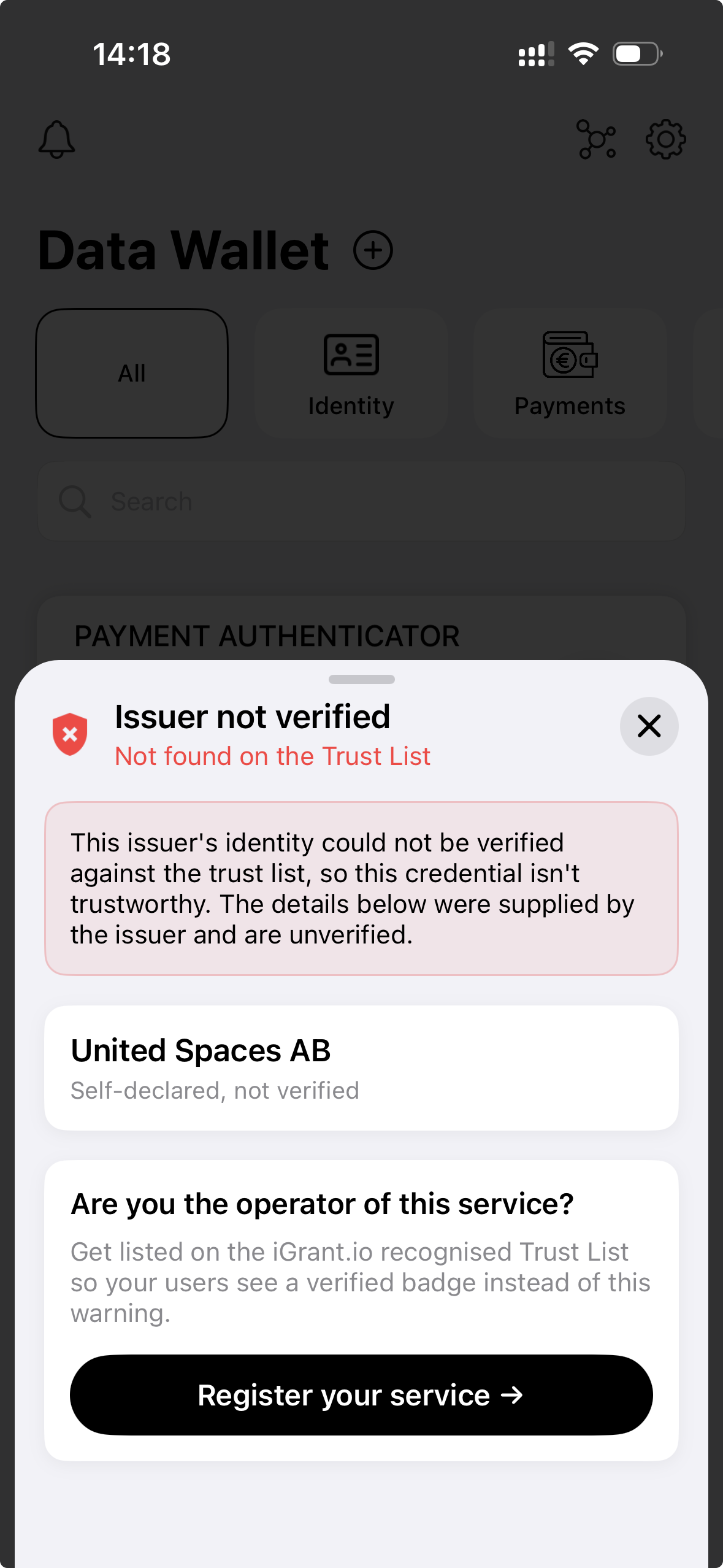
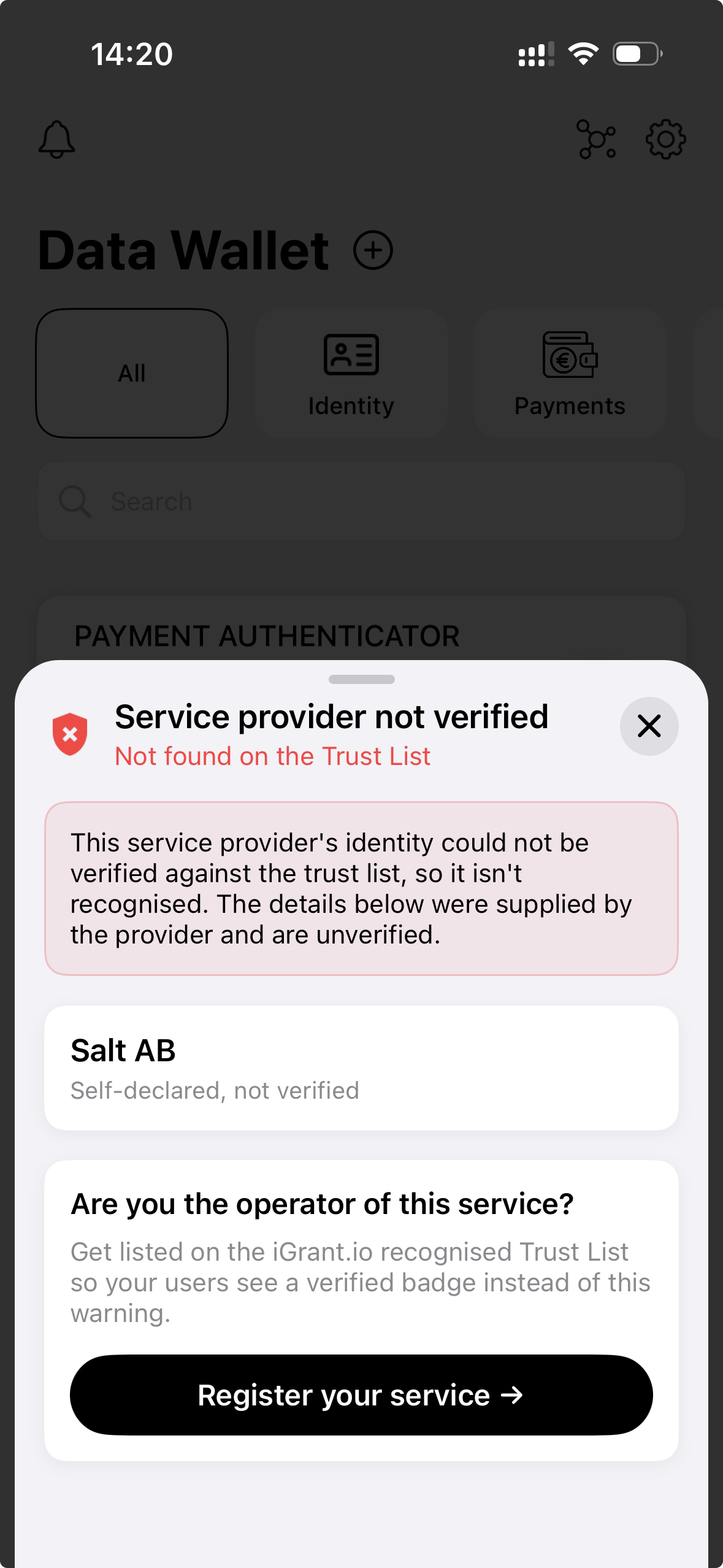
| Attestation Type | Claims | Purpose |
|---|---|---|
| Payment Service User | None | Login and risk-based step-up authentication |
| Payment Card | `pan_last_four`, `scheme`, `scheme_logo` | Payment Authorisation and Recurring Payment Mandate |
| Payment Account | `iban`, `bic`, `currency` | Payment Authorisation, Recurring Payment Mandate, and Account Information Access |
## Transaction Types
| Workflow | Type Identifier | Attestation Used | Description |
|---|---|---|---|
| [Login and Risk-based Authentication](/docs/ts12-risk-based-authentication/) | `urn:eudi:sca:login_risk_transaction:1` | Payment Service User | Step-up SCA for sensitive actions (e.g. login from a new device) |
| [Payment Authorisation](/docs/ts12-payment-authorisation/) | `urn:eudi:sca:payment:1` | Payment Account, Payment Card | Authorise a payment via a PISP or directly |
| [E-mandate](/docs/ts12-emandate/) | `urn:eudi:sca:emandate:1` | Payment Account, Payment Card | Authorise a payment mandate (single, open-ended, recurring or instalment) |
| [Account Information Access](/docs/ts12-account-information-access/) | `urn:eudi:sca:account_access:1` | Payment Account | Authorise an AISP to access account data |
Each workflow follows the same 5-step developer pattern: obtain an API key, create a credential definition, issue a credential, create a presentation definition, and send a verification request with transaction data.
## Learn more
- [Payment Authorisation in EUDI Wallets (iGrant.io paper, v2.3)](https://igrant.io/papers/payment-authorisation-in-eudi-wallets-igrantio-paper-v2.3.pdf): the detailed design, rationale and background behind these workflows.
- **ETSI TS 119 462**: the standard that defines the TS12 payment profile.
- Building blocks used across the workflows: [Payment Wallet Attestation](/docs/openID4vci-payment-wallet-attestation/) and [Payment Data Confirmation](/docs/openID4vci-payment-data-confirmation/).
---
# TS12: Payment Authorisation
Source: https://docs.igrant.io/docs/ts12-payment-authorisation/
---
id: ts12-payment-authorisation
title: "TS12: Payment Authorisation"
hide_title: false
sidebar_label: Payment Authorisation
description: TS12 SCA workflow for payment authorisation using a Payment Card or Payment Account credential, including transaction data with payee details, amount, and currency.
keywords: [TS12, SCA, payment confirmation, payment card, payment account, transaction data, OpenID4VP, EUDI Wallet, verifiable credentials]
slug: /ts12-payment-authorisation/
last_update:
date: 2026-08-20
---
> **Build this with an AI coding agent.** Install the iGrant.io Agent Skills, then ask your agent to build the integration:
>
> ```bash
> npx skills add L3-iGrant/skills
> ```
import { ApiKeyManager } from "@site/src/components/ApiKeyManager";
import DcqlStepTemplate from "@site/src/components/DCQL/DcqlStepTemplate";
import { TS12_PAYMENT_SCENARIOS } from "@site/src/data/ts12/paymentScenarios";
import {
TS12_ATTESTATION_TYPE_OPTIONS,
TS12_PAYMENT_ACCOUNT_CREDENTIAL_DEFINITION,
TS12_PAYMENT_ACCOUNT_ISSUE_REQUEST,
TS12_PAYMENT_AUTHORISATION_PRESENTATION_ACCOUNT,
TS12_PAYMENT_AUTHORISATION_PRESENTATION_CARD,
TS12_PAYMENT_CARD_CREDENTIAL_DEFINITION,
TS12_PAYMENT_CARD_ISSUE_REQUEST,
withAttestationJson,
} from "@site/src/data/ts12ScaPayloads";
TS12 SCA payment authorisation enables a relying party to authorise a payment by requesting a **Payment Card** or **Payment Account** credential with transaction data that captures the payee details, amount, and currency.
## Step 1: Get the API Key (Issuer Admin)
To obtain your API key, please contact [support@igrant.io](mailto:support@igrant.io?subject=Request%20API%20Key). Once you have received your API key, enter it in the field below and click the **Set API Key** button to save it for future use.
credential_sets**. This optional array defines logical groupings and requirements across the requested credentials. This structure provides a robust framework for moving beyond simple credential requests to expressing complex, real-world data requirements in a standardised, machine-readable format.
### 2.1 The Credential Query
The fundamental building block of DCQL is the Credential Query object. Each object in the top-level credentials array represents a Credential Query, which is a request for the presentation of one or more credentials that match the specified criteria. It contains all the necessary parameters to describe the desired credential, including its format, issuer, and specific claims.
| Field Name | Requirement | Description |
id
|
REQUIRED | A unique string identifier for the query. This ID is used to reference the credential in the response and credential_sets definitions. The ID can contain only letters, numbers, hyphens (-) and underscores (_). Do not use spaces.
|
format
|
REQUIRED | A string specifying the required format of the credential (e.g., mso_mdoc, dc+sd-jwt). Valid identifiers are defined in the specification's appendix.
|
multiple
|
OPTIONAL | A boolean indicating if multiple credentials can be returned for this single query. Defaults to false. |
meta
|
REQUIRED | An object for defining format-specific constraints on the credential's metadata and validity data. An empty object means no specific constraints are applied. |
trusted_authorities
|
OPTIONAL | An array of objects specifying trusted issuers or trust frameworks. This helps the Wallet filter credentials from accepted authorities, enhancing privacy by preventing the disclosure of credentials that would likely be rejected. |
require_cryptographic_holder_binding
|
OPTIONAL | A boolean indicating if the Verifier requires proof of cryptographic holder binding. Defaults to true. |
claims
|
OPTIONAL | An array of Claim Query objects that specify the individual data claims requested from within the credential. |
claim_sets
|
OPTIONAL | An array that specifies acceptable combinations of the claims defined in the claims array, allowing for alternatives. |
trusted_authorities** field provides a crucial mechanism for Verifiers to signal trust requirements upfront. Rather than receiving a credential and then checking its issuer against a trust list, the Verifier can guide the Wallet to select only those credentials certified by a recognised authority. This is achieved by specifying a type and a set of values for that type.
| Type Identifier | Description |
aki
|
Matches the Authority Key Identifier from an X.509 certificate in the credential's trust chain. |
etsi_tl
|
Matches an ETSI Trusted List that the credential's issuer is a member of. |
openid_federation
|
Matches the Entity Identifier of a trust anchor in an OpenID Federation that the issuer is part of. |
credential_sets** array allows the Verifier to express logical rules about how those credentials should be combined to satisfy a use case.1 This moves DCQL from a simple "shopping list" to a language capable of expressing complex business logic, such as "provide proof of identity AND (a utility bill OR a bank statement)."
A Credential Set Query is an object within the **credential_sets** array that defines one such logical requirement.
| Field Name | Requirement | Description |
options
|
REQUIRED | A non-empty array where each element is a list of Credential Query IDs. Each list represents one valid combination of credentials that satisfies the set's requirement. |
required
|
OPTIONAL | A boolean indicating if this credential set is mandatory. Defaults to true. |
claims** property is an array of Claim Query objects, each pointing to a specific piece of data.
| Field Name | Requirement | Description |
id
|
REQUIRED (if claim_sets is used) | A unique string identifier for the claim, used for referencing it in the claim_sets array. |
path
|
REQUIRED | A non-empty array representing a path to the claim within the credential's data structure. |
values
|
OPTIONAL | An array of acceptable values for the claim. If present, the Wallet should only return the claim if its value is an exact match for one of the listed values. |
claim_sets** property which enables the Verifier to express preferences and alternatives for the requested claims. It contains an array of arrays, where each inner array is a list of IDs from the claims array.
The logic for selecting claims is as follows:
* If **claims** are absent, the Verifier is not requesting any selectively disclosable claims.
* If **claims** are present but **claim_sets** is absent, the Verifier is requesting all claims listed in the claims array.
* If both **claims** and **claim_sets** are present, the Verifier is requesting one combination of claims from the **claim_sets** array. The order of the combinations expresses the Verifier's preference, from most preferred (first) to least preferred (last). The Wallet SHOULD return the first option it can satisfy.
This layered approach is fundamental to privacy preservation. A Verifier can ask for proof of age by creating a **claim_sets** array that prioritises a simple **age_over_21** boolean claim over the more sensitive **birth_date** claim. The Wallet, following this preference, will provide the minimum information necessary to satisfy the request, empowering users and minimising data exposure.
### 2.4 Example scenarios
The following example scenarios demonstrate how DCQL is used to construct queries for different real-world scenarios.
#### 2.4.1 Use case: Basic Credential Query with trusted authority
This query requests a single credential, a University Degree. It specifies that its issuer must be part of a known trusted authority, such as the EU Trust List, European Blockchain Service Infrastructure (EBSI), the OpenID Federation instance or similar, ensuring its authenticity.

*Figure 01: Require a University Degree credential, only if issued by an authority listed in the EU Trust List or an OpenID Federation or a ledger (Mandatory) etc.*
The query contains a single Credential Query object. The **trusted_authorities** field is used to filter for credentials issued by an entity within the specified federation.
```
{
"credentials": [
{
"id": "university_degree_credential",
"format": "dc+sd-jwt",
"multiple": false,
"meta": {
"vct_values": [
"https://credentials.example.com/identity_credential"
]
},
"trusted_authorities": [
{
"type": "etsi_tl",
"values": [
"https://raw.githubusercontent.com/EWC-consortium/ewc-trust-list/refs/heads/main/EWC-TL.xml"
]
}
]
}
]
}
```
This video demonstrates how **EUDI Wallets** and **OpenID4VP** work with the **Digital Credential Query Language (DCQL)** to enable trusted, privacy-preserving data exchange between holders and relying parties.
over_21** and birthdate. The **claim_sets** array lists ["**over_21**"] as the first, most-preferred option, and ["**birthdate**"] as the second, less-preferred alternative. This guides the wallet to disclose the least amount of information possible.
```
{
"credentials": [
{
"id": "pid",
"format": "dc+sd-jwt",
"meta": {
"vct_values": [
"eu.europa.ec.eudi:pid.1"
]
},
"claims": [
{
"id": "over_21",
"path": [
"is_over_21"
]
},
{
"id": "birthdate",
"path": [
"birth_date"
]
}
],
"claim_sets": [
[
"over_21"
],
[
"birthdate"
]
]
}
]
}
```
#### 2.4.3 Use case: Request and share alternative identities
This query asks the user to provide one form of identification, accepting a Passport, a Photo ID, or a PID.

*Figure 03: Accept any one identity document (Mandatory), Passport, PhotoID or a PID to confirm identity*
Annotation: Three distinct Credential Query objects are defined. The top-level **credential_sets** object contains a single requirement with three options. Each option is a list containing a single credential id. This tells the wallet that providing any one of these three credentials will satisfy the request.
```
{
"credentials": [
{
"format": "dc+sd-jwt",
"id": "Passport",
"meta": {
"vct_values": [
"Passport"
]
},
"require_cryptographic_holder_binding": true
},
{
"format": "dc+sd-jwt",
"id": "PID",
"meta": {
"vct_values": [
"urn:eu.europa.ec.eudi:pid:1"
]
},
"require_cryptographic_holder_binding": true
},
{
"format": "dc+sd-jwt",
"id": "Photo-ID",
"meta": {
"vct_values": [
"eu.europa.ec.eudi.photoid.1"
]
},
"require_cryptographic_holder_binding": true
}
],
"credential_sets": [
{
"options": [
[
"PID"
],
[
"Passport"
],
[
"Photo-ID"
]
],
"required": true
}
]
}
```
This video below demonstrates how **EUDI Wallets** and **OpenID4VP** work with the **Digital Credential Query Language (DCQL)** to request and share alternative identities between holders and relying parties. Here, the Relying Party requests any of the three alternative identity types (Passport, PhotoID or PID). The wallet shows only the matching credential, which the individual selects and shares securely, powered by the iGrant.io Data Wallet and Organisation Wallet Suite.
credential_sets** array has two required sets. The first set has one option: ["**photo_id**"], making it mandatory. The second set has two options: ["**utility_bill**"] or ["**bank_statement**"], allowing the user to provide either one to prove their address. \
```
{
"credentials": [
{
"id": "photo_id",
"format": "mso_mdoc",
"claims": [
{
"path": [
"family_name"
]
}
]
},
{
"id": "utility_bill",
"format": "dc+sd-jwt",
"claims": [
{
"path": [
"address"
]
}
]
},
{
"id": "bank_statement",
"format": "dc+sd-jwt",
"claims": [
{
"path": [
"address"
]
}
]
}
],
"credential_sets": [
{
"options": [
"photo_id"
],
"required": true
},
{
"options": [
[
"utility_bill"
],
[
"bank_statement"
]
],
"required": true
}
]
}
```
#### 2.4.5 Use case: Student transport pass with mandatory and optional credentials
This example demonstrates the full expressive power of DCQL by combining mandatory and optional credential sets with selective claim disclosure in a single, cohesive query.
Scenario: A city's public transport authority offers a discounted travel pass to students. To apply, a student must:
1. Prove their identity: This is a mandatory requirement. The authority needs their full name and date of birth.
2. Prove their student status: This is also mandatory. The authority will accept either a digital Student ID Card or an official Enrolment Letter. From this credential, they need to verify the university's name and confirm the student's enrolment status is "active".
3. Prove local residency (optional): Students who are also local residents may be eligible for an additional discount. This is an optional requirement. The authority will accept either a Utility Bill or a Rental Agreement as proof of address.

*Figure 05: Require a PID and a proof of being a student via Student ID or Enrolment Letter (Mandatory). Also, proof of local address via Utility Bill or Bank Statement for additional discount (Optional)*
DCQL Implementation: This scenario is translated into a DCQL query that defines five potential credentials and three credential sets to enforce the business logic.
* Credential Queries: Five Credential Query objects are defined in the credentials array: one for a national ID, one for a student ID, one for an enrolment letter, one for a utility bill, and one for a rental agreement.
* Claim Sets: Within each credential query, claims and claim_sets are used to specify exactly which data points are needed, such as **full_name** and **date_of_birth** from the national ID, or address from the proof of residency documents. This ensures minimal data disclosure.
* Credential Sets: Three Credential Set Query objects are defined in the **credential_sets** array:
1. A mandatory set requiring the pid.
2. A mandatory set requiring either the student ID card or the enrolment letter.
3. An optional (required: false) set allowing the user to provide either a **utility_bill_doc** OR a **rental_agreement_doc**.
This structure provides an explicit, machine-readable request that gives the user flexibility while ensuring the transport authority receives all necessary information in a privacy-preserving manner.
```
{
"credentials": [
{
"id": "pid",
"format": "mso_mdoc",
"meta": {
"doctype_value": "urn:eu.europa.ec.eudi:pid:1"
},
"claims": [
{
"id": "full_name",
"path": [
"full_name"
]
},
{
"id": "dob",
"path": [
"date_of_birth"
]
}
],
"claim_sets": [
[
"full_name"
],
[
"dob"
]
]
},
{
"id": "student_id_card",
"format": "dc+sd-jwt",
"meta": {
"vct_values": [
"student_id"
]
},
"claims": [
{
"id": "student_id",
"path": [
"student_id"
]
},
{
"id": "university_name",
"path": [
"university_name"
]
}
],
"claim_sets": [
[
"university_name",
"student_id"
]
]
},
{
"id": "enrolment_letter",
"format": "dc+sd-jwt",
"meta": {
"vct_values": [
"employment_letter"
]
},
"claims": [
{
"id": "status",
"path": [
"status"
]
},
{
"id": "university_name",
"path": [
"university_name"
]
}
],
"claim_sets": [
[
"university_name",
"status"
]
]
},
{
"id": "utility_bill_doc",
"format": "dc+sd-jwt",
"meta": {
"vct_values": [
"utility_bill_doc"
]
},
"claims": [
{
"id": "address",
"path": [
"address"
]
}
]
},
{
"id": "rental_agreement_doc",
"format": "dc+sd-jwt",
"meta": {
"vct_values": [
"rental_agreement_doc"
]
},
"claims": [
{
"id": "address",
"path": [
"address"
]
}
]
}
],
"credential_sets": [
{
"options": [
"pid"
],
"required": true
},
{
"options": [
[
"student_id_card"
],
[
"enrolment_letter"
]
],
"required": true
},
{
"options": [
[
"utility_bill_doc"
],
[
"rental_agreement_doc"
]
],
"required": false
}
]
}
```
#### 2.4.6 Use case: Loan application with multiple recent bank statements
This example demonstrates how a loan provider (Relying Party/ Verifier) can request multiple instances of a single credential type.
Scenario: The Loan provider is assessing a loan application. As part of affordability and risk checks, the applicant must share the last 6 months of bank statements.

*Figure 06: Require six recent Bank Statements (Mandatory) to assess affordability as part of a loan application*
The request allows multiple credentials of the same type (bank_statement) to be returned in a single query. This is achieved by setting **"multiple": true**. The format is **dc+sd-jwt**, and the **meta.vct_values** filter ensures only credentials explicitly identified as **bank_statement** are considered.
The **multiple** field enables the Wallet to provide more than one matching credential in response to a single credential query. This is particularly useful in scenarios like this, where each month’s statement is a separate credential issued by the same authority. The Verifier receives all 6 statements in one presentation, maintaining both efficiency and the structured verification flow.
```
{
"credentials": [
{
"id": "bank_statement",
"format": "dc+sd-jwt",
"multiple": true,
"meta": {
"vct_values": [
"https://credentials.bank.com/bank_statement"
]
},
"claims": [
{
"id": "statement_period",
"path": [
"period"
]
},
{
"id": "account_number",
"path": [
"account_number"
]
},
{
"id": "account_holder_name",
"path": [
"account_holder_name"
]
}
],
"claim_sets": [
[
"statement_period",
"account_number",
"account_holder_name"
]
]
}
]
}
```
#### 2.4.7 Use case: Delivery service restricted to specific postal codes
This example demonstrates how a delivery service (Relying Party / Verifier) can request an address credential but only accept it if the postal code matches one of a predefined list of allowed areas.
Scenario: A grocery delivery company offers same-day delivery only to customers in certain postal code areas. When a customer signs up, the company must verify their address and confirm the postal code is in the allowed list before activating their account.

*Figure 07: Require a PID and an address credential with a postal code matching 43242 or 43243 for same-day delivery eligibility (Mandatory)*
The request targets an address credential (dc+sd-jwt format) and uses the **values** field to explicitly state the acceptable postal codes. This field contains an array of possible claim values, and the wallet must only return credentials where the claim’s value exactly matches one of the listed entries. This makes the eligibility check straightforward and ensures the verifier only receives relevant credentials.
```
{
"credentials": [
{
"id": "residential_address",
"format": "dc+sd-jwt",
"meta": {
"vct_values": [
"https://credentials.gov.example/address_credential"
]
},
"claims": [
{
"id": "full_address",
"path": ["street_address"]
},
{
"id": "postal_code",
"path": ["postal_code"],
"values": ["43242", "234234"]
},
{
"id": "city",
"path": ["locality"]
},
{
"id": "country",
"path": ["country"]
}
],
"claim_sets": [
[
"full_address",
"postal_code",
"city",
"country"
]
]
}
]
}
```
## 3.0 EUDI Wallet - A unified experience for individuals and businesses
One of the primary objectives of the EUDI Wallet ecosystem is to provide a seamless and user-friendly experience for both natural persons (individuals) and businesses. For individuals, this means greater control and privacy when sharing only the necessary information. For businesses, it ensures streamlined verification workflows that are standards-based and interoperable. DCQL plays a central role in enabling this unified experience by providing a common, structured way for businesses to request and verify credentials consistently across a wide range of use cases, and for individuals to present credentials securely while preserving privacy.
### 3.1 Business Wallets - Powering flexible business requirements
Using DCQL, Business Wallet administrators can define precise and privacy-preserving credential requests by using one or more query objects. Although the specification only allows a flat list of query objects, this structure is highly versatile. It enables both OR and AND conditions through thoughtful configuration.
By including multiple query objects in a single request, a Business Wallet can offer alternative ways for the holder to fulfil the requirement. This effectively creates a logical OR. For example, it may accept any one of several valid credentials, such as different forms of address proof or registration documents.
To express a logical AND, where multiple credentials are required together, the administrator can include all necessary credential definitions within a single query object, grouped under the same `credential_sets`. This instructs the Wallet to present all listed credentials at once, simulating an AND condition.
| Business scenario | Credential combination example |
| Accepting any one of several recognised identities | The administrator can configure the request to accept any one of: PID, passport, driver's licence, or student ID. This provides flexibility for the holder to choose from several forms of recognised identity documents. |
| Offering a choice of single credentials or a group of proofs | The administrator can configure the query to accept any one of four individual credentials, or a combined proof of, for example, a VAT certificate and tax compliance document, enabling flexible options for the holder. |
| Mixing single credentials and grouped combinations | The administrator can set the configuration to accept one of the first two credentials (e.g., passport or driver's licence) or a combined set of three credentials from another category (e.g., proof of address + tax compliance + bank statement). |
| Multiple instances of the same credential | The administrator can allow the holder to choose one or more available instances of the same credential. For example, the holder can present multiple receipts for refunds from the employer, providing flexibility in proof of purchase or transaction. |
| Request more data to provide additional services | Administrators can configure optional data requests for additional services. For example, suppose the relying party offers extra services (e.g., discounts or loyalty benefits). In that case, they can request additional data from the holder, such as membership status or service preferences, allowing for more tailored user interactions. |
| Scenario | Credential(s) presented |
| Age verification for online purchases | The user may share proof of age, without disclosing full birthdate or other personal details. |
| Flexible identity verification | The user can select a passport, photo ID, or driver's licence, depending on preference and availability. |
| Accessing membership or discounts | The user may share their membership validity or student status without revealing any other personal information. |
| Decide to share optional data | The user may share additional data for certain benefits with a clear lawful basis for use. |
/.well-known/openid-credential-issuer URI endpoint on the issuer’s domain. This JSON document defines credential issuer metadata, such as credential issuer endpoint, authorisation endpoint, methods, credential endpoint, credential deferred endpoint and other particulars necessary to enable secure, efficient communication and issuance processes between the client and the issuer. Through this standardised issuer discovery technique, the OpenID4VCI mechanism ensures seamless interoperability. It simplifies the establishment of trust among participants in decentralised identity systems, thereby enhancing user experience and fortifying security across transactions.
2. Credential offer (credential offer endpoint): The credential offer is a cryptographic invitation, typically embedded within a QR code (cross device), an NFC (cross device) or a deeplink (same device), designed to securely convey essential information and directives from the issuer to the holder. This encapsulated data usually includes details about the credential being offered, the issuer’s intention, and a callback to the issuer’s service endpoints, which will manage the subsequent phases of the credential issuance process.
3. Authenticate and authorise (authorisation endpoint, token endpoint): In OID4VC, the authentication request operates as a pivotal mechanism, anchoring the secure and seamless interaction between the holder, issuer and, potentially, the verifier. This step involves the following substeps:
1. Authorisation request: This is orchestrated by the holder's digital wallet, which communicates with the issuer’s authorisation endpoint to initiate the issuance process. This involves initiating an OAuth authorisation request and obtaining an authorisation code from the identity provider (or authorisation server). The authenticate request encapsulates essential parameters such as client_id, response_type, and scope, alongside other parameters that might inform the issuer about the holder's desired credentials and claims. This step is skipped in the pre-authorisation flow as the digital wallet holder already has the authorisation token and may additionally use a user PIN.
2. Token request and response: Once authorised, the digital wallet acquires a valid access token. In the authorisation code flow, the code is exchanged to obtain the access token refresh token pair (as in 3a). In the pre-authorised flow, the token request contains a pre-authorised code and user PIN, which are exchanged to obtain the token response containing the access token and refresh token pair.
4. Issue credential (credential endpoint): The credential endpoint issues a credential the individual/holder requests once a valid access token is presented. The digital wallet client can request the issuance of a credential of a certain type multiple times, e.g., to associate the credential with different public keys/DIDs or to refresh a certain credential. It is also possible to issue multiple credentials within the same request. In that case, it is at the digital wallet client's discretion to decide the order to request the issuance of multiple credentials requested in the authentication request. Credentials can be issued immediately, if available, or after some time using a deferred credential endpoint.
5. Store credential: After the credential has been issued, the individual can store it in their digital wallet client for future verifiable presentations.
### 4.3 OpenID4VP: How does it work?
The OpenID4VP specification [5] defines an extension of OIDC to allow the presentation of claims in various formats, such as W3C VCs.

_Figure 04: OpenID4VP workflow for presenting and verifying credentials_
The verifiable presentation (VP) involves the following steps:
1. Discover verifier capabilities: This allows for the streamlined discovery of verifier capabilities and configurations through a structured, machine-readable format. It essentially acts as a blueprint that details how digital wallet clients (e.g., holders) should interact with verifiers. Positioned at a well-defined URI endpoint on the verifier's domain, typically under /.well-known/openid-configuration, this configuration document is encoded in JSON format and reveals essential information about the verifier.
2. Request presentation: The presentation request, usually encapsulated within a QR code (cross device), NFC device (cross device) or deeplink (same device), is generated by the verifier and contains a structured set of requirements and instructions detailing the specific verifiable credentials or claims sought from the holder. The presentation request is extracted and processed once the individual scans the QR code (or blips the NFC device or clicks the deeplink). The presentation request contains the definition of the presentation by the verifier. For example, a verifier can specify an EU passport attribute as the credential type and a constraint to only select the name of the holder from the credential.
3. Authenticate and authorise: The authorisation request generally encapsulates essential parameters such as client_id, response_type, and scope alongside other parameters that inform the holder about the verifier's desired credentials and claims.
4. Present VCs: A VP is constructed based on the presentation definition shown to the individual for confirmation. Once the individual confirms the data exchange, a vp_token is returned to the verifier.
5. Verify credentials: After receiving the vp_token, the verifier can cryptographically verify the presentations' authenticity. If the information is present, they can also check a credential's revocation status against a revocation registry.
## 5.0 Key value of OpenID4VCI: The path to verified credentials
### 5.1 OpenID4VCI: Key values
OpenID4VCI merges secure, digital ID checks with user-friendly online processes. It brings several essential benefits to digital identity management and user verification in online systems, summarised below:
**Increased trust and security:** OpenID4VCI makes digital interactions more secure and trustworthy. Using special digital ID proofs (i.e., VCs), which are hard to fake or alter, ensures that online identity checks are robust and reliable.
**User control over identity:** It puts users in control of their own digital IDs. People can choose which bits of their identity information to share, ensuring they remain in charge of their personal data when using online services.
**Ease of use:** OpenID4VCI combines the safety of VCs with easy-to-use online checks, ensuring that while users enjoy strong and safe ID checks, the experience remains straightforward and friendly. This helps users to get on board easily and continue to use the system without hassle.
**High interoperability:** It helps different digital systems work together smoothly. Using well-known online check flows (OIDC flows) and combining them with the new technology of VCs ensures that new systems can work well with existing online services and technologies.
**Privacy and compliance adherence:** OpenID4VCI helps to protect user privacy and supports rules that let users control their own personal data. Allowing users to choose which identity information to share aligns with laws like the General Data Protection Regulation (GDPR), which focuses on securing data sharing and putting users in charge of their personal information.
### 5.2 Real-world reference scenario
In the following real-world reference scenario [7][8], illustrated in the figure, we explain the European Social Security Pass (ESSPASS), which aims to simplify how individuals use their social security benefits in EU countries. Here, the issuer is a national social security office that issues ESSPASS PDA1 verifiable credentials to the individual. The individual can present the credentials across the border in Sweden and prove their social status to an inspecting organisation in Sweden. _(**Disclaimer:** ESSPASS PDA1 is only an example of how the workflow could be. The same flow could be applied to any credentials or attestations)_

_Figure 05: Real-life reference scenario with ESSPASS_
The initial stage of ESSPASS focuses on digitally issuing and verifying a portable document A1 (PDA1) [7] that certifies the applicable social security legislation for work in EU member states. Here is how it works:
* Request an ESSPASS - PDA1: An individual verifies their identity and requests the issuance of an ESSPASS - PDA1 as a VC.
* The back office processes the request and issues the individual ESSPASS [7]-PDA1 verifiable credentials, which are then stored in the data wallet.
* Verification: Any third-party organisation needing to confirm the validity of PDA1 credentials can request and verify them against the EBSI trust anchor.
### 5.3 Reference scenario interactions
Figure 6.0 illustrates the detailed workflow involved in the real-life reference scenario of the National Social Security Office issuing ESSPASS - PDA1 credentials to an individual.
The steps involved in this workflow are:
1. The individual visits the National Social Security Office's webpage and may or may not sign in to their service portal.
2. The individual scans a QR code to request the issuance of a PDA1 document using the digital wallet. Here, the OpenID4VCI flow is triggered. The issuer can also request additional VCs from the individual during the process. Once identified, a request for the credential issuance is placed with the issuer.
3. The issuer can immediately issue a credential or, after some time (called deferred issuance). Once the credential is received, it is securely stored in the digital wallet for future presentations. The issuer may seek additional verifications as part of an out-of-band KYC process.

_Figure 06: National Social Security office issues ESSPASS - PDA1 credential to Individual_
## 6.0 Key value of OpenID4VP: The vanguard of privacy-enhanced digital wallets
### 6.1 OpenID4VP: Key values
OpenID4VP combines VP authenticity with OIDC's widely adopted authentication processes. It offers a suite of advantages quintessential for reinforcing digital identity management and user verification.
**Enhanced authentication credibility**: OpenID4VP amplifies the credibility of digital interactions by incorporating VPs, which serve as reliable and cryptographic confirmations of digital identity. This strengthens the authentication procedure and ensures the user verification process is secure and reliable.
**User-oriented identity management:** The protocol allows users to control their digital identity. By enabling users to present their VPs selectively, OpenID4VP ensures that users can govern the granularity and scope of their shared identity information during the authentication process.
**Smooth user interface:** Despite its sophisticated underpinning, OpenID4VP is crafted to offer a smooth and user-friendly interaction. By combining the security facets of VPs with a straightforward authentication process, OpenID4VP ensures a simplified user journey.
**Comprehensive interoperability:** OpenID4VP enables interoperability by combining traditional OIDC workflows with the innovative use of VPs. This combination ensures that OpenID4VP can be synergistically integrated into existing OIDC-compliant systems, bridging the gap between conventional and contemporary identity technologies.
**Privacy and compliance adherence:** Emphasising user privacy, OpenID4VP facilitates a model where users can directly present their VPs to a relying party, minimising unnecessary data disclosure and thereby complying with regulations like the GDPR.
### 6.2 Real-world reference scenario
In the following reference scenario [7][8][9], we explain that the inspecting organisation verifies the A1 certificate, a form used to confirm the country where an employee or visitor currently pays their social security contributions. Here is how it works:
* Request verification: An individual presents the ESSPASS/PDA1 VC to the verifier.
* The back office checks the VCs inside the presentation and confirms the validity against a trust anchor.
### 6.3 Reference scenario interactions
Figure 7.0 illustrates the detailed workflow involved in the real-life reference scenario of an inspecting organisation verifying an individual's ESSPASS-PDA1 credential.
The steps involved in this workflow are:
1. The individual visits the inspecting organisation's webpage and may or may not sign in to their service portal.
2. Scan a QR code or click a link to obtain the presentation request.
3. Once the presentation request is received, the individual can verify who they are to the verifier.
4. A digital wallet lets the individual see the credentials the verifier requests. They can then present the credentials of their choosing towards the verifier.

_Figure 07: Inspecting organisation verifies ESSPASS - PDA1 credential from an individual_
## 7.0 Bridging to legacy eIDAS systems and SAML
The ARF [2] and new eIDAS regulation [10][14] leans on OpenID-based protocols. However, to ensure interoperability and compatibility of EUDI Wallets with older eIDAS systems, it is essential to map the concepts of SAML [5] to OpenID4VCI and OpenID4VP and vice versa. This is also in line with the eIDAS regulation that requires the creation of minimum technical specifications, standards and procedures for the interoperability framework. This chapter provides an introductory mapping of SAML to OpenID4VCI and OpenID4VP to SAML. Fortunately, translating between SAML and OIDC is straightforward in most areas. Below are some considerations.
### 7.1 Authentication workflow
The eIDAS specifications [12][13] discuss the use of specific authentication messages (the authorisation request and response). These messages are relayed primarily using the HTTP POST method. This setup is reminiscent of certain flows in OIDC and SIOPv2. While most of the mapping is straightforward, the latest OpenID4VCI version presents some complications.
For example, the authorisation request contains the following parameters:
* User authentication type, identification scheme, minimum level of assurance (LoA),
* Identifiers of requested attributes.
The authorisation response contains the following parameters:
* User authentication type
* Retrieved values for the requested attributes.
This ‘one-step’ request/response flow is similar to that described by OIDC or SIOPv2 (response_type=id_token). The OpenID4VP also supports implicit flow but requires an additional data structure (response_type=vp_token). The OpenID4VCI does not help implicit flow; it describes just authorisation code flow and pre-authorized code flow (response_type=code), but both are ‘two-step’ flows that differ from the ‘one-step’ flow of legacy eIDAS systems.
Mapping from SAML to OIDC, SIOPv2, or even OpenID4VP does not require modifications in the communication flow of legacy eIDAS systems, but supporting the current version of OpenID4VCI is a problem.
### 7.2 Security: Signatures and encryption
The eIDAS specifications emphasise the importance of security, requiring signatures for authentication requests and both signatures and encryption for responses. While XML-based messages were previously the norm, they are now transitioning to JSON-based ones.
However, the order in which encryption and signatures are applied differs between the old and new systems. For instance, the eIDAS-focused SAML encrypts data before signing the entire message. In contrast, OIDC signs first before encrypting. Both methods have merits, but harmonising them is crucial for maintaining security during the transition.
Mapping from SAML to OIDC, SIOPv2, OpenID4VP, or OpenID4VCI requires signature and encryption mechanism modifications. Legacy eIDAS systems and EUDI Wallet, as per eIDAS-2.0, shall have a common method for applying security layers such as sign-then-encrypt-then-sign.
### 7.3 Passing parameters
Legacy eIDAS details how parameters should be passed through HTTP Redirect or HTTP POST. The method used often depends on the message's size. However, newer systems like OpenID4VP and SIOPv2 have different size limits, especially when considering QR code uses, where size constraints are more pronounced. Transitioning might require using HTTP POST more extensively, especially when URLs become too lengthy.
## 8.0 EUDI Wallets: Pioneering the future of digital identity
As explored in this paper, the convergence of EUDI Wallets with OpenID4VCI and OpenID4VP represents a transformative leap forward in digital identity and personal data protection. Integrating advanced technologies like SD-JWT instead of simply JWTs in a typical OIDC flow and ZKPs could enhance these solutions towards enhanced end-user privacy and control.
EUDI Wallets, in collaboration with OpenID Foundation protocols (like OpenID4VCI, OpenID4VP), credential formats like JWT, SD-JWT with ZKP, herald a new era in digital identity management - one in which individuals are empowered, data is fortified and privacy is preserved. As these technologies become more integrated into our digital lives, we move closer to a future where the benefits of a connected world can be realised without compromising our personal information and digital sovereignty. The future of digital identity and personal data protection has arrived, and it is both promising and secure!
## Frequently asked questions
### What is OpenID4VC?
OpenID for Verifiable Credentials (OpenID4VC) is a set of OpenID Foundation specifications that extend OpenID Connect to work with verifiable credentials. It consists of three specifications: SIOPv2, OpenID4VCI and OpenID4VP.
### What is the difference between OpenID4VCI and OpenID4VP?
OpenID4VCI defines how an issuer issues verifiable credentials to a wallet, using an OAuth access token and endpoints such as the credential endpoint. OpenID4VP defines how a holder presents credentials directly to a verifier, returning a vp_token for verification.
### What is SIOPv2?
Self-Issued OpenID Provider v2 (SIOPv2) lets an end user act as their own OpenID provider and authenticate with an identifier they control, such as a decentralised identifier (DID), without relying on a central identity provider.
### How does a verifier check a presented credential in OpenID4VP?
The verifier sends a presentation request, often as a QR code, NFC tag or deeplink. The holder confirms the data exchange and returns a vp_token, which the verifier cryptographically verifies and can check for revocation against a revocation registry.
## References
1. OpenID Foundation (2022), ‘OpenID for Verifiable Credentials - Overview’, Available at: [https://openid.net/sg/openid4vc/](https://openid.net/sg/openid4vc/) (Accessed: October 01, 2023)
2. European Commission (2023) The European Digital Identity Wallet Architecture and Reference Framework (2023-04, v1.1.0) [Online]. Available at: [https://github.com/eu-digital-identity-wallet/eudi-doc-architecture-and-reference-framework/releases](https://github.com/eu-digital-identity-wallet/eudi-doc-architecture-and-reference-framework/releases) (Accessed: October 16, 2023).
3. OpenID Foundation (2023), 'Self-Issued OpenID Provider v2 (SIOP v2)', Available at: [https://openid.net/specs/openid-connect-self-issued-v2-1_0.html](https://openid.net/specs/openid-connect-self-issued-v2-1_0.html) (Accessed: October 01, 2023)
4. OpenID Foundation (2023), 'OpenID for Verifiable Credential Issuance (OpenID4VCI)', Available at: [https://openid.net/specs/openid-4-verifiable-credential-issuance-1_0-11.html](https://openid.net/specs/openid-4-verifiable-credential-issuance-1_0-11.html) (Accessed: October 02, 2023).
5. OpenID Foundation (2023) 'OpenID for Verifiable Presentation (OIDC4VP)', Available at: [https://openid.net/specs/openid-4-verifiable-presentations-1_0.html](https://openid.net/specs/openid-4-verifiable-presentations-1_0.html) (Accessed: 02 October 2023).
6. Decentralized Identity Foundation (2022), ‘Self-Issued OpenID Connect Provider DID Profile v0.1 (DEPRECATED)’, Available at [https://identity.foundation/did-siop/](https://identity.foundation/did-siop/) (Accessed: 21 October 2023)
7. European Commission (2022) 'European Social Security Pass', Available at: [https://ec.europa.eu/social/main.jsp?catId=1545&langId=en](https://ec.europa.eu/social/main.jsp?catId=1545&langId=en) (Accessed: 10 October 2023).
8. iGrant.io (2023) 'ESSPASS PDA1 reference scenario', Available at: [https://igrant.io/ebsi.html](https://igrant.io/ebsi.html) (Accessed: 02 October 2023).
9. iGrant.io (2023) 'ESSPASS: Transforming social security rights with OID4VC and OID4VP in digital wallets', YouTube video, Available at: [https://youtu.be/b-dTpMbxHPU](https://youtu.be/b-dTpMbxHPU) (Accessed: October 12, 2023).
10. European Commission (2014) Regulation (EU) No 910/2014 of the European Parliament and of the Council, Official Journal of the European Union, L 257/73. [online] Available at: [https://eur-lex.europa.eu/legal-content/EN/TXT/HTML/?uri=CELEX:32014R0910](https://eur-lex.europa.eu/legal-content/EN/TXT/HTML/?uri=CELEX:32014R0910) (Accessed: 12 October 2023).
11. Assertions and Protocols for the OASIS Security Assertion Markup Language (SAML) V2.0 (2005-03-15) [http://docs.oasis-open.org/security/saml/v2.0/saml-core-2.0-os.pdf](http://docs.oasis-open.org/security/saml/v2.0/saml-core-2.0-os.pdf) (Accessed: October 16, 2023).
12. European Commission (2016) eIDAS Technical Specifications, based on Opinion No. 1/2016 and CIR (EU) 2015/1501 (2016-01-26, v1.0) [https://ec.europa.eu/digital-building-blocks/wikis/display/DIGITAL/eIDAS+eID+Profile](https://ec.europa.eu/digital-building-blocks/wikis/display/DIGITAL/eIDAS+eID+Profile) (Accessed: October 16, 2023).
13. European Commission (2023) eIDAS Technical Specifications, based on Opinion No. 3/2023 and CIR (EU) 2015/1501 (2023-04-24, v1.3) [https://ec.europa.eu/digital-building-blocks/wikis/display/DIGITAL/eIDAS+eID+Profile](https://ec.europa.eu/digital-building-blocks/wikis/display/DIGITAL/eIDAS+eID+Profile) (Accessed: October 16, 2023).
14. European Commission, 2021. Proposal for a Regulation of the European Parliament and of the Council of amending Regulation (EU) No 910/2014 as regards establishing a framework for a European Digital Identity. [Online] Available at: [https://eur-lex.europa.eu/legal-content/EN/TXT/?uri=CELEX%3A52021PC0281](https://eur-lex.europa.eu/legal-content/EN/TXT/?uri=CELEX%3A52021PC0281) (Accessed on: 6 November 2023)
---
# Credential issuance lifecycle (OpenID4VCI): From offer to acceptance
Source: https://docs.igrant.io/concepts/credential-issuance-lifecycle/
---
id: openid4vci-credential-issuance-lifecycle
title: "Credential issuance lifecycle (OpenID4VCI): From offer to acceptance"
hide_title: false
description: "A comprehensive guide to the OpenID4VCI (OpenID for Verifiable Credential Issuance) credential issuance lifecycle for developers, solution architects, and product managers building on EUDI Wallets, European Business Wallets, and digital identity ecosystems."
sidebar_label: Credential issuance lifecycle (OpenID4VCI)
keywords: [credential issuance lifecycle, OpenID4VC, OpenID4VCI, OID4VCI, verifiable credentials, credential states, credential offer, credential issuance, EUDI Wallet, European Business Wallet, digital wallet, iGrant.io, Organisation Wallet Suite, deferred issuance, SD-JWT, mdoc, W3C VC, eIDAS 2.0, digital identity, banking, insurance, payments]
slug: /credential-issuance-lifecycle/
---
> **Build this with an AI coding agent.** Install the iGrant.io Agent Skills, then ask your agent to build the integration:
>
> ```bash
> npx skills add L3-iGrant/skills
> ```

_Figure 01: The credential issuance lifecycle: Six progressive stages - issuer validation decision checks (diamonds), successful completion, issuer denial and holder deletion.
The happy path flows top to bottom: the issuer creates an offer, the holder opens it, authorization succeeds, and a token is issued. The issuer then performs validation checks - verifying that a valid [Wallet Unit Attestation (WUA)](https://docs.igrant.io/concepts/wallet-unit-attestation/) is present and that the European Business Wallet Owner Identification (EBWOID) is in order. These two checks are defined within the European Digital Identity Wallet Architecture and Reference Framework (ARF) [5]. If either check fails, the issuance is denied. If both checks pass, the credential is delivered, the wallet confirms receipt, and the holder accepts it. After the credential is accepted, the holder can choose to delete it.
Each stage is tracked as a `status` value in the credential exchange record and fires a corresponding [webhook event](https://docs.igrant.io/docs/openid4vc-webhooks/), making the entire lifecycle observable and actionable for developers.
## 3.0 How the Lifecycle Works
### 3.1 Offer Sent
The lifecycle begins when the issuer creates and sends a credential offer to the holder. In the OpenID4VC specification, this corresponds to the Credential Offer described in Section 4 [1]. The issuer generates a credential offer containing the necessary metadata, including the credential configuration, issuer endpoint, and grant information, and makes it available to the holder, typically through a QR code or a credential offer URI.
At this point, the offer is waiting for the holder to open it. No authentication or authorization has occurred yet. The issuer triggers this stage by calling the [Issue credential](https://docs.igrant.io/docs/openid4vc-api/config-digital-wallet-open-id-issue-credential) API, which returns a `credentialOffer` that can be encoded as a QR code.
**Example:** A bank wants to issue a KYC verification credential to a customer who has just [opened a new account](https://www.igrant.io/demo/open-bank-account.html). The bank's system calls the Issue credential API and displays the resulting QR code on the customer's screen. The credential's lifecycle has begun; the status is now `offer_sent`.
Credentials may be issued immediately (in-time) or on a deferred basis depending on business requirements. In-time issuance is used when credential data is already available - for example, issuing a [Photo ID credential](https://www.igrant.io/photoid.html) immediately after the holder's passport has been validated. Deferred issuance is used when back-office processing is required first, as explored in Section 4.0.
### 3.2 Offer Received
Once the holder opens the credential offer - for example, by scanning the QR code with the [Data Wallet](https://igrant.io/datawallet.html) or any other EU Digital Identity (EUDI) Wallet - the status transitions to Offer Received. The holder's wallet has retrieved the credential offer and resolved the issuer's metadata, but the holder has not yet proceeded to the authorization step.
This stage corresponds to the wallet resolving the Credential Issuer Metadata and Authorization Server Metadata as described in Sections 11.2 and 11.1 of the OpenID4VC specification [1].
For the bank issuing the KYC credential, this is the moment when the customer has scanned the QR code with their wallet. The bank's system, if it has registered a [webhook](https://docs.igrant.io/docs/openid4vc-api/config-create-webhook), receives an `openid.credential.offer_received` event, confirming that the customer has engaged with the offer.
### 3.3 Token Issued
This stage marks the point at which the holder has been successfully authorized. The authentication and authorization exchange between the holder's wallet and the issuer's authorization server has been completed, and the wallet has obtained an access token.
In OpenID4VC, this maps to the Token Endpoint interaction described in Section 6 [1]. The specification supports two authorization flows:
- **Authorization Code Flow:** The holder authenticates with the issuer's authorization server and exchanges the authorization code for an access token.
- **Pre-Authorized Code Flow:** The issuer provides a pre-authorized code (optionally with a transaction code) that the holder's wallet exchanges directly for an access token.
Once the token is issued, the holder's wallet is ready to request the credential from the Credential Endpoint.
In some scenarios, additional proof of identity may be required before issuance proceeds. When issuing a [Photo ID credential](https://www.igrant.io/photoid.html), for instance, the issuer - a Qualified Trust Service Provider (QTSP) - may require the holder to first present their passport credential for verification. This is handled through a [dynamic credential request](https://docs.igrant.io/docs/openID4vci-issue-dynamic-credential-request/) flow, in which issuance and presentation occur within a single transaction.
### 3.4 Credential Issued
With a valid access token, the holder's wallet requests the credential from the issuer's Credential Endpoint, as described in Section 7 of the OpenID4VC specification [1]. The issuer validates the request, including proof of key possession, and delivers the credential to the holder's wallet. Credentials can be issued in any of the standard formats: [W3C Verifiable Credentials (JWT)](https://www.w3.org/TR/vc-data-model/), [IETF SD-JWT VC](https://www.ietf.org/archive/id/draft-ietf-oauth-sd-jwt-vc-14.html), or [ISO/IEC 18013-5 mdoc/mDL](https://www.iso.org/standard/69084.html).
At this stage, the credential has been delivered to the wallet but the holder has not yet confirmed or accepted it. The credential exchange record status transitions to `credential_issued`, and the issuer receives the `openid.credential.credential_issued` webhook event. Integrations can poll the [Read issuance history](https://docs.igrant.io/docs/openid4vc-api/config-read-digital-wallet-open-id-credential-history) API or use the webhook to update dashboards in real time.
### 3.5 Credential Acknowledged
The holder's wallet confirms receipt of the credential using the Notification Endpoint described in Section 10 of the OpenID4VC specification [1]. This acknowledgement informs the issuer that the credential has been successfully received and stored in the wallet. The status transitions to `credential_acked`.
The distinction between acknowledgement and acceptance is intentional: it allows wallets to implement a review step in which the holder inspects the credential before choosing to keep it. Credentials in the `credential_acked` state are not yet available for presentation to verifiers - they must reach `credential_accepted` first.
### 3.6 Credential Accepted
The holder accepts and saves the credential, marking the issuance as complete. The credential is now fully available in the holder's wallet for future use - for example, presenting it to a verifier during an [insurance onboarding](https://www.igrant.io/demo/insurance.html) process, a [bank account login](https://www.igrant.io/demo/open-bank-account.html), or a [DCQL-based identity verification](https://www.igrant.io/demo/openid4vp-dcql-01.html).
This is the successful terminal state. The issuer receives the `openid.credential.credential_accepted` webhook, and the credential exchange record shows `credential_accepted` as its final status.
## 4.0 Deferred issuance in OpenID4VC
The OpenID4VC specification supports deferred credential issuance for scenarios in which the credential cannot be issued immediately. This is a common requirement in regulated industries where back-office processing - such as underwriting, risk assessment, or regulatory checks - must be completed before a credential can be generated.
In a deferred issuance flow, the issuer creates the credential offer with `issuanceMode: "Deferred"`. The holder scans the QR code and the lifecycle progresses to the Token Issued stage, where it pauses. When processing is complete, the issuer calls the [Issue deferred credential](https://docs.igrant.io/docs/openid4vc-api/config-update-digital-wallet-open-id-credential-history) API with the `credentialExchangeId` from the original offer. The holder's wallet automatically retrieves the credential, and the lifecycle resumes through to Credential Accepted. Follow the [deferred issuance workflow](https://docs.igrant.io/docs/openID4vci-issue-credential-deferred/) for step-by-step guidance.
**Example:** An insurance company cannot issue a policy credential immediately - it requires time for underwriting and regulatory review. The company creates a deferred offer, and the customer scans the QR code. Days later, once underwriting is complete, the issuer calls the deferred issuance API. The customer's wallet retrieves the policy credential automatically, completing the lifecycle.
Back-office systems can monitor pending deferred credentials by calling the [List issuance history](https://docs.igrant.io/docs/openid4vc-api/config-list-digital-wallet-open-id-credential-history) API and filtering for records in the `token_issued` state.
## 5.0 Exception handling and terminal failure states
Not every OpenID4VC credential issuance follows the happy path. The lifecycle includes two terminal states that handle failure and holder-initiated removal.
### 5.1 Issuance denied
Once the holder has been authorized and the token is issued, the issuer performs validation checks before delivering the credential. As shown in the diagram, the issuer verifies that a valid **Wallet Unit Attestation (WUA)** is present and that the **European Business Wallet Owner Identification (EBWOID)** is in order. If either check fails, the lifecycle moves to the **Issuance Denied** terminal state. Common reasons for denial include:
- **Missing or invalid Wallet Unit Attestation (WUA):** The holder's wallet does not present a valid attestation, meaning it does not meet the issuer's trust requirements.
- **Missing or invalid European Business Wallet Owner Identification (EBWOID):** The wallet owner identification associated with the credential request cannot be verified.
- **Invalid proof of key possession:** The cryptographic proof provided by the wallet is invalid or missing.
- **Credential uniqueness enforced:** A valid credential of the same type already exists for this holder.
The denial reason is included in the `openid.credential.issuance_denied` webhook payload, enabling developers to surface specific error messages rather than generic failures. The credential exchange record status is set to `issuance_denied`.
### 5.2 Credential deleted
After a credential has been successfully issued and accepted, the holder may choose to permanently remove it from their wallet. This is a holder-initiated action - the holder may no longer require the credential, or may wish to obtain a fresh one.
The issuer receives the `openid.credential.credential_deleted` webhook event, which allows it to update its records accordingly. This can be significant for compliance purposes: an insurance company, for example, may need to record that a policyholder no longer holds the digital policy attestation in their wallet.
## 6.0 OpenID4VC lifecycle in practice: al-world scenarios
The OpenID4VC lifecycle model has direct implications for how real-world applications behave. The following scenarios illustrate how different stages and issuance modes apply across digital identity use cases.
### 6.1 Digital bank account opening with EUDI Wallet
When a customer [opens a new bank account](https://www.igrant.io/demo/open-bank-account.html) using their EUDI Wallet, the bank needs to issue a KYC verification credential after confirming the customer's identity. This is a straightforward **in-time issuance** scenario: the bank has all the information it needs and can issue the credential immediately by calling the [Issue credential](https://docs.igrant.io/docs/openid4vc-api/config-digital-wallet-open-id-issue-credential) API with `issuanceMode: "InTime"`.
The lifecycle progresses through all six stages in a single flow. The bank's integration can use [webhooks](https://docs.igrant.io/docs/openid4vc-webhooks/) to track when the customer scans the QR code (`offer_received`), when the credential reaches their wallet (`credential_issued`), and when they accept it (`credential_accepted`), updating the onboarding interface at each step. Try the [in-time issuance workflow](https://docs.igrant.io/docs/openID4vci-issue-credential-intime/) to see this in action.
### 6.2 Insurance policy issuance with deferred OpenID4VC credential
When a customer applies for an [insurance policy](https://www.igrant.io/demo/insurance.html), the insurer typically cannot issue the policy credential immediately - it requires time for underwriting, risk assessment, and regulatory checks. This is where **deferred issuance** comes in. This scenario applies equally when the policyholder is an individual using a EUDI Wallet or an organisation using a European Business Wallet - for example, a company receiving a liability insurance credential into its organisational wallet.
The insurance company creates the credential offer with `issuanceMode: "Deferred"`. The customer scans the QR code and the lifecycle reaches the Token Issued stage, but pauses there. Once underwriting is complete, the insurance company calls the [Issue deferred credential](https://docs.igrant.io/docs/openid4vc-api/config-update-digital-wallet-open-id-credential-history) API with the `credentialExchangeId` from the original offer. The customer's wallet automatically retrieves the policy credential, and the lifecycle resumes through to Credential Accepted. Follow the [deferred issuance workflow](https://docs.igrant.io/docs/openID4vci-issue-credential-deferred/) for step-by-step guidance.
Meanwhile, the back-office system can track the status of every pending policy credential by calling the [List issuance history](https://docs.igrant.io/docs/openid4vc-api/config-list-digital-wallet-open-id-credential-history) API, filtering for records in the `token_issued` state.
### 6.3 Merchant payments with eReceipt and boarding pass credentials
In a [merchant-led payment scenario](https://www.igrant.io/demo/merchant-led-payments-with-receipts-boardingpass.html), a customer purchasing a ferry ticket receives multiple credentials in a single transaction: a payment confirmation, an eReceipt, and a boarding pass. Each credential follows its own lifecycle independently. This scenario is well-suited to European Business Wallets, where an organisation may need to receive and store transactional credentials such as eReceipts or travel documents on behalf of its employees or operations.
Webhook events are particularly valuable here. The merchant's system registers [webhooks](https://docs.igrant.io/docs/openid4vc-webhooks/) and uses the `credential_accepted` events to confirm that each credential has been successfully delivered to the customer's wallet. Only when all three credentials show `credential_accepted` does the merchant's system mark the transaction as fully complete. If any credential shows `issuance_denied`, the system can trigger a retry or alert the support team.
### 6.4 Photo ID issuance with dynamic credential request
When issuing a [Photo ID credential](https://www.igrant.io/photoid.html) - a digital identity based on an electronic Machine-Readable Travel Document (eMRTD) - the issuer, a Qualified Trust Service Provider (QTSP), needs to verify the holder's passport before issuing the Photo ID. This is a **dynamic credential request**: the issuance flow requires the holder to first present an existing credential as proof.
The issuer creates both a Presentation Definition (specifying the passport credential required) and a Credential Definition (specifying the Photo ID to be issued), then links them in a single credential offer. When the holder scans the QR code, their wallet presents the passport credential and receives the Photo ID in one seamless flow. The [dynamic credential request workflow](https://docs.igrant.io/docs/openID4vci-issue-dynamic-credential-request/) provides a detailed walkthrough of this process.
### 6.5 University degree verification for employment onboarding
An employment agency uses [DCQL (Digital Credentials Query Language)](https://www.igrant.io/demo/openid4vp-dcql-01.html) to request proof of university degrees from job applicants. For successful presentation, the applicant's wallet must contain degree credentials that have completed the full issuance lifecycle, reaching the `credential_accepted` state. Credentials still in an intermediate state (e.g. `credential_acked` but not yet accepted) are not available for presentation.
This illustrates an important principle: the issuance lifecycle directly governs the presentation lifecycle. Understanding when a credential becomes available for use - at the `credential_accepted` stage - is critical for designing end-to-end workflows that span both issuance and verification under OpenID4VC and OpenID for Verifiable Presentations (OpenID4VP) [4].
## 7.0 Conclusion
The OpenID4VC credential issuance lifecycle provides a well-defined, standards-based framework for tracking how credentials move from issuer to holder. The six progressive stages - **Offer Sent**, **Offer Received**, **Token Issued**, **Credential Issued**, **Credential Acknowledged**, and **Credential Accepted** - together with the two terminal states of **Issuance Denied** and **Credential Deleted**, give developers a clear model for building reliable, event-driven credential issuance systems.
Whether building a [banking onboarding system](https://www.igrant.io/demo/open-bank-account.html), an [insurance credentialing platform](https://www.igrant.io/demo/insurance.html), a [payment and receipts solution](https://www.igrant.io/demo/merchant-led-payments-with-receipts-boardingpass.html), or a [government identity programme](https://www.igrant.io/photoid.html), the lifecycle model ensures a consistent and interoperable approach aligned with the European Digital Identity Wallet Architecture and Reference Framework (ARF) [5]. The lifecycle is equally applicable to personal EUDI Wallets and to European Business Wallets, making it the common foundation for credential issuance across the full spectrum of digital identity use cases.
The Organisation Wallet Suite by iGrant.io implements this lifecycle with full support for [in-time](https://docs.igrant.io/docs/openID4vci-issue-credential-intime/), [deferred](https://docs.igrant.io/docs/openID4vci-issue-credential-deferred/), and [dynamic credential request](https://docs.igrant.io/docs/openID4vci-issue-dynamic-credential-request/) issuance modes, backed by comprehensive [APIs](https://docs.igrant.io/docs/developer-apis) and real-time [webhook notifications](https://docs.igrant.io/docs/openid4vc-webhooks/) at every stage of the OpenID4VC credential issuance process.
## References
1. OpenID Foundation (2024), 'OpenID for Verifiable Credential Issuance (OpenID4VCI)', Available at: [https://openid.net/specs/openid-4-verifiable-credential-issuance-1_0.html](https://openid.net/specs/openid-4-verifiable-credential-issuance-1_0.html)
2. IETF (2012), 'RFC 6749 - The OAuth 2.0 Authorization Framework', Available at: [https://datatracker.ietf.org/doc/html/rfc6749](https://datatracker.ietf.org/doc/html/rfc6749)
3. OpenID Foundation (2014), 'OpenID Connect Core 1.0', Available at: [https://openid.net/specs/openid-connect-core-1_0.html](https://openid.net/specs/openid-connect-core-1_0.html)
4. OpenID Foundation (2024), 'OpenID for Verifiable Presentations (OpenID4VP)', Available at: [https://openid.net/specs/openid-4-verifiable-presentations-1_0.html](https://openid.net/specs/openid-4-verifiable-presentations-1_0.html)
5. European Commission (2026), 'The European Digital Identity Wallet Architecture and Reference Framework (ARF) 2.9.0', Available at: [https://eudi.dev/2.9.0/architecture-and-reference-framework-main/](https://eudi.dev/2.9.0/architecture-and-reference-framework-main/)
6. iGrant.io (2025), 'Organisation Wallet Suite - OpenID4VC Implementation', Available at: [https://www.igrant.io/demo.html](https://www.igrant.io/demo.html)
---
# Credential Issuance for EUDI Wallets (OpenID4VCI)
Source: https://docs.igrant.io/concepts/openid4vci-credential-issuance/
---
id: openid4vci-credential-issuance
title: "Credential Issuance for EUDI Wallets (OpenID4VCI)"
hide_title: false
description: "OpenID4VCI (OID4VCI) is the protocol EUDI wallets use to receive verifiable credentials. Learn the credential offer, authorization and pre-authorized code flows, with examples."
sidebar_label: Credential Issuance (OpenID4VCI)
keywords: [OpenID4VCI, OID4VCI, oid4vc, OIDC4VCI, OpenID4VC, credential issuance, credential offer, pre-authorized code, authorization code, SD-JWT VC, ISO mdoc, EUDI Wallet, European Business Wallet, verifiable credentials, ARF, iGrant.io]
slug: /openid4vci-credential-issuance/
---
> **Build this with an AI coding agent.** Install the iGrant.io Agent Skills, then ask your agent to build the integration:
>
> ```bash
> npx skills add L3-iGrant/skills
> ```

*Figure 01: Revocation propagates in six steps. A cause is raised, the Wallet Provider revokes the Wallet Unit by setting the WIA and, where relevant, KA status-list indices, the PID Provider polls those indices every 24 hours and revokes the PID, and the Relying Party, checking only the PID status, sees a revoked credential. Two links hold the chain together, marked A and B.*
The chain has six steps and, crucially, two links where responsibility passes from one party to the next. Everything else is plumbing. Get the two links right and the rest follows.
**Try it:** open the simulator in [Single](https://eudi-wallet-wua-playground.igrant.io/revocation-chaining-simulator) mode, pick a cause, and press *Revoke the Wallet Unit*. Watch the outcome propagate down the six stages, and click any WIA, KA, or PID to read the real, signed token that carries its status reference.
## 3.0 The two links that hold the chain together
### 3.1 Link A: From Wallet Unit status to the PID Provider's decision
The first link is a legal obligation made technical. A PID Provider must check the revocation status of both the WIA and the KA it received during issuance, at least once every 24 hours, for the entire validity period of the PID; if either has been revoked, it must revoke the PID `[2]` `[3]`. This is what turns "the Wallet Provider revoked the wallet" into "the PID is now revoked". The Wallet Provider never touches the PID; it only changes the status of the Wallet Unit, and the PID Provider does the rest.
### 3.2 Link B: From PID status to the Relying Party
The second link is what makes the whole scheme usable at presentation time. A Relying Party checks only the PID's own status; it never sees the WIA or the KA. The ARF is explicit that this is enough: by verifying the revocation status of the PID, the Relying Party implicitly verifies the revocation status of the Wallet Unit `[1]`. The chain collapses a multi-party trust question into a single status check that any Relying Party already knows how to make.
## 4.0 What makes the chain possible: status lists and the maintenance period
### 4.1 Three Token Status Lists, two owners
Every WIA, KA, and PID carries a reference to an entry in a Token Status List `[4]`: a published, indexed array where each position records whether one attestation is valid or revoked. Revoking something does not change the token in the holder's wallet; it flips the bit at that token's index in the list the issuer publishes.
There are three lists, owned by two parties.

*Figure 02: The Wallet Provider maintains the WIA status list and the KA status list, and revokes a Wallet Unit by setting the relevant indices. The PID Provider maintains the PID status list; during its 24-hour check it reads the Wallet Provider's lists and, if it sees a revocation, sets the PID's own index. A Relying Party only ever reads the PID list.*
The KA list is worth a closer look. A Wallet Provider can use a type-shared index, where all Key Attestations describing the same [WSCD or keystore](/concepts/wallet-secure-cryptographic-application-device/) category share one index, or a per-KA index, where each Key Attestation has its own `[2]`. The choice matters at scale: with a type-shared index, a single flip revokes every wallet of that type at once.
**Try it:** switch the simulator to [Population](https://eudi-wallet-wua-playground.igrant.io/revocation-chaining-simulator) mode to see all three status lists at once across a fleet of citizens, grouped by key storage (WSCD A, WSCD B, or a device Keystore). Toggle between the type-shared and per-KA index models and revoke a WSCD type to watch one index flip take out an entire group.
### 4.2 The maintenance period
Link A only works if the WIA and KA are still checkable for as long as the PID lives. That is guaranteed by a commitment separate from the token's own short lifetime: the WIA and KA each carry a maintenance period during which the Wallet Provider promises to keep the status entry up to date `[1]` `[2]`. The rule that ties it together is that the PID's technical validity must end before both the WIA maintenance period and the KA maintenance period. A WIA can therefore be valid for only a few hours as a freshness check while its status remains maintainable for the whole life of any PID issued against it.
## 5.0 How the Wallet Provider revokes: causes and granularity
### 5.1 The causes
The Wallet Provider revokes a Wallet Unit at least in these circumstances `[1]`:
- The user asks for it, typically after losing the device or having it stolen.
- The security of the Wallet Unit is breached or compromised, detected through the Wallet Provider's own monitoring.
- A PID Provider requests it because the person using the wallet has died.
- The Wallet Solution is suspended (optionally) or withdrawn (mandatorily).
### 5.2 What gets set, and how widely
Revocation is not all-or-nothing. Depending on the cause, the Wallet Provider sets different indices `[1]`:
- To revoke the whole Wallet Unit, it revokes the Wallet Instance by setting its WIA index.
- If a single Wallet Secure Cryptographic Device is breached, it revokes that device and the Wallet Instance using it.
- If a whole type of device is breached, it revokes every Wallet Instance using a device of that type. With a type-shared KA index this is a single flip.
- If a keystore is breached, it revokes that keystore, and normally the Wallet Instances using it as well.
### 5.3 Revoking narrowly: The keystore case
There is one important exception, and it is the clearest illustration of why the chain is more subtle than "revoke everything". If a keystore is breached, the Wallet Provider may, on the basis of a documented risk analysis, decide not to revoke the Wallet Instance. In that case only the attestations bound to that keystore are impacted, and the presentation of the PID remains available to the user `[1]`.

*Figure 03: Two outcomes. On the left, a lost device: the WIA is revoked, so the PID Provider revokes the PID. On the right, a risk-analysed keystore breach: the KA for that keystore is revoked but the WIA stays valid, the PID Provider sees nothing to act on, and the PID keeps working.*
**Try it:** in the simulator, choose the cause *Keystore breach, risk analysis keeps the PID usable* and revoke. The KA index flips red, but the WIA and PID stay green, and the Issuer summary reports zero PIDs revoked. Compare it with *User reports a lost or stolen device* to see the whole chain go red instead.
## 6.0 How the PID Provider keeps the PID in step
Link A is a loop the PID Provider runs for the life of every PID `[2]` `[3]`:
1. At issuance, keep the WIA and KA the wallet presented, along with their status references.
2. At least every 24 hours, fetch each Token Status List and read the bit at the recorded index.
3. Also check that the Wallet Provider has not been suspended or cancelled on its Trusted List.
4. If the WIA is revoked, or the KA is revoked, or the Wallet Provider is suspended or cancelled, revoke the PID.
Because the maintenance period (Section 4.2) guarantees the lists stay answerable for the whole life of the PID, this loop cannot be starved of information. And because the PID Provider writes to its own status list, the revocation it makes is immediately visible to every Relying Party through Link B.
## 7.0 The chain runs one way
Chaining flows downward only. Revoking, expiring, or deleting a PID does not revoke the Wallet Unit; it simply moves the Wallet Unit from the Valid state back to Operational, and expiration and revocation are independent transitions `[1]`. Nor is the obligation universal: only the PID Provider is required to chain revocation from the Wallet Unit. Other Attestation Providers may apply the same 24-hour discipline to give Relying Parties the same assurance, but they are not obliged to.
## 8.0 Try it: The Revocation Chaining Simulator
The [Revocation Chaining Simulator](https://eudi-wallet-wua-playground.igrant.io/revocation-chaining-simulator) turns everything above into something you can operate. It builds real, signed tokens in the browser, so the WIA, KA, and PID you click into genuinely decode and verify.
- **Single** mode traces one citizen through the six-stage chain, showing the result of each step and its exact specification citation.
- **Population** mode applies the same cause to a fleet of citizens over the three Token Status Lists, so you can see a WSCD type breach revoke a whole cohort while a single loss revokes just one, and watch the Issuer's behaviour summarised as "revoked N of M".
Suggested experiments:
- Revoke with *lost or stolen device* and follow the red result down the chain.
- Switch to *Keystore breach, risk analysis keeps the PID usable* and confirm the PID survives.
- In Population mode, flip between type-shared and per-KA KA indices and revoke a WSCD type to feel the difference in blast radius.
- Click a PID to see its own `status` claim, the index the PID Provider flips in Link A.
## 9.0 Conclusion
Revocation chaining is the mechanism that lets a decentralised ecosystem behave coherently when a wallet is lost. No single party revokes everything; instead, the Wallet Provider changes the Wallet Unit's status, an obligation (Link A) turns that into a PID revocation, and a single status check (Link B) delivers the result to the Relying Party. Token Status Lists and the maintenance-period commitment are what make the links reliable, and the granularity rules, including the risk-analysed keystore case, are what keep revocation proportionate. If you remember one sentence: revoking a Wallet Unit does not revoke a PID directly, it obliges the PID Provider to, and the Relying Party only ever needs to ask about the PID.
## References
1. European Digital Identity Wallet Architecture and Reference Framework (ARF) 2.9.0. See in particular Sections 4.6.4, 4.6.6, 6.5.3.4, 6.5.3.5, 6.5.4.2, and 6.6.2.4.
2. Technical Specification 3: Wallet Unit Attestation (TS3), v1.5. See Sections 2.4.2, 2.4.3, 2.5.1, and 2.5.2.
3. Commission Implementing Regulation (EU) 2024/2977, Article 5(4)(b): a PID Provider must revoke a PID when the Wallet Unit to which it was issued is revoked.
4. IETF Token Status List (OAuth Status List), the status mechanism referenced by TS3 for WIAs, KAs, and issued credentials.
5. OpenID for Verifiable Credential Issuance (OpenID4VCI) v1.0, the issuance protocol that TS3 profiles.
6. Regulation (EU) 2024/1183 (eIDAS 2.0), the regulatory basis for the EUDI Wallet.
---
# WSCD and WSCA in the EUDI Wallet: where the keys live and how they are protected
Source: https://docs.igrant.io/concepts/wallet-secure-cryptographic-application-device/
---
id: wallet-secure-cryptographic-application-device
title: "WSCD and WSCA in the EUDI Wallet: where the keys live and how they are protected"
hide_title: true
description: "What the Wallet Secure Cryptographic Device (WSCD) and Application (WSCA) are in the EUDI Wallet: the Secure Cryptographic Interface, the four WSCD architectures, ISO/IEC 18045 levels, and how they underpin the Wallet Unit Attestation (WUA)."
keywords: [Wallet Secure Cryptographic Application, WSCA, Wallet Secure Cryptographic Device, WSCD, Secure Cryptographic Interface, SCI, secure element, HSM, eSIM, eSE, JavaCard applet, key attestation, Wallet Unit Attestation, WUA, EUDI Wallet, European Business Wallet, eIDAS 2.0, EUDI ARF, ISO 18045, level of assurance high, iGrant.io, WSCD architectures, remote WSCD, local native WSCD, keystore, QSCD, Key Attestation, OpenID4VCI, ISO/IEC 18045, Level of Assurance High, PID, QEAA, EUDI ARF 2.9.0]
slug: /wallet-secure-cryptographic-application-device/
image: /img/cDocs/wallet-secure-cryptographic-application-device.jpg
sidebar_label: WSCA and WSCD
sidebar_position: 6
---
> **Build this with an AI coding agent.** Install the iGrant.io Agent Skills, then ask your agent to build the integration:
>
> ```bash
> npx skills add L3-iGrant/skills
> ```

*Figure 01: The secure cryptographic stack. The Wallet Instance reaches keys only through the Secure Cryptographic Interface, the WSCA performs the operations, and the WSCD holds the key material.*
The principle is simple to state and important to keep in mind throughout: **the keys are generated inside the WSCD and never leave it**. The Wallet Instance requests that operations be performed; it does not hold the private key itself.
## 2.0 What problem do the WSCD and WSCA solve?[](#20-what-problem-do-the-wscd-and-wsca-solve "Direct link to 2.0 What problem do the WSCD and WSCA solve?")
The WUA article frames an issuer's central worry as a single question: *are the keys safe?* The WSCD and WSCA are the components that let the honest answer be "yes". They address three concerns.
- **Isolation.** The private keys must be generated in and remain within a protected environment that the wider operating system, the wallet app, and any malware on the device cannot access. Reading or exporting a key must be infeasible even for a sophisticated attacker with the device in hand.
- **Controlled use.** Keys may only be used for sanctioned operations, typically after the user has authenticated with a gesture such as a PIN or biometric. The WSCA mediates this so that signing occurs based on the user's intent rather than silently in the background.
- **Provable protection.** It is not enough for keys to be safe; an issuer with no prior relationship to the wallet must be able to *verify* that they are safe. The protection level of the WSCD has to be certified and then asserted in a way the issuer can check. This is exactly what the Key Attestation does, in addition to the WSCD described here.
In a closed system, a provider could simply trust its own hardware. The EUDI ecosystem is open by design, as the [WUA article](https://docs.igrant.io/concepts/wallet-unit-attestation/) explains, so the protection has to be both real and demonstrable to strangers.
## 3.0 The two components and the interface between them[](#30-the-two-components-and-the-interface-between-them "Direct link to 3.0 The two components and the interface between them")
The secure layer is not one thing. It is a device, an application that runs on that device, and a carefully guarded interface that connects it to the rest of the wallet.
### 3.1 Wallet Secure Cryptographic Device (WSCD)[](#31-wallet-secure-cryptographic-device-wscd "Direct link to 3.1 Wallet Secure Cryptographic Device (WSCD)")
The **WSCD** is trusted hardware that provides a secure environment and storage for cryptographic assets such as keys and runs the WSCA [1]. It is tamper-proof and duplication-proof: the design goal is that key material cannot be extracted or cloned, even by an attacker with physical possession of the device.
The ARF describes the WSCD in two parts [1]:
- the **WSCD hardware**, the physical component issued by the WSCD vendor, such as a secure element or a hardware security module; and
- the **WSCD firmware**, the security-related software supplied by the vendor, such as the operating system and cryptographic libraries that run on that hardware.
The WSCD is the *root of the assurance* the rest of the system relies on. When the Key Attestation states that keys are at the `iso_18045_high` level, it is making a claim about this device and its certification.
### 3.2 Wallet Secure Cryptographic Application (WSCA)[](#32-wallet-secure-cryptographic-application-wsca "Direct link to 3.2 Wallet Secure Cryptographic Application (WSCA)")
The **WSCA** is the secure application that runs on and uses the functions of the WSCD [1]. It manages the critical assets, generating keys, performing signatures, and enforcing that keys are only used as permitted. One WSCA is associated with **at most one Wallet Instance**, and it manages the keys for that specific instance [1]. This one-to-one binding matters: it is what lets the ecosystem reason about "this wallet's keys" rather than a shared pool.
What form the WSCA takes depends entirely on the kind of WSCD it runs on, which is the subject of Section 5.
### 3.3 The Secure Cryptographic Interface (SCI)[](#33-the-secure-cryptographic-interface-sci "Direct link to 3.3 The Secure Cryptographic Interface (SCI)")
The Wallet Instance does not reach into the WSCD directly. It communicates with the WSCA across the **Secure Cryptographic Interface (SCI)**, the channel over which sensitive operations such as key generation and signing are requested, and results returned [1][2]. Keeping this boundary explicit is what allows the same Wallet Instance to work with very different WSCDs, from a chip inside the phone to a remote hardware security module, without the app ever handling raw key material. The ARF considers the security of this interface significant enough to warrant a dedicated discussion [2].
## 4.0 Where they sit in the wallet architecture[](#40-where-they-sit-in-the-wallet-architecture "Direct link to 4.0 Where they sit in the wallet architecture")
Placing the components in the ARF's architecture makes the relationships concrete. The Wallet Instance is the app the user interacts with, holding the user interface and the issued credentials. Beneath it, across the SCI, sits the WSCA, and beneath that the WSCD with its hardware and firmware. To the side, the Wallet Provider backend issues the Wallet Unit Attestation and provides support and maintenance, while issuers and relying parties connect over the standardised OpenID4VC interfaces.
Two related components are worth distinguishing from the WSCD, because they often appear alongside it in ARF diagrams:
- a **keystore**, the more general store the wallet uses for keys that do not require the full assurance of a WSCD; and
- a **QSCD** (Qualified Signature Creation Device), the device used specifically for qualified electronic signatures, which is a related but distinct certified component.
For the high-assurance binding keys that hold a PID or a (Q)EAA, it is the WSCD and WSCA that carry the weight, and that the WUA attests.
## 5.0 The four deployment options[](#50-the-four-deployment-options "Direct link to 5.0 The four deployment options")
The ARF does not mandate a single piece of hardware. It allows four implementation options for the WSCD, and a wallet may combine them (a hybrid WSCD) [1]. The WSCA changes shape to match.

*Figure 02: The four WSCD deployment options, with the form the WSCA takes in each.*
- **Remote.** The WSCD is a remote device, such as a Hardware Security Module (HSM), reached over the network, often offered as a Hardware-Security-Module-as-a-Service. Cryptographic operations and key storage happen in a highly secured data centre, and the WSCA is the server-side application running there.
- **Local external.** The WSCD is a separate secure chip outside the phone, such as a chip-based, NFC-enabled national identity card that the user taps. Here, the WSCA typically takes the form of a dedicated JavaCard applet running on the card.
- **Local internal.** The WSCD is an embedded secure element accessible from inside the device, such as an eSIM or an embedded Secure Element (eSE). The WSCA is again usually a JavaCard applet, this time on the embedded element.
- **Local native.** The WSCD is the device manufacturer's own built-in secure hardware, exposed through the operating system's keystore. The WSCA takes the form of a trusted service application or the platform keystore itself.
Each option trades reach, cost, and assurance differently. A remote HSM can serve devices without secure hardware of their own; a smartcard adds a tangible token but requires the user to carry it; native hardware is the most seamless but depends on what the manufacturer ships. What they share is the requirement to be **certified** to the level the use case demands.
## 6.0 Levels of assurance and certification[](#60-levels-of-assurance-and-certification "Direct link to 6.0 Levels of assurance and certification")
Not all secure hardware is equal, so the ARF ties key protection to measurable, certified levels rather than vendor claims. The relevant scale is the attack-potential resistance defined in ISO/IEC 18045, and for the highest-value credentials, the requirement is the **high** level [1][3].
This is where the WSCD meets the WUA in practice. TS3 requires that, for a PID, the keys report `iso_18045_high` and that the attestation carries a mandatory `certification` claim describing the scheme, the evaluated requirements, and the level [3]. In other words, the abstract promise "these keys are safe" is reduced to a checkable statement about *which certified WSCD* the keys live in and *to what level* it was evaluated. An issuer that needs the high level will refuse keys that can only demonstrate a lower one.
Certification also explains why the WSCD is a standing concern rather than a one-off. If a vulnerability is later found in a particular WSCD model, the affected Key Attestations must be revoked, and because issuers recheck revocation status regularly, the credentials bound to that hardware are no longer trusted [3]. The security of the device is therefore tracked across the credential's whole life, not just at issuance.
## 7.0 How this connects to the Wallet Unit Attestation[](#70-how-this-connects-to-the-wallet-unit-attestation "Direct link to 7.0 How this connects to the Wallet Unit Attestation")
This page describes the components; the [WUA](https://docs.igrant.io/concepts/wallet-unit-attestation/) is how their trustworthiness travels to an issuer. The two fit together as a single chain.

*Figure 03: The WSCD is the physical root of the assurance of the Key Attestation claims. Without a certified WSCD, there is nothing for the WUA to vouch for.*
Reading the chain from the bottom up:
1. **The WSCD and WSCA** generate and hold the keys in certified hardware so that the keys cannot leave the device.
2. **The Key Attestation** (the WUA's [Key Attestation](https://docs.igrant.io/concepts/wallet-unit-attestation/#32-key-attestation-ka)) is a signed statement from the Wallet Provider that the listed keys were generated in, and are bound to, the same certified WSCD at a stated level.
3. **The WUA** combines that Key Attestation with the [Wallet Instance Attestation](https://docs.igrant.io/concepts/wallet-unit-attestation/#31-wallet-instance-attestation-wia) and is presented during [OpenID4VCI issuance](https://docs.igrant.io/concepts/credential-issuance-lifecycle/).
4. **The issuer** verifies the chain up to the Wallet Provider Trusted List and checks that the assurance signals meet the use case, as set out in the WUA article's [verification steps](https://docs.igrant.io/concepts/wallet-unit-attestation/#60-how-an-issuer-verifies-a-wua), before binding a credential.
The short version: the WSCD is the thing that is true, and the WUA is how that truth is proven to someone who has never met your wallet.
## 8.0 In practice: what changes with the WSCD[](#80-in-practice-what-changes-with-the-wscd "Direct link to 8.0 In practice: what changes with the WSCD")
The deployment choice has real consequences for builders and for users.
### 8.1 Issuing a PID at the high level of assurance[](#81-issuing-a-pid-at-the-high-level-of-assurance "Direct link to 8.1 Issuing a PID at the high level of assurance")
A government PID Provider needs keys at `iso_18045_high`. Only a WSCD certified to that level, whether a native secure element, an embedded element, a smartcard, or a remote HSM, can satisfy it. If the device a user holds cannot reach the high level natively, the wallet must fall back to another option, for example, a remote HSM or an external smartcard, before a PID can be bound. The WSCD choice is therefore not just an implementation detail; it gates which credentials a given device can hold.
### 8.2 A device with no secure hardware of its own[](#82-a-device-with-no-secure-hardware-of-its-own "Direct link to 8.2 A device with no secure hardware of its own")
An older or lower-cost phone may lack a secure element that the wallet can use. The remote WSCD option allows such a device to retain high-assurance credentials by performing key operations in a certified HSM accessible over the network, with the WSCA running server-side. The user experience stays the same; the assurance comes from the data centre rather than the handset.
### 8.3 An organisational key in a European Business Wallet[](#83-an-organisational-key-in-a-european-business-wallet "Direct link to 8.3 An organisational key in a European Business Wallet")
The same components serve organisations. When a [European Business Wallet](https://docs.igrant.io/concepts/european-business-wallets/) holds an organisational attestation, the binding keys still live in a WSCD and are operated by a WSCA, and the same Key Attestation vouches for them. A remote HSM is a common choice here, since business processes often run on servers rather than a single handset.
### 8.4 Recovering from a hardware vulnerability[](#84-recovering-from-a-hardware-vulnerability "Direct link to 8.4 Recovering from a hardware vulnerability")
If a flaw is found in a WSCD model, the protection asserted by Key Attestation is no longer warranted. The Wallet Provider revokes the affected Key Attestations, and issuers stop trusting the credentials bound to that hardware at the next revocation check. The WSCD's certification status is, in effect, a live input to every trust decision.
## 9.0 Conclusion[](#90-conclusion "Direct link to 9.0 Conclusion")
The WSCD and WSCA are the EUDI Wallet's foundation of trust in hardware. The **WSCD** is the certified, tamper-proof device where keys are generated and stored; the **WSCA** is the secure application that runs on it and performs the cryptographic operations for exactly one Wallet Instance; and the **Secure Cryptographic Interface** is the guarded boundary that lets the wallet app use those keys without ever holding them. The ARF allows four ways to deploy this layer, remote, local external, local internal, and local native, each certified to a measurable level of assurance. Everything the [Wallet Unit Attestation](https://docs.igrant.io/concepts/wallet-unit-attestation/) claims about key protection ultimately rests on this layer: the WSCD is the fact, and the WUA is the proof.
## References[](#references "Direct link to References")
1. European Commission, 'The European Digital Identity Wallet Architecture and Reference Framework (ARF)', Available at:

_Figure 01: The EU Digital Identity Wallet ecosystem._
That openness is both the value and the challenge. The issuer almost never built the wallet. It is being asked to place a credential into software made by a different organisation, running on a device it does not control, possibly in another country.
In a closed system this barely arises: if the same company makes the app and runs the service, it trusts its own software and the question never comes up. EUDI is the opposite by design, so trust has to cross organisational and national borders. What is needed is a portable, standard way for any wallet to prove itself to any issuer, with no prior relationship between them.
When a Person Identification Data (PID) Provider or a Qualified Electronic Attestation of Attributes (QEAA) issuer is about to release a high-value credential, it faces a simple but critical question: *is the thing asking for this credential a genuine, certified wallet, and will the credential be bound to keys that live in secure hardware?* A username and password cannot answer that. Neither can a TLS connection on its own. The answer is the **Wallet Unit Attestation (WUA)**.
The WUA is a signed statement, ultimately rooted in the Wallet Provider, that vouches for two things at once: the **authenticity of the wallet instance**, and the **protection level of the cryptographic keys** that will hold the credential. The ARF defines it as the wallet's trust anchor towards issuers and, where required, relying parties [1]. Without it, an issuer cannot distinguish a certified Wallet Unit from a convincing but rogue application.
This article unpacks the WUA into its two building blocks, shows how each is carried during OpenID4VCI issuance, explains how the EUDI TS3 profile tightens the generic OpenID4VCI rules, and walks through how an issuer verifies a WUA and how it behaves over its lifecycle.
This article focuses on the WUA at credential issuance, where it is defined and most visibly used. Wallet authentication towards a relying party at presentation time relies on a separate mechanism and is out of scope here.
## 2.0 What problem does a WUA solve?
Issuing a credential is an act of trust extended by the issuer to the wallet. Three concerns have to be settled before that trust is warranted:
- **Is the wallet genuine?** The issuer needs assurance that the requesting software is an instance of a Wallet Solution that has been certified and is operated by a known Wallet Provider, not a clone or a tampered build.
- **Are the keys safe?** A credential is only as trustworthy as the protection of the private key it is bound to. The issuer needs assurance that the binding keys were generated in, and cannot leave, a suitably certified Wallet Secure Cryptographic Device (WSCD) or key storage component, at the level of assurance the use case demands (for PID, the high level).
- **Can trust be withdrawn?** If a wallet instance or a key store is later found to be compromised, there has to be a way to revoke the attestations so that issuers stop trusting it. This is the subject of ARF discussion Topic C [2].
The WUA answers all three. It lets an issuer make a risk decision on solid, cryptographically verifiable grounds rather than on assumptions. Conceptually, you can explore the "why" behind these requirements on the playground's [Get started](https://eudi-wallet-wua-playground.igrant.io/docs) page.
## 3.0 The two building blocks of a WUA
A WUA is not a single token. It is composed of two attestations, both originating from the Wallet Provider but answering different questions.

_Figure 02: The WUA is the combination of a Wallet Instance Attestation and a Key Attestation, both rooted in the Wallet Provider._
### 3.1 Wallet Instance Attestation (WIA)
The **Wallet Instance Attestation** answers *"is this wallet instance genuine and healthy right now?"*. It is issued and signed by the Wallet Provider to a specific wallet instance after the instance has passed the provider's integrity checks. The wallet then proves it controls that instance with a separate proof of possession (the client attestation PoP), signed by the instance's own key [5]. During issuance it is used as **client authentication** at the OAuth 2.0 token endpoint, following the OAuth 2.0 Attestation-Based Client Authentication mechanism (media type `oauth-client-attestation+jwt`) [5]. OpenID4VCI v1.0 normatively references draft 07 of that mechanism [4][5].
Because the property it asserts ("this app is genuine and healthy") can change quickly, the WIA is deliberately **short-lived**: TS3 requires its time-to-live to be under 24 hours (TS3 §2.2.1.1) [3], so the wallet obtains a fresh WIA frequently. You can inspect a decoded WIA on the playground's [Wallet Instance Attestation](https://eudi-wallet-wua-playground.igrant.io/wallet-instance-attestation) page.
### 3.2 Key Attestation (KA)
The **Key Attestation** answers *"are the keys that will hold this credential in certified secure hardware?"*. It is a JWT, signed by the Wallet Provider, that lists one or more public keys in an `attested_keys` array and asserts that they were generated in, and are bound to, the **same** WSCD or key storage component, at a stated attack-potential-resistance level. In generic OpenID4VCI this is the `key-attestation+jwt` structure defined in Appendix D [4].
Crucially, the KA is the part that scales: a single KA can attest **many** keys at once, which is what makes batch issuance possible (Section 4.2). You can decode a KA, and toggle the TS3 profile, on the playground's [Key Attestation](https://eudi-wallet-wua-playground.igrant.io/key-attestation) page.
## 4.0 How a WUA is used during credential issuance
The two building blocks enter the OpenID4VCI flow at two different points.
```mermaid
sequenceDiagram
participant WU as Wallet Unit
participant AS as Authorization Server
participant CI as Credential Issuer
rect rgb(227, 242, 253)
Note over WU,AS: Stage A: authenticate the wallet (WIA)
WU->>AS: 1. Token request, client authentication with the WIA(client attestation JWT + PoP) AS-->>WU: 2. Access token (+ c_nonce) end rect rgb(232, 245, 233) Note over WU,CI: Stage B: bind the credential to an attested key (KA) WU->>CI: 3. Credential Request: jwt proof signed with attested_keys[0],
carrying the KA in its key_attestation header CI->>CI: 4. Verify WIA, KA and x5c to the Trusted List,
freshness, key_storage_status CI-->>WU: 5. One credential per attested key, up to batch_size end ``` _Figure 03: Issuance in two stages. Stage A authenticates the wallet with the WIA at the Authorization Server; Stage B binds one credential per attested key using the KA carried in the Credential Request._ ### 4.1 Proof of possession and the jwt proof In OpenID4VCI, the KA is carried inside the Credential Request. The recommended transport is the **`jwt` proof type**: the wallet creates a proof of possession (PoP) for **one** of the attested keys and places the KA in that proof's `key_attestation` JOSE header [4]. The proof JWT is signed by a key identified in its header (via `kid`, `jwk`, or `x5c`), and the issuer validates that signature. This gives the issuer a live demonstration that the wallet actually controls the key material the KA describes. There is also a standalone `attestation` proof type that conveys a KA **without** any proof of possession. It exists to avoid unnecessary user interaction, but it is the weaker option because it proves no live control of a key. For high-assurance use cases the `jwt` proof with a PoP is preferred. Compare both on the playground's [Proof of possession](https://eudi-wallet-wua-playground.igrant.io/proof-of-possession) page. ### 4.2 Batch and multi-key issuance This is the part most often misunderstood, so it is worth stating precisely. A single `jwt` proof carrying a KA with several `attested_keys` is enough to obtain several credentials in one step. OpenID4VCI Appendix F.1 says the issuer "SHOULD issue a Credential for each cryptographic public key specified in the `attested_keys` claim" [4], and Section 14.6 confirms the issuer "determines the number of the Credentials issued ... regardless of number of proofs/keys" [4]. In other words, the batch is driven by the **`attested_keys` array**, not by sending one proof per key. Two numbers govern the outcome: - **N**, the number of keys the KA attests. - **`batch_size`**, the cap the issuer applies. This comes from the issuer's credential metadata, specifically the `credential_reuse_policy.options.batch_size` parameter defined in ETSI TS 119 472-3 [6]. The issuer binds **min(N, `batch_size`)** keys, issuing one copy of the credential per bound key so the wallet can present a fresh key per transaction for better unlinkability. Because the KA is single-use, any attested keys beyond the cap are wasted. Drag N and `batch_size` and watch the counters move on the playground's [Batch issuance](https://eudi-wallet-wua-playground.igrant.io/batch-issuance) page. ## 5.0 OpenID4VCI v1.0 and the TS3 profile TS3 v1.5 is the EUDI profile of how OpenID4VCI carries a Key Attestation and a proof of possession [3]. The two agree on the big picture (the proof carries the KA in its `key_attestation` header, and a single proof drives the batch), but TS3 tightens several details for the EUDI trust model. The differences that matter in practice: | Aspect | OpenID4VCI v1.0 [4] | TS3 v1.5 profile [3] | | --- | --- | --- | | KA media type (`typ`) | `key-attestation+jwt` (hyphenated) | `keyattestation+jwt` (no hyphen). A known divergence to watch for interoperability. | | Which key signs the proof | Any attested key, identified by the proof header (`kid` / `jwk`). No fixed position. | MUST be `attested_keys` index 0; the `kid` requirement was removed (TS3 §2.2.2.1). | | Issuer identity on the KA | `iss` present (the Wallet Provider). | `iss` removed; identity is taken from the `x5c` signing certificate, which chains to the Wallet Provider Trusted List. | | Key security level | `key_storage` / `user_authentication` on the ISO 18045 scale. | `iso_18045_high` required for a WSCD (for example, for PID). | | Certification | `certification` is an OPTIONAL URL. | Mandatory; carries the scheme, evaluated requirements, and level. | | Revocation and maintenance | Optional status reference. | Adds `key_storage_status`, with a status reference and an `exp` maintenance commitment. | The single most common interoperability snag is the media-type hyphen: a verifier that matches `typ` exactly will reject the other form. See the full rule-by-rule view, side by side with the payloads, on the playground's [OpenID4VCI vs TS3](https://eudi-wallet-wua-playground.igrant.io/openid4vci-vs-ts03) page. TS3 also explains *why* it asks for only one signature (by `attested_keys[0]`) rather than a per-key proof. Requiring a single signature improves the user experience, since some WSCDs require a user gesture to sign, and it does not weaken security, because the Wallet Provider's signature on the KA already binds every attested key to the same WSCD or keystore (TS3 §2.2.2.1) [3]. ## 6.0 How an issuer verifies a WUA When a Credential Request arrives, the issuer runs a sequence of checks before binding anything: 1. **Authenticate the client with the WIA** at the token endpoint, and confirm it is current and not revoked. 2. **Verify the KA signature**, and validate the `x5c` certificate chain up to the **Wallet Provider Trusted List**. Under TS3 the issuer identity comes from that certificate, not from an `iss` claim [3]. 3. **Verify the proof of possession** carried in the `jwt` proof, confirming the wallet controls the signing key (under TS3, `attested_keys[0]`). 4. **Check freshness.** If the issuer provided a `c_nonce`, it must appear in the attestation, which prevents replay [4]. 5. **Check the assurance signals**: that `key_storage` and `user_authentication` meet the level the use case requires (for PID, `iso_18045_high`), that `certification` is acceptable, and that `key_storage_status` is satisfactory. Only when these pass does the issuer issue one credential per bound key, up to `batch_size`. Step through these checks interactively on the playground's [How the issuer verifies](https://eudi-wallet-wua-playground.igrant.io/verification) page. ## 7.0 Lifecycle and maintenance A WUA is not a one-off artefact; its two parts age differently, and TS3 sets out how trust is kept current [3].

_Figure 04: The WUA lifecycle. From the Issued state the attestation is kept current (revocation re-checked at least every 24 hours; re-issuance with a fresh single-use WIA and KA), until it becomes Revoked (status set to revoked) or Expired (WIA time-to-live elapsed)._
- **The WIA is short-lived.** Its time-to-live is under 24 hours (TS3 §2.2.1.1), so the wallet refreshes it frequently. This is appropriate because "the app is genuine and healthy" is a fast-changing claim.
- **The KA is single-use and describes a fixed fact.** "These keys are in this kind of certified secure hardware" does not change day to day, so the KA is not given a short expiry. Instead, a new, previously unused KA is sent on each re-issuance (TS3 §2.4.2).
- **Revocation is the safety net.** A PID Provider must re-check the revocation status of both the WIA and the KA at least once every 24 hours for the credential's validity period (TS3 §2.4.3). A KA must be revoked if a security vulnerability affecting the WSCD or key storage is identified (TS3 §2.5.2), and a Wallet Provider can revoke a wallet instance's attestations when it is no longer trusted [2].
- **Device and app updates.** TS3 does not define triggers specific to an operating-system update or a Wallet App update or reinstall. In practice, change is governed by the mechanisms above: the sub-24-hour WIA means a fresh WIA is obtained soon after any change, and whether a new KA or re-attestation is needed depends on whether the update alters the instance identity or the WSCD keys, which is implementation-specific.
The playground's [FAQ](https://eudi-wallet-wua-playground.igrant.io/faq) collects these lifecycle questions with their exact TS3 section references.
## 8.0 WUA in practice: real-world scenarios
The mechanics above play out in a handful of recurring patterns.
### 8.1 Issuing a PID at the high level of assurance
A government PID Provider receives a Credential Request from a wallet. Before it releases the PID, it authenticates the client with the WIA, validates the KA and its `x5c` chain to the Wallet Provider Trusted List, and confirms that `key_storage` and `user_authentication` report `iso_18045_high`. Only if the keys are shown to live in a high-assurance WSCD does it bind and issue the PID. If the assurance signals fall short, the issuer denies the request. Here the WUA is acting as the issuer's risk gate.
### 8.2 Batch issuance for unlinkable presentations
A wallet wants several copies of the same PID so it can present a different key to each relying party and avoid being tracked. It attests five keys in one KA and sends a single `jwt` proof. The issuer reads `attested_keys`, applies its `batch_size`, and returns one PID bound to each key, up to the cap. One user gesture, one proof, several single-use credentials.
### 8.3 A Wallet Unit Attestation in a European Business Wallet
WUAs are not limited to personal wallets. When a [European Business Wallet](https://docs.igrant.io/concepts/european-business-wallets/) requests an organisational attestation, the same two building blocks apply: a WIA authenticates the business wallet instance, and a KA attests the keys that will hold the organisational credential. The issuer's checks are identical in shape, which is why the lifecycle generalises across individual and business identity.
### 8.4 Withdrawing trust after a key-store vulnerability
A vulnerability is found in a particular WSCD model. Under TS3, the Wallet Provider must revoke the affected Key Attestations (TS3 §2.5.2), and because a PID Provider re-checks the revocation status of the WIA and KA at least every 24 hours (TS3 §2.4.3), the issued credentials stop being trusted without anyone having to reach into each wallet. This is why the WUA is not only an issuance-time check but a standing trust relationship.
## 9.0 Try it: the interactive WUA Playground
Reading about a WUA only takes you so far. The **[EUDI Wallet WUA Playground](https://eudi-wallet-wua-playground.igrant.io/)** lets you generate and inspect the real payloads in the browser, with nothing to install:
- Open the **[WUA Playground](https://eudi-wallet-wua-playground.igrant.io/home)** to set the number of keys and the `batch_size`, then click any **KA**, **proof**, **credential**, or **Credential Request** to read its JSON.
- Toggle "Show the TS3 profile" to diff the generic OpenID4VCI Key Attestation against the EUDI-profiled one, field by field.
- Watch the counters for credentials, WSCD signatures, and bound keys respond as you change the inputs.
It is an illustrative teaching aid: every payload is generated and signed client-side, and every detail links back to the source specification.
## 10.0 Conclusion
The Wallet Unit Attestation is what turns "trust me, I am a wallet" into something an issuer can verify. Its two parts answer two questions: the **WIA** proves the wallet instance is genuine and healthy, and the **KA** proves the binding keys live in certified secure hardware. Together they let an issuer release a PID or a (Q)EAA on solid, cryptographic grounds, support batch issuance from a single proof, and be withdrawn through revocation if trust is lost. TS3 sharpens the generic OpenID4VCI rules for the EUDI ecosystem, most notably by anchoring identity in the Trusted List via `x5c`, mandating high-assurance signals, and standardising on a single proof signed by the first attested key. The interactive playground is the fastest way to build intuition for how all of this looks on the wire.
## References
1. European Commission (2026), 'The European Digital Identity Wallet Architecture and Reference Framework (ARF) 2.9.0', Available at: [https://eudi.dev/2.9.0/architecture-and-reference-framework-main/](https://eudi.dev/2.9.0/architecture-and-reference-framework-main/)
2. European Commission (2026), 'ARF Discussion Topic C: Re-issuance and Revocation of Wallet Unit Attestations', Available at: [https://eudi.dev/2.9.0/discussion-topics/c-rr-wallet-unit-attestations/](https://eudi.dev/2.9.0/discussion-topics/c-rr-wallet-unit-attestations/)
3. EU Digital Identity Wallet (2026), 'Technical Specification 3 (TS3): Wallet Unit Attestation', Available at: [https://github.com/eu-digital-identity-wallet/eudi-doc-standards-and-technical-specifications/blob/main/docs/technical-specifications/ts3-wallet-unit-attestation.md](https://github.com/eu-digital-identity-wallet/eudi-doc-standards-and-technical-specifications/blob/main/docs/technical-specifications/ts3-wallet-unit-attestation.md)
4. OpenID Foundation (2025), 'OpenID for Verifiable Credential Issuance (OpenID4VC) 1.0', Available at: [https://openid.net/specs/openid-4-verifiable-credential-issuance-1_0.html](https://openid.net/specs/openid-4-verifiable-credential-issuance-1_0.html)
5. IETF (2025), 'OAuth 2.0 Attestation-Based Client Authentication (draft-ietf-oauth-attestation-based-client-auth-07)', Available at: [https://datatracker.ietf.org/doc/html/draft-ietf-oauth-attestation-based-client-auth-07](https://datatracker.ietf.org/doc/html/draft-ietf-oauth-attestation-based-client-auth-07)
6. ETSI (2026), 'ETSI TS 119 472-3 V1.1.1: Electronic Signatures and Trust Infrastructures (ESI); Profiles for Electronic Attestation of Attributes; Part 3: Profiles for issuance of EAA or PID', European Telecommunications Standards Institute.
7. European Parliament and Council (2024), 'Regulation (EU) 2024/1183 (eIDAS 2.0)', Available at: [https://eur-lex.europa.eu/eli/reg/2024/1183/oj](https://eur-lex.europa.eu/eli/reg/2024/1183/oj)
8. iGrant.io (2026), 'EUDI Wallet WUA Playground', Available at: [https://eudi-wallet-wua-playground.igrant.io/](https://eudi-wallet-wua-playground.igrant.io/)
---
# What are EU Digital Identity (EUDI) Wallets
Source: https://docs.igrant.io/concepts/what-is-the-eu-digital-identity-wallet/
---
id: what-is-eudi-wallet
title: "What are EU Digital Identity (EUDI) Wallets"
hide_title: false
description: "Learn what EU Digital Identity (EUDI) Wallets are, what they store, who runs them, and when certified national wallets arrive under eIDAS 2.0 rules."
sidebar_label: What are EUDI Wallets?
keywords: [EU Digital Identity Wallet, EUDI Wallet, what is the EUDI Wallet, EUDI Wallet explained, eIDAS 2.0, Regulation 2024/1183, EU Digital Identity Regulation, implementing acts, PID, Person Identification Data, QEAA, PuB-EAA, EAA, public sector EAA, electronic attestation of attributes, wallet provider, relying party, digital identity wallet, European Business Wallet, selective disclosure, is the EUDI Wallet free, when is the EUDI Wallet available, iGrant.io]
slug: /what-is-the-eu-digital-identity-wallet/
image: /img/cDocs/what-is-eudi-wallet.png
---
> **Build this with an AI coding agent.** Install the iGrant.io Agent Skills, then ask your agent to build the integration:
>
> ```bash
> npx skills add L3-iGrant/skills
> ```
| Natural Person Wallet | Business Wallet and Ecosystem |
| Focus on user experience | Integration into business workflows and systems |
| Individual compliance with regulations | Organisational-level regulatory and audit requirements |
| Basic trust setup for relying parties | Full lifecycle trust and identity management across entities |
| Interoperability of wallet apps | Interoperability across industries and Member States |
| Limited credential handling | Handling of advanced credentials like LPID, QEAAs, and delegation |
| # | Lifecycle Phase | Use Case |
| 1 | Definition | Import machine-readable DPIA to pre-populate Data Agreement template. |
| 2 | Preparation |
Prepare Data Agreement and issue it towards individuals (Organisational users). The individuals are informed about the validity of the data agreement (E.g. revocation, expiry etc.) |
| 3 | Capture |
The individual countersigns a Data Agreement and captures the Data Agreement receipt. E.g. via a digital rights management portal or using a digital wallet.
Individuals are also able to download the signed data agreement record and share it with an external auditor via an out-of-band process. This could be during a dispute, for e.g. Individuals can also delegate the signing to another individual. |
| 4 | Proof | Audit of mutually signed data agreement by an external auditor. |
| # | Activity | Phase | Actors |
| Assessment | |||
| 1.0 |
Perform DPIA or similar privacy assessment (external or self-assessment)
Output: DA template consisting of usage purpose, data attribute etc as per the DA schema |
Definition and preparation | Assessor, DS, DUS |
| For DS: Lawfully expose data and demonstrate provenance | |||
| 2.1 |
If the organisation wishes to expose personal data to a third party, it creates the DDA offer, If required, publishes to a data marketplace
Output: DDA is available and is ready for any DUS to sign. Provenance: action to create an entity (DDA) by an actor (DS). |
Definition and preparation | DS |
| 2.2 |
Add DUS when they sign up
Output: DDA is updated with the DUS signatory info (during the DDA capture phase) Provenance: action to update and sign off entity (DDA) by an actor (DUS) |
Capture | DUS |
| 2.3 |
Any interested party can check the signed DDA proof of compliant data usage.
Provenance: Query to view provenance metadata |
Proof | Auditor, Individual, DS or DUS or any 3PP |
| 2.4 |
Automated enforcement of DDA
Provenance: query provenance metadata to ensure the signing of DDA is permitted |
Proof,
Capture |
DS, DUS |
| For DUS: Lawfully consume data and demonstrate provenance | |||
| 3.1 | If the organisation (DUS) wishes to consume data, it checks the available DDA offers in the marketplace. | Definition and Preparation | DUS |
| 3.2 | Organisation (DUS) signs up (Same as step 2.2) | Capture | DUS |
| 3.3 | DUS updates and register the DA based on the DDA | Definition and Preparation | DUS |
| 3.4 | Any interested party can check the signed DA proof of compliant data usage | Proof | Auditor, Individual, DS or DUS or any 3PP |
The mapping of national assurance levels of the notified electronic identification schemes shall follow the requirements laid down in Implementing Regulation (EU) 2015/1502.
The results of the mapping shall be notified to the Commission using the notification template laid down in Implementing Decision (EU) 2015/1984. | <To be filled out by the Member State> | | 5 | **Nodes**
1. A node in one Member State shall be able to connect with nodes of other Member States.
2. The nodes shall be able to distinguish between public sector bodies and other relying parties through technical means.
3. A Member State implementation of the technical requirements set out in this Regulation shall not impose disproportionate technical requirements and costs on other Member States in order for them to interoperate with the implementation adopted by the first Member State. | <To be filled out by the Member State> | | 6 | **Data Privacy and confidentiality**
1. Protection of privacy and confidentiality of the data exchanged and the maintenance of data integrity between the nodes shall be ensured by using best available technical solutions and protection practices.
2. The nodes shall not store any personal data, except for the purpose set out in Article 9(3) of Implementing Regulation (EU) 2015/1501. | <To be filled out by the Member State> | | 7 | **Data integrity and authenticity for the communication**
Communication between the nodes shall ensure data integrity and authenticity to make certain that all requests and responses are authentic and have not been tampered with. For this purpose, nodes shall use solutions which have been successfully employed in cross-border operational use. | <To be filled out by the Member State> | | 8 | **Message format for the communication**
The nodes shall use for syntax common message formats based on standards that have already been deployed more than once between Member States and proven to work in an operational environment.
The syntax shall allow:
(a) proper processing of the minimum set of person identification data uniquely representing a natural or legal person;
(b) proper processing of the assurance level of the electronic identification means;
(c) distinction between public sector bodies and other relying parties;
(d) flexibility to meet the needs of additional attributes relating to identification. | <To be filled out by the Member State> | | 9 | **Management of security information and metadata**
1. The node operator shall communicate the metadata of the node management in a standardised machine processable manner and in a secure and trustworthy way.
2. At least the parameters relevant to security shall be retrieved automatically.
3. The node operator shall store data which, in the event of an incident, enable reconstruction of the sequence of the message exchange for establishing the place and the nature of the incident. The data shall be stored for a period of time in accordance with national requirements and, as a minimum, shall consist of the following elements:
(a) node's identification;
(b) message identification;
(c) message date and time. | <To be filled out by the Member State> | | 10 | **Information assurance and security standards**
1. Node operators of nodes providing authentication shall prove that, in respect of the nodes participating in the interoperability framework, the node fulfils the requirements of standard ISO/IEC 27001 by certification, or by equivalent methods of assessment, or by complying with national legislation.
2. Node operators shall deploy security critical updates without undue delay. | <To be filled out by the Member State> | | 11 | **Person identification data**
1. A minimum data set of person identification data uniquely representing a natural or a legal person shall meet the requirements set out in the Annex to Implementing Regulation (EU) 2015/1501 when used in a cross-border context.
2. A minimum data set for a natural person representing a legal person shall contain the combination of the attributes listed in the Annex to Implementing Regulation (EU) 2015/1501 for natural persons and legal persons when used in a cross-border context.
3. Data shall be transmitted based on original characters and, where appropriate, also transliterated into Latin characters. | <To be filled out by the Member State> | ## ANNEX IV - Template for the opinion on the electronic identification scheme of a Member State **Opinion No. XX/202X of the Cooperation Group on the <insert Member State> eID scheme <insert scheme name>** Having regard to Article 12(5) of Regulation (EU) 910/2014 ('the European Digital Identity Regulation'), Having regard to Implementing Regulation (EU) 2025/1568. Having regard to the Rules of Procedure of the Cooperation Group, Whereas: Article 12(5) of the European Digital Identity Regulation obliges Member States to carry out peer reviews of electronic identification schemes to be notified under Article 9(1), point (a) of the European Digital Identity Regulation. Article 5(10) of Commission Implementing Regulation (EU) 2025/1568 on cooperation mandates the Cooperation Group to adopt opinions on how an electronic identification scheme to be notified meets the requirements of the European Digital Identity Regulation. <insert Member State>, with a view to notifying its eID scheme <insert scheme name> in accordance with Article 9(1) of the European Digital Identity Regulation, provided the following information to the Member States on <insert date> (hereinafter referred to as: 'pre-notification') in line with Article 7(g) of the European Digital Identity Regulation: - Notification form; - Supporting Documentation. On <insert date of CG meeting>, the Cooperation Group: - agreed to organise the peer review of the <insert Member State> eID scheme <insert scheme name> according to Article 46e(5)(d) of the European Digital Identity Regulation and Implementing Regulation (EU) 2025/1568; - formed a 'Peer Review Group'; and - agreed which topics the peer review process would cover and how it would be organised according to the provisions of Implementing Regulation (EU) 2025/1568. The Peer Review Group submitted its report according to Article 5 of Implementing Regulation (EU) 2025/1568 to the Cooperation Group on <insert date>. The Cooperation Group has examined and discussed the Peer Review Report. Taking into account the outcomes of the peer review, the peer review report and the additional information provided by <insert Member State> regarding: – and that <insert Member State> commits to: – The Cooperation Group adopted the following opinion: ### Opinion Based on the examination of the pre-notification documents provided by <insert Member State> and the findings of the Peer Review Report, the Cooperation Group is of the opinion that the pre-notification documents and additional information provided by <insert Member State> demonstrate sufficiently how the <insert Member State>eID scheme <insert scheme name> to be notified meets the requirements - for assurance level 'High'; - for assurance level 'Substantial'; - for assurance level 'Low'; in line with the requirements of Articles 7, 8(1)-(2), 12(1), 12a(1) and 12a(5) of the European Digital Identity Regulation and with the requirements of Implementing Regulation (EU) 2015/1502. According to Article <insert number> of the Rules of Procedure, the Cooperation Group agrees to publish this opinion. <insert Member State>, <insert date> --- # EUDI Wallet - Person identification data and electronic attestations of attributes Source: https://docs.igrant.io/regulations/implementing-acts-pid-and-eaass/ --- id: implementing-acts-pid-and-eaas title: EUDI Wallet - Person identification data and electronic attestations of attributes description: Learn how the EU Implementing Acts define using PID and Electronic Attestation Attributes (EAAs) for secure and trusted digital identity verification. sidebar_label: Person identification data and electronic attestations of attributes keywords: [Implementing Acts, EUDI Wallet, PID, person identification data, electronic attestation, EAA, eIDAS 2.0] slug: /implementing-acts-pid-and-eaass/ --- > **Build this with an AI coding agent.** Install the iGrant.io Agent Skills, then ask your agent to build the integration: > > ```bash > npx skills add L3-iGrant/skills > ```
| - | 5 | Operational risk assessment; |
| - | 6 | Policies and practices; |
| - | 7 | Identity proofing service management and operation; |
| - | 8 | Identity proofing service requirements; |
| - | 9.1 | Introduction, compliance with the present document, general requirements for all use cases; |
| - | 9.2.2 | Use cases using an identity document for attended remote identity proofing; |
| - | 9.2.3 | Use cases using an identity document for unattended remote identity proofing; |
| - | 9.2.4 | Use case for identity proofing by authentication using eID means; |
| - | 9.5 | Use cases for additional identity proofing to enhance an identity proven by use of an eID from Baseline LoIP to Extended LoIP. |
| (1) | 5 | Operational risk assessment |
| - | OVR-5-01: The requirements specified in ETSI EN 319 401 [1], clause 5 shall apply. | |
| - | NOTE 1: When the identity proofing is done by the provider of person identification data itself, the risk assessment of the provider of person identification data can cover the identity proofing. | |
| (2) | 6.1 | Identity proofing service practice statement |
| - | OVR-6.1-02: An IPSP shall identify in its practice statement the use cases for which compliance with the present document is claimed. | |
| - | NOTE 1: When the identity proofing is done by the provider of person identification data itself, the identity proofing service practice statement of the provider of person identification data can cover the information on the identity proofing and there is no need for a specific practice statement for identity proofing. | |
| (3) | 7.9 | Vulnerabilities and incident management |
| - | OVR-7.9-02: Reporting obligations according to ETSI EN 319401 [1] REQ-7.9.2-02X and clause 7.9.3 shall be fulfilled as required by the identity proofing context and the obligations of the provider of person identification data relying on the IPSP's service. | |
| - | EXAMPLE: Reporting to the supervisory authority supervising a provider of European Digital Identity Wallets established in the designating Member State can be done in cooperation between the IPSP and the provider of person identification data. | |
| (4) | 7.10 | Collection of evidence |
| - | OVR-7.10-01: The requirements specified in ETSI EN 319 401 [1], clause 7.10 shall apply. | |
| - | NOTE 1: Long-term requirements for retention of evidence can be fulfilled by the provider of person identification data requesting the identity proofing instead of by the IPSP when the two are different entities. | |
| - | NOTE 2: The requirements of clause 8.5.2 of the present document apply. | |
| (5) | 7.11 | Business continuity management |
| - | OVR-7.11-02: Processes for crisis management according to ETSI EN 319401 [1], REQ-7.11.3-01X shall be as required by the identity proofing context and the obligations of the provider of person identification data relying on the IPSP's service. | |
| (6) | 7.12 | Termination and termination plans |
| - | OVR-7.12-01: The requirements specified in ETSI EN 319401 [1], clause 7.12, excluding REQ-7.12-11, shall apply. | |
| - | NOTE: When the IPSP and the provider of person identification data requesting the identity proofing are different entities, they can agree mutual or unilateral assistance in establishing termination plans. | |
| (7) | 8.1 | Initiation |
| - | INI-8.1-05: In the event that the remote identity proofing process is aborted or fails, the IPSP shall ensure that individuals are provided with sufficient explanations and remedies particularly in the case of unattended remote identity proofing. The information should ensure that individuals can effectively contribute to the prompt resolution of the problem and, if needed, exercise their data subject rights – such as the right to rectification or the ability to contest the decision – against the relevant controller. | |
| (8) | 8.2.1 | General requirements |
| - | COL-8.2.1-08: The IPSP shall implement measures to ensure compliance with the requirements of data protection by design and by default in accordance with Article 25 of Regulation (EU) 2016/679 during the onboarding process especially as regards to the processing of biometric data. Relevant measures may consist of adequate privacy-enhancing cryptographic controls, devices and organisational measures. Those measures should limit the data collection to what is strictly necessary for the processing of biometric data and any other personal data to be collected from the physical and digital sources of identification for the binding of the User's personal identification data to their wallets and to the User's device in which the Wallet Unit is installed. | |
| (9) | 8.2.4 | Use of existing eID means as evidence |
| - | [CONDITIONAL] COL-8.2.4-02X: If the Baseline LoIP is targeted, the eID means shall have been notified at least at eIDAS LoA substantial or its assurance level shall have been confirmed by an accredited conformity assessment body defined in Article 2(13) of Regulation (EC) No 765/2008 or by an equivalent body, and, if all applicable requirements are fulfilled, the assessment shall result in a certificate of compliance based on a certification audit. This formal certification process shall be based on a security evaluation process that refers to the levels of assurance defined for notified electronic identification means or for certified European Digital Identity Wallets under Regulation (EU) No 910/2014 [i.25]. | |
| - | COL-8.2.4-02A: void. | |
| (10) | 8.3.1 | General requirements |
| - | VAL-8.3.1-11X: The identity proofing process shall verify that the evidence is valid at the time of the identity proofing. | |
| (11) | 8.3.3 | Validation of physical identity document |
| - | VAL-8.3.3-21: The effectiveness of the measures for complying with the requirements VAL-8.3.3-05X, VAL-8.3.3-05A, VAL-8.3.3-05B, VAL-8.3.3-05C, VAL-8.3.3-07A and VAL-8.3.3-07X, shall be confirmed by an accredited conformity assessment body defined in Article 2(13) of Regulation (EC) No 765/2008 or an equivalent body. | |
| - | VAL-8.3.3-22: The reference face image from the physical identity document shall be collected using near field communication and the process shall perform passive or active authentication of the chip on the physical identity document. | |
| (12) | 9.1 | Introduction, compliance with the present document, general requirements for all use cases |
| - | USE-9.1-01X: To be compliant with the present document, an identity proofing process shall conform to use case in clause 9.5 of the present document for Extended LoIP. | |
| - | USE-9.1-03X: void. | |
| (13) | 9.2.3.4 | Use case for automated operation |
| - | USE-9.2.3.4-04: The IPSP shall establish target values for the FAR and FRR, based on a risk analysis and its threats intelligence procedure, by following the methodology established in the ENISA report 'Methodology for sectoral cybersecurity assessments' [i.28] or an equivalent methodology, in fully automated identity proofing processes. The target values used by the IPSP shall be equal to or lower than those set for hybrid use cases, when they exist. The IPSP shall maintain these target values for FAR and FRR consistently, supported by a risk analysis and its threats intelligence procedure. | |
| (14) | 9.5.1 | General requirements |
| - | First paragraph: Where the applicant is a natural person, including a natural person representing a legal person, and the identity of the applicant has been proven to Baseline LoIP by means of authentication using an eID, and an enhancement to Extended LoIP is required, the following requirements shall apply. | |
| - | USE-9.5.1-08: The additional identity proofing required to strengthen the reliability of an identity is only applicable for eID that have not been issued with a reliance on automated comparison between face images for the initial issuance process. | |
| (15) | 9.5.2 | Use case for enhancing identity proofing to Extended LoIP by a full identity proofing using an identity document |
| - | USE-9.5.2-01: The identity proofing to enhance from Baseline to Extended LoIP shall be according to the requirements for Extended LoIP from one of the use cases described in clauses 9.2.2, or 9.2.3 of the present document for Extended LoIP. | |
| (16) | 9.5.3 | Use case for enhancing identity proofing to Extended LoIP by use of a previously captured reference face image |
| - | USE-9.5.3-01: An identity proofing process fulfilling the requirements for Extended LoIP from one of the use cases described in clauses 9.2.2, or 9.2.3 of the present document, or the identity proofing process has been peer reviewed or certified by an accredited conformity assessment body defined in Article 2(13) of Regulation (EC) No 765/2008 or an equivalent body to comply with assurance level high in accordance with Regulation (EU) No 910/2014 [i.25] shall be used to capture a reference face image and to bind the necessary identity attributes to this reference face image. |