DCQL: Combined Credential Sets
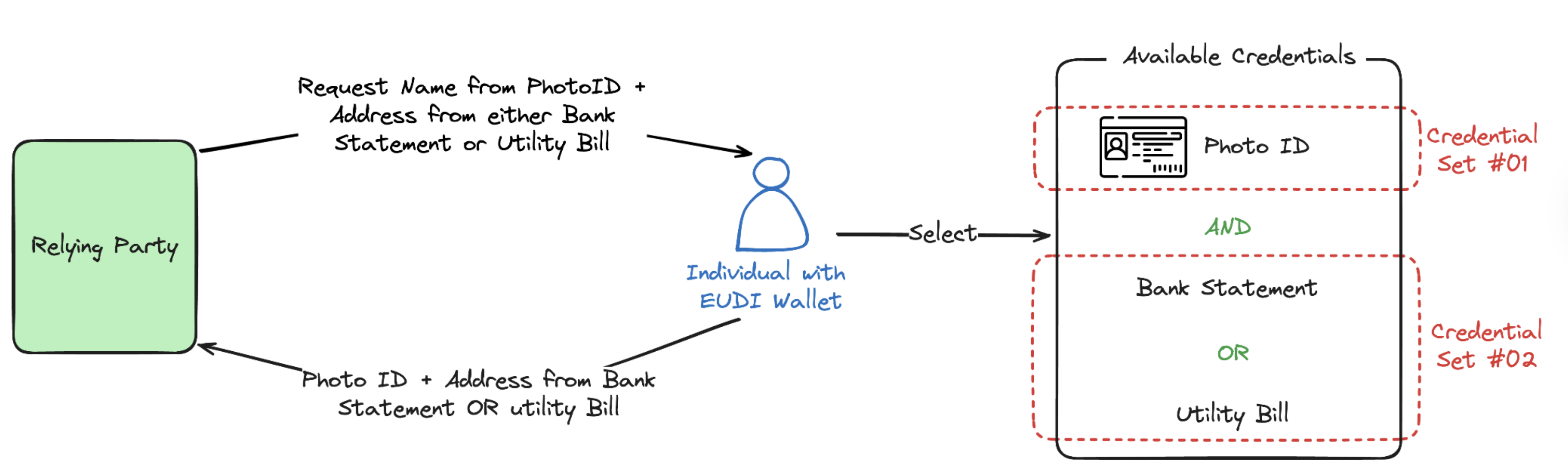
Multiple credential_sets can be combined in a single DCQL query, each marked as required. This allows a verifier to request several credential groups simultaneously, where each group may accept alternatives.
Scenario: A KYC check requires:
- A Photo ID credential for identity verification.
- A separate Proof of Address, where either a Utility Bill or Bank Statement is acceptable.
For the underlying DCQL query, diagram and example, see the “KYC request with Photo ID and address proof” use case in our DCQL concepts article.
Step 1: Get the API Key (Verifier Admin)
To obtain your API key, sign in to the dashboard and go to Account > Developer APIs > Create API Key (see Get API Keys). Once you have your API key, enter it in the field below and click the Set API Key button to save it for future use.
x509 key of your organisation: a key with a certificate chain. After you set the API key, the page fills in such a key. To choose another key, click the key label next to a signing key field in a request, for example cryptographicKeyIdentifier. To create a key, attach a certificate or see your keys, follow the key management guide. To add your certificate to the NXD trust list, see trust list registration.Step 2: Create Presentation Definition (Verifier Admin)
To create a presentation definition for requesting proof, you can run the code block below using the Run button. Alternatively, you can manually copy the code block and use it in the body of the API request provided here.
Request
Response
Once a presentation definition is created, the presentationDefinitionId is autofilled in Step 3 automatically (and updated whenever Step 2 is re-run). You can also reuse the same presentationDefinitionId to verify multiple credentials.
Step 3: Create Verification Request (Verifier/Relying Party)
When you run Step 2 on this page, the presentationDefinitionId field below is autofilled automatically (and updated whenever Step 2 is re-run). If you are executing the APIs yourself, replace <presentationDefinitionId> with the ID obtained in Step 2. To create the verification request, execute the code block below using the Run button. Alternatively, you can manually copy the JSON and use it in the body of the API available here.
After receiving the response, toggle the button provided to dynamically generate a QR code. The EUDI Wallet/Holder can then accept the verification request using the Data Wallet (or any other EU Digital Identity Wallet) by either scanning the QR code or directly accessing the verification request on their mobile device, such as via a browser.
Request
Response
Users can copy the presentationExchangeId from the JSON response for use in Step 5 to read the verification.
Step 4: Send and Receive Verifiable Presentation (Holder)
The holder wallet consents to send the requested credentials.
- Receive Verification:
- Use the
requestUrl(step 3) with the API available here to receive the verification. - Copy the
presentationIdfrom the JSON response received from Receive Verification for the filter call.
- Use the
- Filter Verification:
- Use that
presentationIdwith the API available here to find matching credentials. - Save the
<id>and<credentialId>from the response.
- Use that
- Send Verification:
- Use the
presentationId,<id>and<credentialId>with the API available here to send the credentials to the verifier.
- Use the
Step 5: Send and Receive Verifiable Presentation (Verifier/Relying Party)
- The verifier (relying party) receives the requested credentials. Read them with the Read Verification API. In the response,
isVerifiedholds the result,presentationholds the disclosed claims of each credential, andpresentationValidityholds the result of each check. vpTokenholds the raw tokens that the wallet sent. Decode an SD-JWT or a JWT token with the JWT Decoder.