Trusted Lists and Lists of Trusted Entities (ETSI TS 119 612 and TS 119 602)
- ETSI TS 119 612 V2.4.1: trusted lists. §5.3 scheme information, §5.4 TSP information, §5.5 service information, §5.7 digital signature, Annex A authenticating trusted lists. Commission Implementing Decision (EU) 2025/2164 refers to this version (trusted lists).
- ETSI TS 119 602 V1.1.1: lists of trusted entities. §4 concepts, §6.3 list and scheme information, §6.5 trusted entity information, §6.6 service information, §6.8 digital signature, Annex A bindings, Annex C registered URIs, Annexes D to I EU profiles.
- ETSI TS 119 615 V1.3.1: procedures for using and interpreting the national trusted lists of the EU Member States.
In short
- A trusted list (ETSI TS 119 612) is a signed XML list of trust service providers and their services. Each EU Member State publishes one, and the EU List of Trusted Lists (LoTL) points to them.
- A list of trusted entities, or LoTE (ETSI TS 119 602), is a newer, general data model for signed lists, in XML or JSON. The EU uses it for wallet providers, PID providers, PuB-EAA providers, access certificate authorities, providers of registration certificates, and registrars.
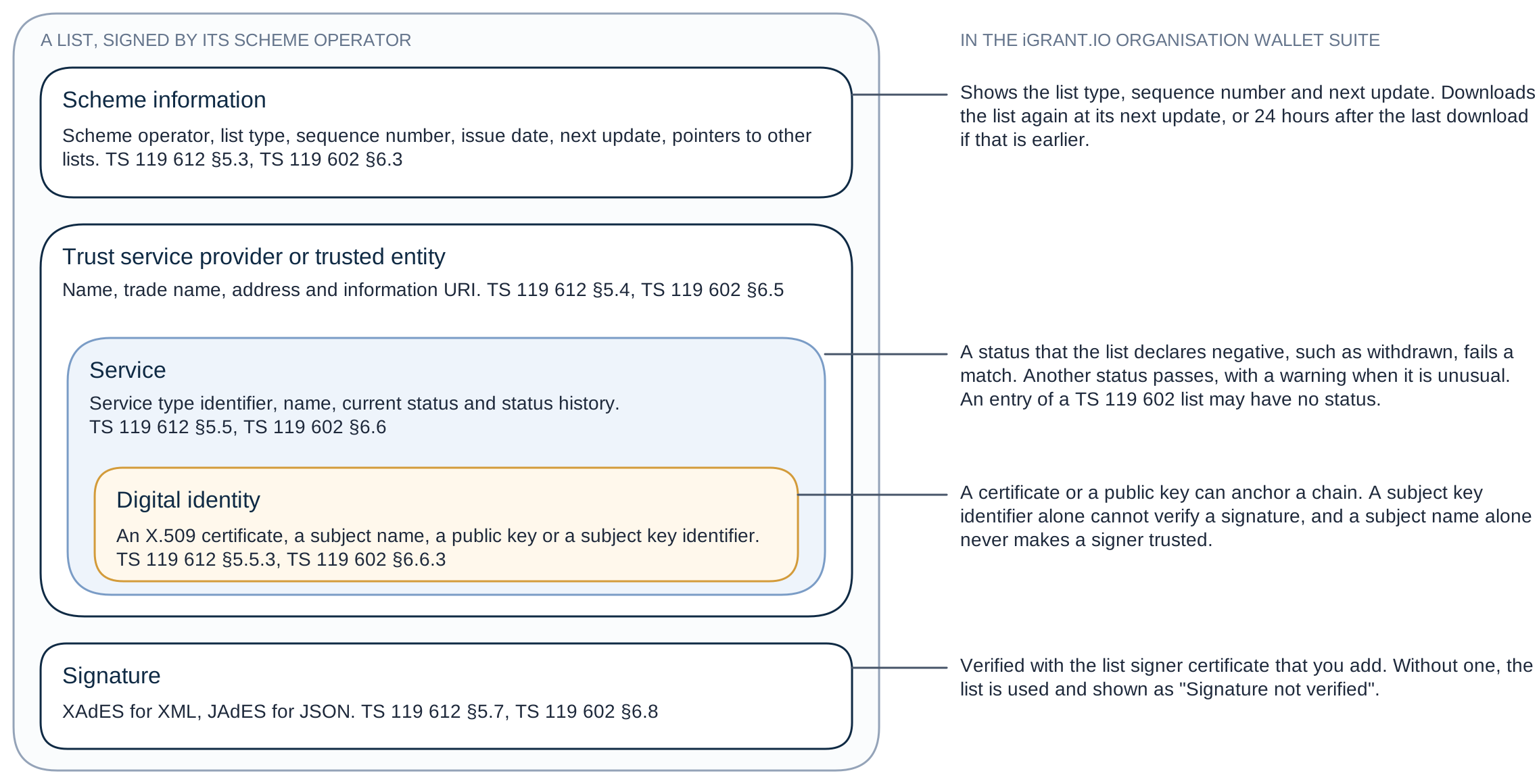
- Both have the same structure: scheme information, the listed entities, their services, the digital identity of each service, and a signature.
- In the iGrant.io dashboard, a trust anchor of kind ETSI TL is a trusted list, and a trust anchor of kind ETSI LOTE is a list of trusted entities.
One structure, two specifications
| Part | Trusted list (TS 119 612) | List of trusted entities (TS 119 602) |
|---|---|---|
| Formats | XML (Annex B) | XML or JSON (Annex A) |
| List type | TSLType, §5.3.3, for example .../TSLType/EUgeneric | LoTEType, §6.3.3, for example http://uri.etsi.org/19602/LoTEType/EUWalletProvidersList |
| Publisher | Scheme operator, §5.3.4: in the EU, the body that each Member State designates | Scheme operator, §6.3.4: for the EU lists, the European Commission |
| Next update | §5.3.15 | §6.3.15 |
| Pointers to other lists | §5.3.13, with the certificates that sign them | §6.3.13 |
| Listed party | Trust service provider (TSP), §5.4 | Trusted entity, §6.5 |
| Service type | ServiceTypeIdentifier, §5.5.1, for example http://uri.etsi.org/TrstSvc/Svctype/EAA/Q | §6.6.1, for example http://uri.etsi.org/19602/SvcType/PID/Issuance |
| Service status | Required, §5.5.4, with a history, §5.5.10 | Optional, §6.6.4. A profile can require it. |
| Digital identity | §5.5.3: an X.509 certificate, a subject name, a public key or a subject key identifier | §6.6.3.1 to §6.6.3.4: the same four, and another identifier (§6.6.3.5) |
| Signature | §5.7: XAdES (XML) | §6.8: XAdES for XML, JAdES for JSON |
A LoTE profile (§4.7) adds rules for one kind of list, for example that every service must have a status. TS 119 602 defines the EU profiles in its annexes:
| Annex | Profile | LoTE type |
|---|---|---|
| D | Providers of person identification data | EUPIDProvidersList |
| E | Wallet providers | EUWalletProvidersList |
| F | Providers of wallet-relying party access certificates | EUWRPACProvidersList |
| G | Providers of wallet-relying party registration certificates | EUWRPRCProvidersList |
| H | Public sector bodies issuing electronic attestations of attributes | EUPubEAAProvidersList |
| I | Registrars and registers | EURegistrarsAndRegistersList |
Lists of lists
A List of Trusted Lists (LoTL) points to other lists, and gives the certificates that sign each of them (TS 119 612 §5.3.13 and Annex A). A relying party that trusts the LoTL can therefore find each list and check its signature. The European Commission publishes the EU LoTL of the national trusted lists. Pilots publish their own: the WE BUILD LoTL points to twelve lists, among them the QEAA and EAA lists of the NXD Trust List.
In the iGrant.io Organisation Wallet Suite
You add each list as a trust anchor on the Trust Anchors page, with its URL, its kind (ETSI TL or ETSI LOTE), its role (Used As) and, optionally, its list signer certificate. See Manage Trust Anchors for the add, the refresh and the states of a list.
- The signature is verified with the list signer certificate that you add. Take it from the LoTL pointer of the list, or from the scheme operator. Without one, the list is used and shown as Signature not verified.
- Entries: the wallet makes one entry for each certificate of the digital identity of a service. A service with two certificates gives two entries, and a service without a certificate gives one entry. The counts of entries in the dashboard and in the API count these entries.
- Roles: a trust anchor uses only the entries of its list for its role. See The role of an entry.
- Statuses: a status that the list declares negative, such as
withdrawn, fails a match.grantedpasses.recognisedatnationallevelpasses for an EAA provider, and with a warning for the other roles. Another status passes with a warning. An entry of a TS 119 602 list may have no status. - Digital identities: an X.509 certificate or a public key can anchor a certificate chain. A subject key identifier alone cannot verify a signature, and a subject name alone never makes a signer trusted. See Certificates and Chains.
In the NXD Trust List
The NXD Foundation (NordXDataspace Foundation) publishes the NXD Trust List at https://trustlist.nxd.foundation/trust-lists/. iGrant.io uses it by default for demos, interoperability tests and all other non-production use.
- QEAA and EAA providers are in two trusted lists (TS 119 612, XML):
NXD-TL-QEAA.xmlandNXD-TL-EAA.xml. - The other roles are in six lists of trusted entities (TS 119 602), each in XML and JSON: PID providers, wallet providers, PuB-EAA providers, access certificate authorities, providers of registration certificates, and registrars.
- Signatures: XML lists are signed with XAdES Baseline B, and JSON lists have a JWS in a
signaturemember. - Changes: every change to an entry regenerates and re-signs all the lists.
See Trust Roles for the list of each role.
Related pages
- Trust Roles: Wallet Providers, Issuers and Relying Parties
- Certificates and Certificate Chains
- Who Trusts Whom: The EU Digital Identity Wallet Trust Model
- DCQL: Trusted Authorities: restrict a credential query to the issuers of an ETSI list
- Trust Sources APIs (the API name of trust anchors)
- WE BUILD WP4: ETSI trusted lists implementation profile