Who Trusts Whom: The EU Digital Identity Wallet Trust Model
- EUDI Wallet Architecture and Reference Framework (ARF) v3.0.0, chapter 6 (trust model), in particular §6.2.2, §6.3.2, §6.4.2, §6.6.2 and §6.6.3
- Commission Implementing Regulation (EU) 2024/2980 (notifications) and (EU) 2025/848 (registration of wallet-relying parties)
- ETSI TS 119 602 V1.1.1 (lists of trusted entities) and ETSI TS 119 612 V2.4.1 (trusted lists)
In short
- In the EU Digital Identity Wallet ecosystem, nobody is trusted because of what it says about itself. Each party proves who it is with a certificate, and the other side checks that certificate against a list that an authority publishes.
- The Member States publish trusted lists (ETSI TS 119 612), and the European Commission publishes lists of trusted entities (LoTE, ETSI TS 119 602), one for each kind of party.
- A wallet unit checks the issuers and relying parties it talks to. An issuer checks the wallet unit before it issues. A relying party checks who signed the credentials it receives.
- The iGrant.io Organisation Wallet Suite (the platform behind the iGrant.io dashboard and APIs) performs these checks as an issuer, as a verifier and as an organisation wallet. You choose the lists it checks against on the Trust Anchors page.
The parties
The ARF describes the trust model around the wallet unit: the wallet instance on a user's device, with its secure cryptographic application and keystores (ARF v3.0.0 §6.1).
| Party | Role in the trust model | How it becomes trusted |
|---|---|---|
| Wallet provider | Provides the wallet solution. Gives each wallet unit a wallet instance attestation (WIA) and key attestations. | Its wallet solution is certified, and the Member State notifies it to the Commission (CIR 2024/2980). The Commission adds its trust anchors to the Wallet Provider LoTE (§6.2.2). Wallet providers are not registered like relying parties, so they have no access or registration certificates. |
| PID provider | Issues person identification data (PID). | Registered with a registrar (CIR 2025/848) and notified to the Commission. Listed in the PID Provider LoTE (§6.3.2). |
| QEAA provider | Issues qualified electronic attestations of attributes. | Registered, and listed in the national trusted list of its Member State once it has the qualified status (eIDAS Article 22). |
| PuB-EAA provider | Issues attestations on behalf of a public sector body. | Registered and notified. Listed in the PuB-EAA Provider LoTE. |
| EAA provider | Issues non-qualified attestations. | Registered, but not notified to the Commission, so it is not on an EU list (§6.3.2). Pilots publish their own lists. |
| Relying party | Requests attributes from wallet units. | Registered with a registrar in its Member State. It is not on a list itself: it holds certificates issued under the listed authorities (§6.4.2). |
| Access Certificate Authority | Issues access certificates (WRPAC) to registered PID providers, attestation providers and relying parties. | Listed in the Access Certificate Authority LoTE. |
| Provider of registration certificates | Issues registration certificates (WRPRC) that state what a provider or relying party registered to issue or request. | Listed in the Registration Certificate Provider LoTE. |
Every registered PID provider, attestation provider and relying party receives an access certificate and a registration certificate. The access certificate authenticates it. It does not say whether its subject is a PID provider or a relying party, or which attestations it may issue: the registration certificate says that (§6.3.2.3).
Who checks whom
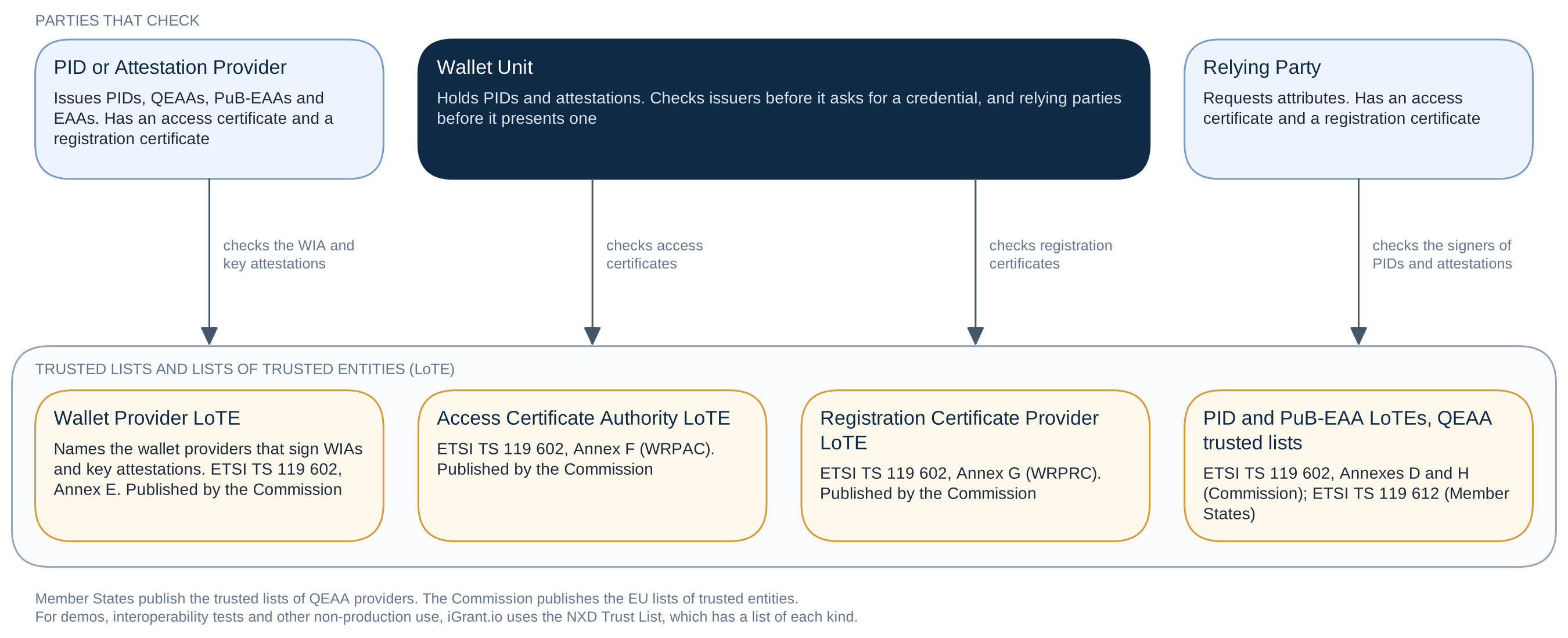
When a credential is issued (ARF v3.0.0 §6.6.2):
- The wallet unit authenticates the PID provider or attestation provider. The provider does not sign a request: it signs its credential issuer metadata, which carries its access certificate. The wallet unit validates that certificate against the Access Certificate Authority LoTE, and checks the signature over the metadata.
- The wallet unit checks the registration certificate in the metadata against the Registration Certificate Provider LoTE, so that it knows that the provider is registered for the type of credential it offers.
- The provider checks the wallet unit: the WIA and the key attestations must be signed by a wallet provider in the Wallet Provider LoTE.
When a credential is presented (ARF v3.0.0 §6.6.3):
- The relying party signs its request and sends its access certificate with the intermediate certificates, up to but not including the trust anchor. The wallet unit validates the chain against the Access Certificate Authority LoTE, and stops if it cannot.
- The wallet unit checks the registration certificate, so that the relying party does not request more attributes than it registered.
- The relying party checks who signed each credential, against the PID Provider LoTE, the PuB-EAA Provider LoTE or the trusted list that applies, and checks who signed the status list of the credential.
In the iGrant.io Organisation Wallet Suite
The Organisation Wallet Suite performs these checks in three places: as an issuer (credential definitions), as a verifier (presentation definitions) and as an organisation wallet (the holder configuration). Each check has a Require switch and an accepted list of trust anchors; see Accepted lists.
| Check in the ARF | Where you turn it on | Role of the trust anchors (Used As) | Support |
|---|---|---|---|
| The issuer checks the WIA and the key attestations | Credential definition: requiresTrustedWalletProvider and acceptedWalletProviders | Wallet provider | Supported. An Android hardware Keystore key attestation is checked against the Google Hardware Attestation Root instead. |
| The wallet checks the access certificate of an issuer | Holder configuration: requiresTrustedIssuer and acceptedIssuers (signed issuer metadata) | Access certificate provider | Supported |
| The wallet checks the registration certificate of an issuer or a relying party | Registration certificate provider | Not supported yet | |
| The wallet checks the access certificate of a relying party | Holder configuration: requiresTrustedRelyingParty and acceptedRelyingParties, optionally narrowed by acceptedClientIds | Access certificate provider | Supported |
| The relying party checks who signed a credential | Presentation definition, for each credential query: requiresTrustedCredentialSigner and acceptedCredentialSigners. The holder configuration has the same check for the credentials it receives. | PID provider, mDL issuer or any issuer role | Supported |
| The relying party checks who signed the status list | requiresTrustedStatusIssuer and acceptedStatusIssuers | Status issuer | Supported. By default, the credential signer may also sign the status list. |
Trust Roles lists every role and the checks that use it. Certificates and Chains explains how a signer certificate is validated against a trust anchor.
In the NXD Trust List
The official EU lists are for production. For demos, interoperability tests and all other non-production use, iGrant.io uses the NXD Trust List, published by the NXD Foundation (NordXDataspace Foundation). It has one list for each kind of party in the table above, so you can try every check of the trust model before your organisation is on an official list. See Register Your Organisation on a Trust List to get listed, and Trust Roles for the list of each role.
Related pages
- Trust Roles: Wallet Providers, Issuers and Relying Parties
- Trusted Lists and Lists of Trusted Entities
- Certificates and Certificate Chains
- Trust in the Wallet Ecosystem
- WE BUILD WP4 trust group: the use cases UC-TE-02 to UC-TE-06 describe these checks in detail